The metal ball inside a ball-type kitchen faucet controls water flow and temperature. Its holes line up with the hot and cold water inlets as you move the handle. This lets you adjust the water stream with one hand.
In American homes, a kitchen faucet gets used for many small tasks each day. You turn it on to rinse a plate, fill a pot, wash fresh food, or clean the sink. Some older and traditional single-handle faucets use a metal ball inside the valve to control the water. This small part helps the faucet respond when you lift, lower, or turn its handle.
The metal ball is not found in every kitchen faucet. Ball-type faucets use a movable ball with openings that control the mix of hot and cold water. Cartridge and ceramic disc faucets use different parts to do a similar job. Knowing which design you have can help you understand a leak, choose the right repair part, and avoid taking apart a faucet that works in a different way.
Source: www.plumbingsupply.com
What Is the Purpose of a Metal Ball in a Kitchen Faucet?
The main purpose of the metal ball is to regulate water flow and temperature. It acts as a movable valve inside certain single-handle kitchen faucets. As you move the handle, the ball changes position and controls how much hot and cold water can enter the faucet‘s mixing area.
The ball usually has carefully placed openings, also called ports. These openings connect with the water passages inside the faucet body. When you move the handle, the ports change position in relation to the hot and cold inlets. This controls the water that passes through the valve and reaches the spout.
A metal ball does not create water pressure or heat the water. Your home’s plumbing supplies the water, and your water heater supplies hot water. The ball controls the flow through the faucet and helps set the temperature of the mixed stream.
Source: ikonet.com
Water flow control
The ball moves to allow more or less water through the valve. The handle position determines how far the openings line up with the inlet passages.
Temperature adjustment
The ball helps control the amounts of hot and cold water entering the mixing area. The resulting temperature depends on the handle position and the temperatures and pressures of the incoming water.
Single-handle operation
The ball lets one handle control both flow and temperature. You do not need separate knobs for hot and cold water.
Controlled shutoff
When the handle moves to the off position, the ball’s solid surfaces and the valve’s sealing parts block the normal flow of water.
Does Every Kitchen Faucet Have a Metal Ball?
No. A metal ball is a feature of a ball-type faucet, not a standard part in every kitchen faucet. Some single-handle models use a removable cartridge, while others use ceramic discs to regulate the flow. Two-handle faucets may use cartridges or other valve designs.
A traditional ball faucet often has a single handle mounted over a rounded cap. That shape can be a useful clue, but appearance alone does not prove which valve is inside. Check the faucet’s model information or parts diagram before opening it.
Ball faucet
Uses a movable ball with openings to control flow and temperature.
Cartridge faucet
Uses a cartridge that moves or rotates to regulate the water. It does not need the traditional loose ball assembly.
Ceramic disc faucet
Uses closely fitted ceramic discs to control the water passages.
How Does the Metal Ball Control Water Flow?
The ball controls water by changing the position of its openings inside the faucet valve. The handle connects to a stem on the ball. When you move the handle, the stem moves the ball, changing the path available to the incoming water.
Inside a typical ball-type faucet, hot and cold water enter through separate passages. The ball’s ports open to these passages in different amounts, depending on the handle position. Water then passes into the mixing area and travels through the spout.
The exact movement depends on the faucet design. In many traditional models, moving the handle up or down changes the flow rate, while moving it from side to side adjusts the temperature. Some designs combine these movements differently, so the manufacturer’s instructions take priority.
Source: The Home Depot
Handle raised
On a common design, raising the handle opens the valve farther and increases the water flow.
Handle lowered
Lowering the handle reduces the flow until the valve reaches its closed position.
Handle moved toward cold
The ball changes position so the valve admits more cold water relative to hot water.
Handle moved toward hot
The ball changes position so the valve admits more hot water relative to cold water.
What Happens When You Turn the Faucet Off?
When you move the handle to the off position, the ball rotates or tilts so its openings no longer provide the normal path for water to pass through the valve. The ball and the sealing parts work together to stop the flow.
The ball alone is not responsible for every part of the seal. Rubber valve seats press against the ball, and springs may help keep those seats in contact with it. If the seats become worn, dirty, or damaged, water can seep through even when the handle is off.
The ball controls the passage
Its position determines whether the valve allows water to flow.
The seats help stop leaks
These small sealing parts fit against the ball and close gaps where water could escape.
The springs maintain contact
In common ball-faucet designs, the springs push the seats toward the ball to help maintain a seal.
Main Parts That Work With the Metal Ball
A ball-type faucet relies on several parts working together. The metal ball controls the water passages, while the seats, springs, cam, packing, and other seals guide movement and help prevent leaks. A problem with one small part can affect the whole faucet.
Knowing these parts helps you avoid replacing the wrong component. A faucet that drips from the spout may need new seats and springs, while a leak around the handle may point to the cam, packing, adjusting ring, or another seal. The location of the leak offers a clue, but it does not confirm the cause by itself.
Source: agruma.net
Metal ball assembly
The ball has openings that control water flow and mixing. Its stem connects to the handle.
Valve seats
These small rubber parts form seals against the ball and help stop water when the faucet is off.
Springs
The springs sit beneath the seats in many common ball faucets and help press them against the ball.
Cam and packing
These parts sit above the ball in many designs. The cam helps guide the ball’s movement, and the packing helps seal the area around the stem.
Adjusting ring and cap
These parts hold the upper assembly in place. On designs with an adjusting ring, its setting can affect handle tension and sealing.
O-rings
These rubber rings seal certain joints, including around the spout on designs that use them.
Why Are Rubber Seats and Springs So Important?
The ball moves every time you use the handle, but the rubber seats must still form a close seal against it. Springs help maintain pressure between the seats and the ball. Over time, normal use, debris, and water conditions can affect these parts.
A damaged seat may let water pass through the valve after you turn the faucet off. A weak, displaced, or corroded spring can also affect the seal. This is why replacing the metal ball alone may not solve a dripping faucet.
Worn rubber
A seat may lose its shape or develop damage that allows water to pass.
Debris in the valve
Small particles can interfere with the contact between the ball and the seats.
Incorrect assembly
A spring or seat placed in the wrong position may prevent the valve from sealing properly.
Why Do Some Kitchen Faucets Use Metal Balls?
A metal ball provides a compact way to control two water supplies with one handle. The ball can move in more than one direction, allowing the valve to adjust both flow and temperature without separate hot and cold handles.
Many traditional ball faucets use stainless steel or another specified material for the ball assembly. The material and shape depend on the faucet design. Some ball-type faucets use plastic balls, so a metal ball should not be treated as a universal feature of this faucet category.
A well-matched ball assembly can provide smooth handle movement and controlled water flow. However, the performance of the whole faucet also depends on the valve body, seals, fit, water conditions, and maintenance. Metal construction alone does not guarantee that a faucet will never leak or wear out.
Source: www.homedepot.com
Compact valve design
A movable ball can regulate both hot and cold water within a relatively small valve assembly.
Multiple directions of movement
The ball can respond to the handle’s position and change the openings available to the incoming water.
Potential resistance to wear
A properly made metal ball may resist certain forms of wear, but its lifespan depends on the material, finish, water conditions, and use.
Repairable construction
Many traditional ball faucets have replaceable internal parts. Repair is possible when compatible parts are available and the valve body remains in good condition.
Is the Metal Ball the Same as a Ball Bearing?
No. The metal ball inside a ball-type faucet is a valve component, not an ordinary ball bearing. A ball bearing usually helps reduce friction between moving mechanical parts. A faucet valve ball has openings and surfaces designed to control water passages.
The two parts may both look round and metallic, but their jobs are different. A replacement ball for a faucet must match the correct valve design. A generic metal sphere or bearing cannot replace the original valve component.
Faucet valve ball
Controls water flow and mixing through its shape, openings, and position.
Ball bearing
Supports mechanical movement in equipment and is not designed to seal or regulate a faucet’s water passages.
Signs That the Faucet Ball or Valve May Have a Problem
A ball-type faucet may show several signs when its internal parts need attention. The most common clues include dripping from the spout, leaking around the handle, a stiff handle, or poor control over water temperature. These symptoms can have more than one cause, so check the whole valve assembly before blaming the ball.
Start by observing where the water appears and how the handle behaves. A slow drip from the spout after the handle is fully closed suggests that the valve is not sealing properly. Water that appears around the handle may point to a different seal or a loose or damaged upper assembly.
A change in flow can also result from a clogged aerator, debris in the valve, or a supply problem. If both hot and cold water are weak, check for a wider supply issue before opening the faucet. Do not force a handle that feels stuck, since excess force can damage the stem or other parts.
Source: hofensanitary.com
Water drips from the spout
Possible causes include worn seats and springs, debris, a scratched ball, or damage elsewhere in the valve.
Water leaks around the handle
The cam, packing, adjusting ring, or related seals may need inspection. The precise cause depends on the faucet model.
The handle feels stiff
Excessive cap pressure, deposits, damaged parts, or incorrect assembly may make the handle harder to move.
The temperature changes unexpectedly
The valve may not be regulating the hot and cold supplies as intended. Check the supply conditions and internal parts if the problem persists.
Water flow is weak
A blocked aerator, supply restriction, or debris in the valve may be responsible. Weak flow alone does not prove the ball is damaged.
How to Tell Whether the Ball Needs Replacement
The best way to assess the ball is to inspect it after safely shutting off the water and opening the faucet according to the manufacturer’s instructions. Look for visible scratches, worn surfaces, mineral deposits, or damage around the stem and openings. Compare the part with the correct model diagram if you are unsure what you see.
A stainless steel ball may remain usable even when the faucet leaks. If the ball is smooth and undamaged, worn seats, springs, or seals may be the better repair target. If the ball is scratched, damaged, or does not fit correctly, replacing it with the specified part may be necessary.
Inspect the ball surface
Look for scratches, pitting, deposits, and damaged edges around the openings.
Check the other valve parts
Inspect the seats, springs, cam, packing, and any accessible seals for wear or incorrect placement.
Confirm part compatibility
Match the faucet’s make, model, stem shape, and valve design before ordering a replacement.
How to Inspect a Metal Ball in a Kitchen Faucet
You can inspect many traditional ball faucets with basic hand tools, but the steps vary by model. Before starting, find the faucet’s instructions or parts diagram and make sure replacement parts are available. If the faucet is under warranty, check the warranty terms before taking it apart.
The most important preparation step is shutting off the water supply. Most American kitchen sinks have hot and cold shutoff valves beneath the sink. If these valves are absent or will not close, shut off the appropriate main water supply before proceeding. Never open a pressurized faucet valve.
Source: www.plumbingsupply.com
Tools and supplies
Depending on the faucet, you may need an Allen wrench or screwdriver, adjustable pliers, a soft cloth, a small container for parts, and compatible replacement seals or a repair kit.
Protect the work area
Cover the sink surface with a towel and plug the drain so small screws, springs, and seals cannot fall into it.
Keep the parts in order
Take clear photos during disassembly and place each component in sequence. Small springs and seats can look alike but may need to face a particular way.
Step 1: Shut Off the Water
Close the hot and cold shutoff valves beneath the sink. Open the faucet handle to release remaining pressure and let trapped water drain. Confirm that water has stopped before loosening any faucet parts.
If the shutoff valves leak, will not turn, or fail to stop the water, do not continue with disassembly. Have the supply issue addressed first.
Check both supplies
Make sure the hot and cold lines are shut off, even if the repair appears to affect only one side.
Relieve pressure
Open the handle after shutting off the supplies and allow the remaining water to drain.
Step 2: Remove the Handle and Cap
Locate the handle’s set screw, which may sit beneath a small decorative cover or along the side of the handle. Use the correct tool to loosen it, then lift the handle off carefully. Remove the cap or adjusting ring only as directed by the faucet’s instructions.
Protect the finish with a soft cloth when using pliers. Avoid gripping a decorative surface too tightly. If the cap refuses to move, do not use extreme force or keep turning if the internal valve appears to rotate with it.
Use the correct tool
A correctly sized wrench or screwdriver is less likely to damage the screw or handle.
Stop if parts bind
A stuck cap, rotating valve body, or damaged screw may require a plumber or a model-specific removal method.
Step 3: Lift Out and Inspect the Ball Assembly
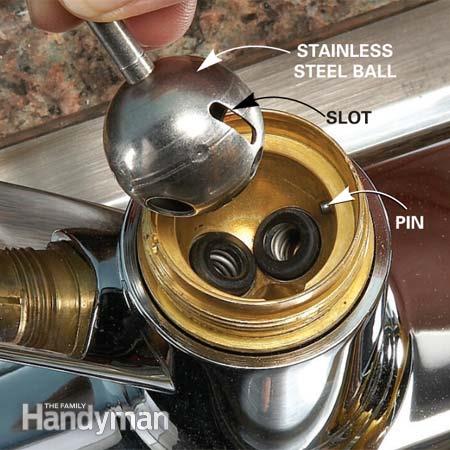
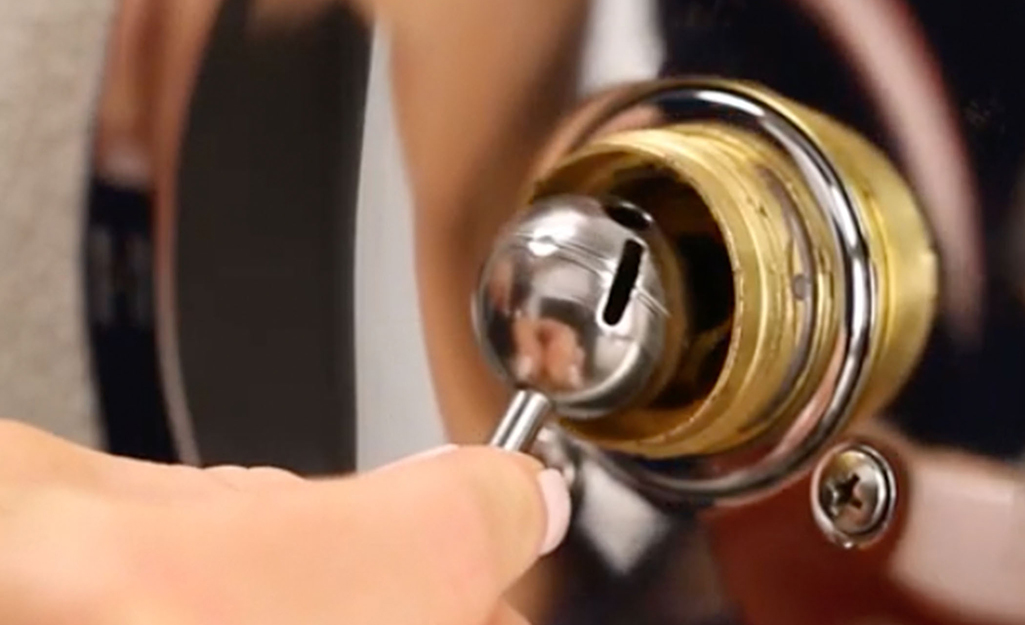
On a compatible ball faucet, removing the cap allows access to the cam, packing, and ball assembly. Lift the parts out gently and note the ball’s orientation. Some models use a locating pin that must line up with a slot when the ball goes back in.
Inspect the ball and surrounding parts under good light. Clean light mineral deposits only with a method approved for the material and finish. Replace a visibly damaged part rather than trying to reshape it. Do not assume every faucet has the same ball or internal layout.
Check for damage
Look for scratches, pitting, worn surfaces, and a damaged stem.
Examine the seats and springs
Look for torn rubber, debris, corrosion, misplaced parts, or springs that no longer appear serviceable.
Keep the original orientation
Use your photos and the model diagram to record the correct position of the ball and cam.
Step 4: Reassemble and Test the Faucet
Replace damaged parts with compatible components and reinstall the ball, seats, springs, cam, packing, and cap in the specified order. Make sure the locating pin and cam tab engage the correct slots. Tighten the cap and adjusting ring only as directed.
Restore the water supply slowly and check for leaks around the handle, spout, and connections beneath the sink. Test both hot and cold water, move the handle through its normal range, and confirm that the faucet shuts off. If the handle is too stiff or water continues to leak, turn off the supplies and inspect the assembly again.
Signs of a successful repair
The faucet opens and closes normally, adjusts temperature as expected, and does not leak from the spout or handle.
If the leak continues
Recheck part compatibility, orientation, seats, springs, packing, and the ball’s condition. Seek professional help if the valve body or supply connection is damaged.
Should You Clean or Replace the Metal Ball?
Cleaning may be enough when the ball has light mineral deposits but no visible damage. Replacing the ball is more appropriate when its surface is scratched, pitted, broken, or otherwise unable to work correctly with the valve seats. The correct choice depends on the condition of the entire assembly.
Before cleaning, check the faucet manufacturer’s instructions for the recommended method. Avoid harsh abrasives that may scratch the ball or damage its finish. A mild cleaning method suited to the material is preferable to aggressive scrubbing.
If the ball looks sound but the faucet still drips, check the seats and springs rather than repeatedly cleaning or replacing the ball. These sealing parts often account for leaks in traditional ball faucets. Replacing the correct worn components can be more useful than changing a part that is still in good condition.
Source: ikonet.com
Clean the ball
Consider cleaning when there are removable deposits and the ball remains smooth and intact. Follow the model’s care guidance.
Replace the ball
Replace it when it has damage that could affect movement or sealing, or when the manufacturer specifies replacement.
Repair the sealing parts
If the ball is in good condition, worn seats, springs, cam, or packing may be the source of the problem.
Replace the faucet
A new faucet may be the more practical option if the valve body is damaged, compatible parts are unavailable, or repeated repairs do not restore proper operation.
How to Choose the Right Replacement Ball
Do not buy a ball based on appearance alone. Different faucets can use balls with different stem shapes, dimensions, port layouts, and locating features. A part that looks close may not fit or seal correctly.
Find the manufacturer’s name and model number, then check the official parts diagram or a trusted replacement-parts listing. Some models use a round stem, while others use a different stem shape. Confirm the exact fit before purchasing a ball or repair kit.
Match the model
Use the faucet’s model information rather than relying only on the brand name.
Check the stem and ports
Compare the shape, locating features, and openings with the documented replacement part.
Check the repair kit contents
Make sure the kit includes the parts needed for your specific problem and is listed as compatible with your faucet.
Common Mistakes to Avoid With a Ball-Type Faucet
Small faucet parts can be easy to mix up, and a simple repair can become harder if the valve is forced or assembled incorrectly. Work slowly, keep the parts organized, and use the correct instructions for the exact faucet model.
A frequent mistake is tightening the adjusting ring too much to stop a drip. On designs that use this ring, excessive tightening can make the handle hard to move and may speed up wear on the sealing surfaces. Follow the manufacturer’s adjustment method instead of applying more force until the leak disappears.
Another mistake is replacing the metal ball without checking the rubber seats and springs. A new ball will not solve a leak if the real problem lies with a worn seal, damaged valve body, or incorrectly installed part. Diagnose the symptoms before buying replacements.
Source: The Home Depot
Do not work with the water on
Shut off both supplies and relieve pressure before opening the valve.
Do not force a stuck cap
Excessive force can damage the finish or internal parts. Stop if the valve turns with the cap or the assembly feels unsafe to remove.
Do not mix up small parts
Record the original position of the ball, springs, seats, and cam before removal.
Do not overtighten the ring
Excessive adjustment can cause a stiff handle and increase wear. Use the recommended setting.
Do not assume all faucets use a ball
Check the model before buying parts or following a ball-faucet repair guide.
Do not ignore a damaged valve body
A cracked, badly worn, or otherwise damaged body may need professional repair or faucet replacement.
When Should You Call a Plumber?
Call a plumber if you cannot shut off the water, a supply connection leaks, the faucet body is damaged, or a stuck part will not come apart without force. Professional help is also sensible when the faucet uses an unfamiliar design or the same leak returns after a correct repair.
If the faucet is covered by a warranty, contact the manufacturer before disassembly or replacement. Warranty terms vary, and unauthorized repairs may affect the available service options. Keep the model number and a clear description of the problem ready when you ask for help.
Uncontrolled water flow
Stop work if water cannot be shut off safely.
Damaged plumbing parts
Get help for a cracked valve body, damaged supply line, or leaking connection beneath the sink.
Repeated leaks
A recurring problem may need a closer inspection of the valve body, part compatibility, or water supply.
Metal Ball Faucet vs. Cartridge and Ceramic Disc Faucets
A metal ball is only one way to control water in a kitchen faucet. Cartridge and ceramic disc designs perform a similar basic task, but their internal parts and repair methods differ. Identifying the valve type matters more than deciding which design sounds better in general.
A traditional ball faucet often allows separate parts such as the ball, seats, and springs to be serviced. A cartridge faucet uses a cartridge that may need cleaning or replacement, depending on the model. A ceramic disc faucet uses closely fitted discs, and its repair procedure is different from that of a ball valve.
There is no single repair method for all three designs. A ball-faucet repair kit will not work in a cartridge or ceramic disc valve unless the product is explicitly designed for that model. When choosing parts, use the manufacturer’s diagram and instructions.
Source: agruma.net
Ball faucet
Uses a movable ball and commonly has replaceable seats and springs. Its internal assembly can contain several small parts.
Cartridge faucet
Uses a cartridge to regulate water. Repair may involve replacing the cartridge or its compatible seals.
Ceramic disc faucet
Uses ceramic discs to open, restrict, or close water passages. Follow the model’s instructions when cleaning or replacing its valve assembly.
Which Faucet Type Is Easier to Repair?
Ease of repair depends on the faucet’s design, age, condition, available parts, and the person’s experience. A traditional ball faucet may be straightforward to service when its parts are accessible and its repair instructions are clear. However, the number of small components can make correct assembly tricky.
A cartridge faucet may be easier to service if the cartridge is readily available and simple to remove. Ceramic disc designs can also be repairable, but they require the correct parts and method. Do not choose a faucet type based on one feature alone; consider parts access, maintenance needs, and the manufacturer’s support.
For a small repair
Identify the valve type and confirm that compatible replacement parts are available.
For an older faucet
Check whether the valve body is sound and whether the required parts can still be sourced.
For a repeated problem
Compare the cost and effort of another repair with replacing the entire faucet.
How to Keep a Ball-Type Kitchen Faucet Working Well
Basic care can help a ball-type faucet work as intended, although no maintenance routine can prevent every failure. Use the handle normally, avoid forcing it past its intended range, and deal with drips before they cause water damage beneath the sink.
Clean the outside with a soft cloth and a cleaner approved for the faucet’s finish. Harsh cleaners and abrasive pads may damage decorative surfaces. If the faucet develops mineral buildup, follow the manufacturer’s instructions for the affected part rather than applying a strong chemical to the whole assembly.
Pay attention to changes in handle movement, water flow, and leaks. These signs can help you spot a problem early. If you need to open the faucet, shut off the water first and use the correct parts diagram.
Source: www.plumbingsupply.com
Keep the faucet clean
Use a soft cloth and suitable cleaner to remove grime without scratching the finish.
Do not force the handle
A stiff handle may signal excess adjustment, deposits, or worn parts. Find the cause instead of pushing harder.
Check for small leaks
Look around the spout, handle, and under-sink connections when you notice water where it should not be.
Use compatible repair parts
Choose parts listed for the faucet model to reduce the risk of poor fit or incorrect sealing.
Keep the model information
Save the manual, model number, and parts diagram so future repairs are easier to plan.
Does Hard Water Damage the Metal Ball?
Hard water contains dissolved minerals that can leave deposits on faucet parts. These deposits may interfere with movement or sealing, especially when they collect around the valve or other small passages. The amount of buildup depends on the local water supply and the faucet’s condition.
Mineral deposits do not automatically mean the ball must be replaced. If the ball is undamaged, an approved cleaning method may be enough. If the deposits have accompanied scratches, pitting, or persistent leakage, inspect the seats and other internal parts before deciding on a repair.
Look for visible deposits
White or chalky buildup may indicate mineral residue, though appearance alone does not confirm the water chemistry.
Clean with care
Use only a cleaning method compatible with the material and the faucet manufacturer’s instructions.
Check the seal after cleaning
If the faucet still leaks, inspect the seats, springs, and ball for damage or poor fit.
Frequently Asked Questions
Q
What does the metal ball inside a kitchen faucet do?
The metal ball controls water flow and temperature in a ball-type kitchen faucet. Its openings change position as you move the handle, regulating how much hot and cold water enters the mixing area. The valve’s seats and other sealing parts help stop water when the faucet is off.
Q
Can a damaged metal ball cause a kitchen faucet to leak?
Yes. A scratched, worn, or damaged ball may prevent the valve from sealing correctly. However, dripping can also result from worn rubber seats, weak springs, debris, or damaged seals. Inspect the full valve assembly before replacing the ball.
Q
Why does my ball faucet drip when the handle is off?
A drip usually means water is passing through a valve that should be closed. Worn seats and springs are common possible causes in traditional ball faucets, but a damaged ball or debris can also interfere with the seal. Shut off the water before inspecting the internal parts.
Q
Can I replace the metal ball without replacing the whole faucet?
Often, yes, if the faucet is a serviceable ball-type design and the correct replacement part is available. Check the model number and parts diagram to confirm compatibility. If the valve body is damaged or suitable parts are unavailable, replacing the entire faucet may be more practical.
Q
Are all metal balls in kitchen faucets made of stainless steel?
No. Materials vary by faucet design and manufacturer. Some ball faucets use stainless steel balls, while others may use plastic or different specified materials. Check the product documentation rather than assuming that every round internal component is stainless steel.
Q
Is the metal ball responsible for mixing hot and cold water?
In a ball-type faucet, the ball helps regulate how much hot and cold water enters the mixing area. The handle changes the position of the ball’s openings relative to the inlet passages. The final temperature also depends on the incoming water temperatures and supply conditions.
Q
Can I use any round metal ball as a replacement?
No. A faucet valve ball must match the valve’s shape, openings, stem, and locating features. A generic metal sphere or ball bearing is not a suitable substitute. Use a compatible part listed for your exact faucet model.
Q
Does every single-handle kitchen faucet contain a metal ball?
No. Single-handle faucets may use a ball valve, a cartridge, or ceramic discs. The handle style alone does not confirm the internal mechanism. Check the faucet model or parts diagram before following repair instructions.
✦ Wrapping Up
Conclusion
The purpose of a metal ball in a kitchen faucet is to control water flow and temperature. In a ball-type design, its openings line up with the hot and cold water passages as the handle moves. The ball works with seats, springs, and seals to help the faucet open, adjust, and shut off properly.
When a ball faucet leaks or becomes hard to move, the ball may not be the only part at fault. Worn seats, weak springs, damaged packing, mineral deposits, or incorrect assembly can cause similar symptoms. Check the faucet model, shut off the water before inspection, and use compatible replacement parts. If the valve body is damaged or the repair is beyond your comfort level, seek help from a qualified plumber.
💡 Key Takeaway
If your kitchen faucet is dripping, first identify whether it uses a ball valve. Shut off both water supplies, inspect the correct parts diagram, and check the ball, seats, springs, and seals before buying replacements.