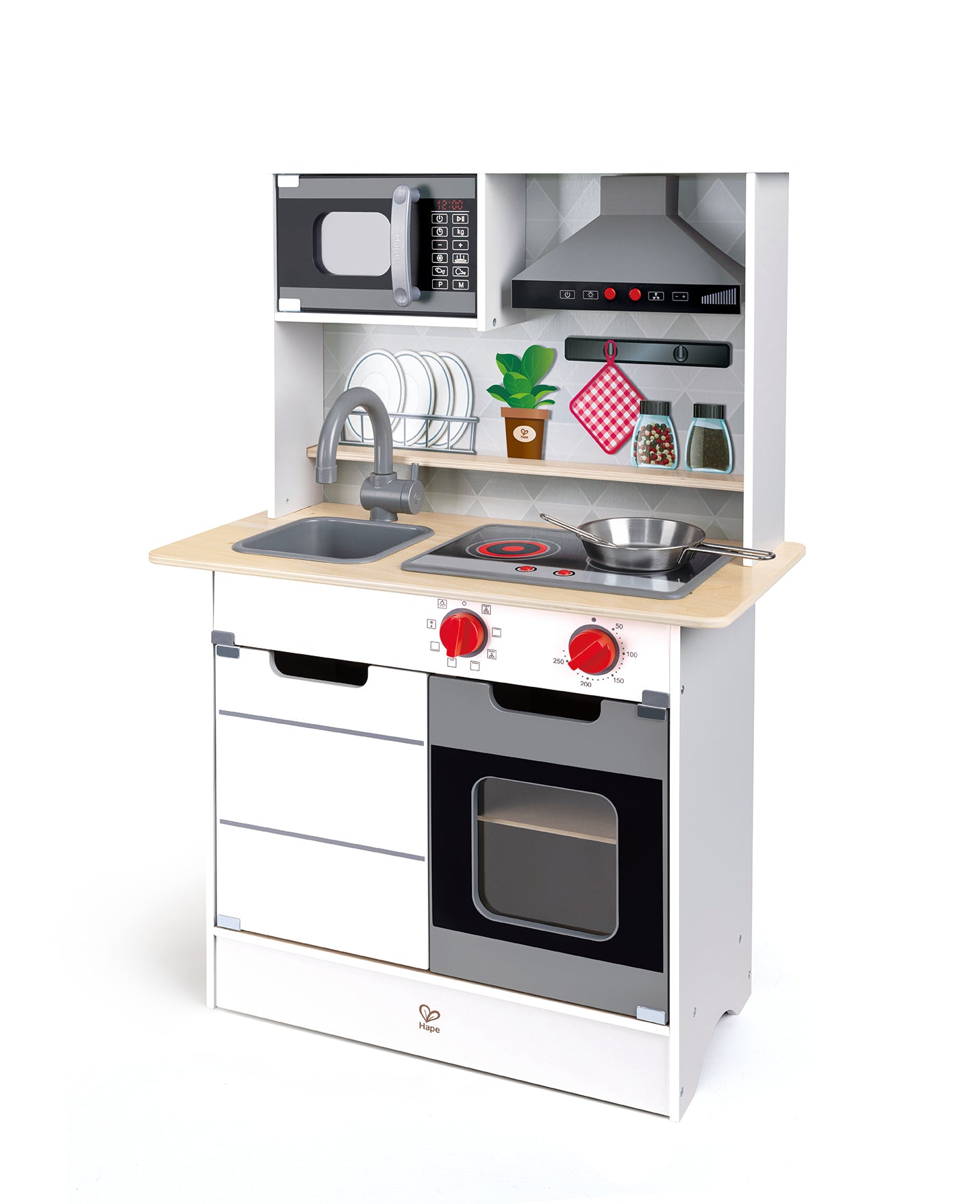
A Hape kitchen playset is a pretend cooking toy that lets children act out everyday kitchen tasks. The right model depends on your child’s age, available floor space, preferred play style, and the features included in that exact set.
In American homes, a play kitchen can give children a place to copy familiar tasks, from washing pretend dishes to serving a meal. Kids can play alone or invite a parent, sibling, or friend to join in. The setup may be as simple as a small wooden stove or as detailed as a kitchen with cabinets, a sink, and sound effects.
Hape sells different pretend kitchen toys, so the name alone does not tell you which features a particular model has. Before you buy one in the United States, check the exact product name, listed age range, dimensions, included parts, assembly needs, and current safety information. These details matter more than a long list of features.
A Hape kitchen playset is a toy kitchen designed for pretend cooking and other household role-play. Depending on the model, it may include a cooking surface, oven, sink, storage areas, knobs, utensils, or other play features. Some models may also use lights or sound effects.
The goal is to let children act out things they see adults do. A child might pretend to wash a cup, stir a pot, prepare breakfast, or serve dinner. These simple actions can turn an ordinary play session into a small story.
Not every Hape kitchen has the same design. Some sets focus on basic pretend cooking, while others offer more features or a larger play area. Always use the model’s own listing and instructions to confirm what comes in the box.
Source: flitit.com
Pretend cooking
Children can act out preparing food, setting up a meal, and serving family members or toys.
Household role-play
A play kitchen gives children a familiar setting for making up stories about shopping, cooking, cleaning, and sharing food.
Hands-on activity
Moving toy dishes, turning suitable knobs, and opening storage areas gives children simple actions to explore.
Wooden Kitchens and Feature-Rich Models
Many buyers look at wooden play kitchens because they want a solid-looking toy with a home-like design. The word wooden, however, does not mean every part is wood. A model may combine wood, engineered wood, plastic, metal, fabric, or electronic parts.
A feature-rich kitchen may have lights, sounds, or special cooking effects. These features can interest some children, but they also add parts that parents may need to check, maintain, or replace. Choose the design that suits your child’s interests rather than paying for features that may rarely be used.
Basic design
A good fit for children who enjoy simple pretend meals and do not need electronic effects.
Kitchen with accessories
Useful when the included cookware and utensils match the child’s play interests and are suitable for the child’s age.
Light-and-sound design
Worth considering if the product instructions clearly explain the electronic features, power source, and care needs.
How to Choose the Right Hape Kitchen Playset
Start with your child’s age, the available space, and the way your child likes to play. These three factors can narrow the choices before you compare colors, accessories, or special effects.
For a younger child, simple actions and easy-to-reach play areas may matter most. An older preschooler may enjoy a kitchen with more storage, more pretend tasks, and room for a second child. These are general considerations, not a substitute for the age range and warnings on the exact product.
Source: ygrowup.net
Check the age range
Follow the manufacturer’s stated age guidance and consider whether the child can use the features safely. Do not assume a toy is suitable just because it looks simple.
Measure the room
Record the available width, depth, and height. Leave room for the child to stand, move, and open any doors or compartments.
Review the included parts
Confirm whether pots, pans, utensils, pretend food, or other accessories are included or sold separately.
Consider daily use
Think about where the kitchen will sit, who will play with it, and whether adults can reach it easily for cleaning or repairs.
Match the Kitchen to Your Child’s Play Style
Some children love to copy real kitchen routines. They may spend a long time washing pretend plates, placing food in an oven, or arranging cups on a shelf. For them, useful storage and reachable play surfaces may matter more than sound effects.
Other children enjoy short bursts of dramatic play. They may pretend to run a restaurant, sell meals, or cook for a group of stuffed animals. A kitchen that supports several kinds of stories can suit these play sessions well.
If you are unsure, look at what the child already enjoys. A child who likes stacking and sorting may use shelves and containers often. A child who enjoys songs or pretend buttons may be more interested in a model with interactive features.
For simple play
Look for easy-to-understand features and a layout that lets the child make up activities without much adult setup.
For shared play
Check whether there is enough standing room for two children and whether both can reach the play areas.
For changing interests
A straightforward kitchen with a few compatible accessories may leave room for new games as the child grows.
Use a Measurement Check Before Ordering
Product photos can make a toy kitchen look smaller or larger than it is. Check the stated assembled dimensions and compare them with the space at home. Also consider the box size if you need to carry it through a narrow hallway or up stairs.
For example, if a listing gives the kitchen’s width and depth, mark that footprint on the floor with painter’s tape. Stand beside the marked area and check whether a child can move around it without blocking a doorway or walkway. This simple test can prevent a cramped setup.
Measure the full footprint
Use the assembled width and depth, not just the product photo or package dimensions.
Allow working room
Leave enough space for standing, turning, and using doors or removable parts.
Check the room layout
Keep the kitchen away from stairs, heaters, cooking appliances, and busy walkways.
What Features Should You Compare?
The most useful features are the ones your child can reach and use during ordinary play. A kitchen does not need every available extra to support pretend cooking. Compare the actual functions, construction, and care instructions before deciding whether a more complex model is worth the difference in price.
A feature listed in a product name may refer to a particular version or regional model. Confirm the exact listing, especially when a seller uses a generic title or combines photos from several products.
Source: cdn.ae1stcry.com
Cooking area
Look at the number and layout of pretend burners, the shape of the play surface, and whether the controls are easy to use.
Check whether the sink is fixed, removable, or designed for pretend use only. Never add real water unless the manufacturer expressly permits it.
Oven and storage
Inspect the doors, shelves, handles, and compartments. They should be usable without creating avoidable pinch or tipping risks.
Lights and sounds
Verify how the effects work, which batteries are required if any, and whether the instructions explain safe battery access.
Accessories
Count the items included in the box and identify any extra pieces that must be purchased separately.
Are Lights and Sounds Worth It?
Lights and sounds can make a pretend kitchen feel more interactive. They may appeal to children who enjoy buttons, switches, and cause-and-effect play. Still, an electronic feature is only useful if the child enjoys it and the toy remains easy to use and maintain.
A model without electronics can still support cooking stories, turn-taking, sorting, and language practice. It may also avoid the need to replace batteries. Compare the full cost and care needs instead of treating extra effects as proof that one kitchen is better.
Choose effects for a reason
Buy a light-and-sound model when those features match the child’s interests, not just because they appear in the product photos.
Check battery access
Any battery compartment should be secured as directed by the manufacturer and kept inaccessible to children when required.
Think about noise
If sound effects are included, check the available controls and whether the sounds can be turned off when needed.
What About Build and Finish?
Review the product materials and assembly details rather than judging construction from color or appearance alone. Look for clear instructions, parts that fit as intended, and a stated method for checking and tightening fasteners.
Painted or coated surfaces should be cared for according to the maker’s instructions. Stop using a part if it cracks, develops a sharp edge, or sheds pieces. Contact the seller or manufacturer for advice instead of trying an unapproved repair that could create another hazard.
Inspect joints
After assembly, check the listed fasteners and connections for looseness, gaps, or visible damage.
Check moving parts
Make sure doors, knobs, and removable pieces behave as described in the instructions.
Follow care directions
Use only cleaning methods and repair steps permitted by the manufacturer.
Assembly and First-Time Setup
Assemble a Hape kitchen playset according to the instructions for the exact model. Parts and fasteners can differ between designs, so a video or guide for another kitchen should not replace the supplied manual. Set aside enough time to build it without rushing.
Keep the child away from loose screws, tools, packaging, and small parts during assembly. Use the correct fasteners and tools, and do not skip a step because a panel seems stable without it. The finished toy should match the assembly instructions.
Source: thetoybox.co.nz
A Practical Setup Sequence
Begin by checking the package contents against the parts list. If a piece is missing or damaged, contact the seller or manufacturer before assembling around the problem. Missing hardware should not be replaced with a random screw or other part.
Step 1: Prepare the area
Choose a flat, well-lit place and keep children and pets clear of loose parts.
Step 2: Sort the hardware
Lay out the listed panels, fasteners, and tools. Keep small items in a container until they are needed.
Step 3: Follow the manual
Build the kitchen in the specified order and tighten each connection as directed.
Step 4: Check stability
Place the completed kitchen on a level surface and follow any wall-anchoring or anti-tip instructions.
Step 5: Inspect the details
Look for loose hardware, sharp edges, trapped packaging, or parts that do not work as described.
Step 6: Introduce the play features
Show the child how the pretend controls, doors, and accessories work, and explain any boundaries for safe play.
If Assembly Does Not Go as Planned
If two holes do not line up or a panel will not sit flat, stop and review the previous steps. A part may be facing the wrong way, or a fastener may have been tightened too early. Do not force the parts together, drill new holes, or change the structure without the manufacturer’s approval.
If a screw spins without holding, a panel splits, or the finished kitchen wobbles, keep children away from it. Use the product’s support process to ask about the correct replacement part or repair method. Do not allow play until the problem is resolved.
Parts do not align
Check panel orientation and assembly order against the manual before loosening or moving parts.
A part is missing
Use the seller or manufacturer’s parts service rather than guessing at a substitute.
The kitchen feels unstable
Stop use, check the floor and assembly, and follow the model’s stability or anchoring instructions.
Toy Kitchen Safety for Children
Safe use depends on the exact toy, the child’s age and behavior, and the condition of the assembled kitchen. Read the warnings and follow the manufacturer’s instructions before the first play session. Adult supervision is especially important when a child is young or still puts objects in their mouth.
A pretend kitchen is not a real cooking appliance. Keep it separate from the stove, oven, hot pans, sharp kitchen tools, cleaning products, and other household hazards. Do not let a child use real food-preparation equipment just because it resembles an item in the toy set.
Source: toys.hape.com
Follow age and small-part warnings
Keep pieces away from children for whom they present a choking risk. Do not assume that every accessory is suitable for every age.
Check for damage
Inspect the toy at regular intervals for cracks, splinters, loose fasteners, sharp edges, and broken accessories.
Secure the structure
Use the supplied anti-tip measures or wall anchor when required by the instructions. Confirm that the mounting method suits the wall and hardware.
Manage batteries carefully
Follow the manual for battery type, installation, and storage. Keep loose batteries and battery compartments inaccessible as directed, and seek urgent medical help if a child may have swallowed a button battery.
Keep the area clear
Place the play kitchen away from stairs, hot surfaces, heaters, cords, and paths where people could trip.
Use only approved repairs
Do not keep using a damaged component or make changes that weaken the structure.
How to Check Product Safety Information in the United States
Before buying or using a toy in the United States, review the exact product identification, age guidance, and safety notices. The U.S. Consumer Product Safety Commission publishes information about recalls and toy safety. Search for the specific product name and model where those details are available, and check any notices that apply to the item you own.
A lack of a recall result is not proof that a toy is suitable for every child or free from every possible problem. Inspect the physical item, follow the manufacturer’s warnings, and report a concern through the appropriate seller or safety agency process.
Confirm the model
Keep the product name, model or item number, seller, and purchase details where available.
Review recall notices
Check official CPSC recall information and the manufacturer’s current safety notices.
Keep proof of purchase
A receipt or order record can help when you need customer support, a return, or a replacement part.
Can Children Use Real Food or Water with the Toy?
Treat the kitchen as a pretend-play toy unless the exact instructions explicitly allow another use. A toy sink does not automatically hold water safely, and a play surface is not necessarily designed for real food. Water can damage some materials or create a slipping hazard if it reaches the floor.
Use pretend food and accessories that are suitable for the child’s age. If the child wants to help with real cooking, provide a separate, age-appropriate task with close adult supervision and keep the child away from hot surfaces and sharp tools.
Keep pretend play separate
Do not use real heat, sharp tools, or household cleaning products with the toy.
Check material limits
Follow the manual before adding water or cleaning any component.
How a Play Kitchen Can Support Learning
Pretend kitchen play creates chances to practice everyday skills through play. Children can name objects, sort toy food, follow simple routines, and make up stories about a meal. These activities are opportunities for learning, not a guarantee that a particular toy will produce a specific developmental result.
Adults can help without taking over. Ask what the child is cooking, invite them to choose the next pretend step, or take a role as a customer. The aim is to keep the game open enough for the child to make choices.
Source: m.media-amazon.com
Language and Imagination
A pretend restaurant gives children reasons to use words and build a story. They might ask what a customer wants, explain a pretend recipe, or describe what is on a plate. Adults can add a new word now and then without turning the game into a lesson.
Simple prompts can help when a child is unsure how to begin. Ask, ‘What should we make for lunch?’ or ‘Where will the clean cups go?’ Then give the child time to answer and continue the story.
Name objects
Talk about cups, plates, pans, pretend vegetables, and other safe play items.
Build a story
Take turns pretending to cook, order a meal, serve food, or tidy up.
Explore choices
Let the child choose the pretend menu, the roles, and the order of play.
Sorting, Counting, and Taking Turns
Toy dishes and pretend food can be sorted by color, type, or size. Older children may enjoy counting plates or making sure each toy guest gets a cup. These tasks use familiar objects, so they can fit naturally into play without worksheets or formal rules.
When two children share the kitchen, simple roles can reduce conflict. One child might prepare a pretend meal while the other sets the table, then they can swap. Adults may need to help children share popular items or agree on what happens next.
Count and match
Invite the child to match one plate to each pretend guest or sort safe accessories into groups.
Practice routines
Use a simple play sequence such as prepare, serve, and tidy.
Share roles
Take turns being the cook, server, or customer, while keeping the game flexible.
Accessories, Storage, and Daily Care
You do not need a large accessory collection to make a play kitchen useful. Start with a small set of age-appropriate dishes, cookware, and pretend food, then see what the child actually uses. Too many loose pieces can make cleanup harder and leave small items scattered around the home.
Before buying extra accessories, check their size, materials, and intended age range. Make sure they fit the play kitchen’s shelves and storage areas, and do not assume that a piece from another brand will fit a particular compartment or work with an electronic feature.
Source: m.media-amazon.com
Build a Small, Useful Accessory Set
A simple starter collection can include a few plates, cups, toy utensils, and pretend food that suits the child’s interests. Choose pieces that can be used in more than one game. For example, a plate can be part of a restaurant story one day and a pretend picnic the next.
Keep the number of pieces manageable. Add more only when the child shows interest in a new kind of play. If a toy has small parts, sharp edges, or a warning that conflicts with the child’s age, leave it out.
Basic dishes
Choose age-appropriate plates, cups, and bowls that are easy to handle.
Pretend cookware
Use toy pots and pans intended for the child’s age and compatible with the play kitchen.
Pretend food
Select durable pieces with no loose parts or damage that could create a safety concern.
Storage basket
Use a separate container for loose pieces so cleanup stays simple.
Cleaning and Routine Inspection
Follow the maker’s cleaning instructions because different surfaces may need different care. A soft, slightly damp cloth may suit some finished surfaces, but do not assume every component can be wet or treated with the same cleaner. Avoid soaking wooden parts or using harsh products unless the instructions expressly permit them.
Dry cleaned parts as directed and let them dry fully before putting them away. If the toy includes electronics, keep liquids away from electrical components and battery compartments. Remove a damaged piece from play until you can confirm the correct repair or replacement.
Clean on a regular basis
Wipe frequently handled surfaces using a method approved for the materials.
Check hardware
Inspect screws, joints, doors, and other moving parts at intervals and tighten only as directed.
Store small items
Keep accessories in a container and check for missing or damaged parts after play.
Protect electronics
Follow the instructions for battery replacement, storage, and cleaning around electronic features.
Buying a Hape Kitchen Playset in the United States
When shopping in the United States, compare the complete cost and the details of the exact item. The advertised price may not include shipping, tax, optional accessories, or any costs linked to an imported product. Prices and stock can change, so check the current listing before placing an order.
A product sold by an overseas retailer may use a different model name, package, or set of included accessories from a US listing. Check the product number and seller details rather than relying on the photo alone. If a listing does not clearly identify the item, ask the seller to confirm the model before you buy.
Source: m.media-amazon.com
Compare the full price
Include shipping, applicable tax, and the cost of any accessories you need but that are not included.
Check the seller
Review the retailer’s identity, return terms, customer support details, and item condition.
Confirm delivery details
Check the expected delivery window and what happens if the package arrives damaged or incomplete.
Read the warranty terms
Confirm which seller or manufacturer handles support and whether the stated terms apply to your purchase location.
Save the product listing
Keep the model name, item number, order confirmation, and relevant instructions for later reference.
Compare the Total Cost, Not Just the Sticker Price
A lower listed price is not always the lower final cost. A kitchen may require extra cookware, pretend food, or batteries for electronic functions. Another model may include the pieces you want but cost more to ship.
For a fair comparison, write down the item price, shipping, estimated tax, required extras, and return costs if those are disclosed. Do not assign a dollar value to an unverified feature or assume that every accessory shown in a photo comes in the package.
Item price
Record the current price for the exact model and product condition.
Required extras
Add only the accessories or batteries needed for the way you plan to use the toy.
Delivery and returns
Check shipping fees, delivery estimates, and the return policy before comparing offers.
What to Do When a Listing Is Unclear
If the listing has a generic name, mismatched photos, or no useful product number, do not assume it is the model you want. Contact the retailer and ask for the exact model identification, assembled dimensions, included accessories, and applicable age warnings.
If the seller cannot confirm these details, consider another listing with clearer product information. A few minutes spent checking the item can help prevent ordering a kitchen that is too large, lacks expected accessories, or does not match the child’s needs.
Ask for the model number
Use it to distinguish products with similar names or photos.
Confirm the box contents
Ask which accessories are included and which are sold separately.
Verify support
Find out who handles missing parts, product damage, and warranty questions.
Common Mistakes to Avoid
The biggest buying mistakes often come from assuming that all toy kitchens are alike. A good-looking photo cannot confirm the size, contents, assembly needs, or suitability for a particular child. Check those details before deciding.
Another common problem is adding too many accessories too soon. Start with the pieces that support the child’s favorite games, keep the floor clear, and add more only when they have a clear use.
Ignoring assembled dimensions
Measure the intended space and compare it with the complete kitchen, not just the packaging.
Assuming every pictured item is included
Read the package contents and look for any separate-accessory notes.
Skipping assembly checks
Inspect the finished toy and follow stability instructions before allowing play.
Using real kitchen equipment
Keep knives, hot cookware, appliances, and cleaning chemicals away from pretend play.
Buying by features alone
Focus on what the child can use safely and what fits your space and budget.
Overlooking after-sale support
Check how the seller handles damaged deliveries, missing pieces, and warranty claims.
When a Different Kind of Play Kitchen May Be Better
A full-size toy kitchen may not suit every home. If floor space is limited, a compact pretend cooking set or a small tabletop play area may offer a more practical way to play. The key is to provide a stable setup with enough room for the child to use the pieces safely.
If the child loses interest in long pretend stories, a simpler set may be easier to store and bring out when wanted. There is no need to buy the largest or most feature-rich option to support enjoyable play.
For small rooms
Consider a smaller footprint or a compact play set that can be stored when not in use.
For limited budgets
Compare basic models and included pieces before paying for extra functions.
For shared spaces
Choose a design that can be placed away from walkways and stored accessories neatly.
Frequently Asked Questions
Q
What age is a Hape kitchen playset suitable for?
The suitable age depends on the exact model and its warnings. Read the manufacturer’s age guidance and check the size of the included pieces before use. A younger child may need closer supervision, and small accessories may be unsuitable for children who still put objects in their mouths.
Q
Does a Hape kitchen playset come with pots and pretend food?
That depends on the model and package. Some listings may include cookware or other accessories, while others may show extra items in photos that are sold separately. Check the full package contents and ask the seller if the listing is unclear.
Q
Are all Hape kitchen playsets made entirely of wood?
No assumption should be made from the brand or product name alone. A play kitchen may combine wood or engineered wood with plastic, metal, fabric, or electronic components. Review the materials listed for the exact model.
Q
Do Hape kitchen playsets need batteries?
Only models with battery-powered functions may need batteries. Check the product description and instructions to see whether batteries are required, included, or sold separately. Follow the specified battery type and all compartment safety directions.
Q
How do you clean a Hape kitchen playset?
Use the cleaning method given in the instructions for that model. Do not soak wooden parts or let water enter electronic components unless the manufacturer explicitly permits it. Dry parts as directed and remove any damaged item from play.
Q
Can a Hape kitchen playset be used outdoors?
Do not assume it is designed for outdoor use. Sun, rain, damp ground, and temperature changes can damage materials or affect stability. Use the kitchen indoors unless the manufacturer specifically approves outdoor use and explains how to care for it.
Q
How can I check whether a Hape kitchen playset has been recalled?
Identify the exact product and model, then check official US Consumer Product Safety Commission recall information and the manufacturer’s current safety notices. Keep the item out of use if you find a matching safety notice or observe a serious defect, and follow the official instructions.
✦ Wrapping Up
Conclusion
A Hape kitchen playset can give children a familiar place to cook pretend meals, serve guests, and make up their own stories. The best fit depends on the child’s age, the available room, the included accessories, and whether simple or interactive features suit the way the child plays.
Take time to check the exact model, assembled size, materials, safety warnings, and seller terms. After assembly, inspect the structure and keep the play area clear. A small set of suitable accessories and a little room for imagination may be all a child needs for hours of pretend kitchen fun.
💡 Key Takeaway
Before ordering, compare the exact model’s dimensions, age guidance, package contents, assembly instructions, safety information, and total delivered cost. Once it arrives, follow the manual and inspect the finished kitchen before the first play session.