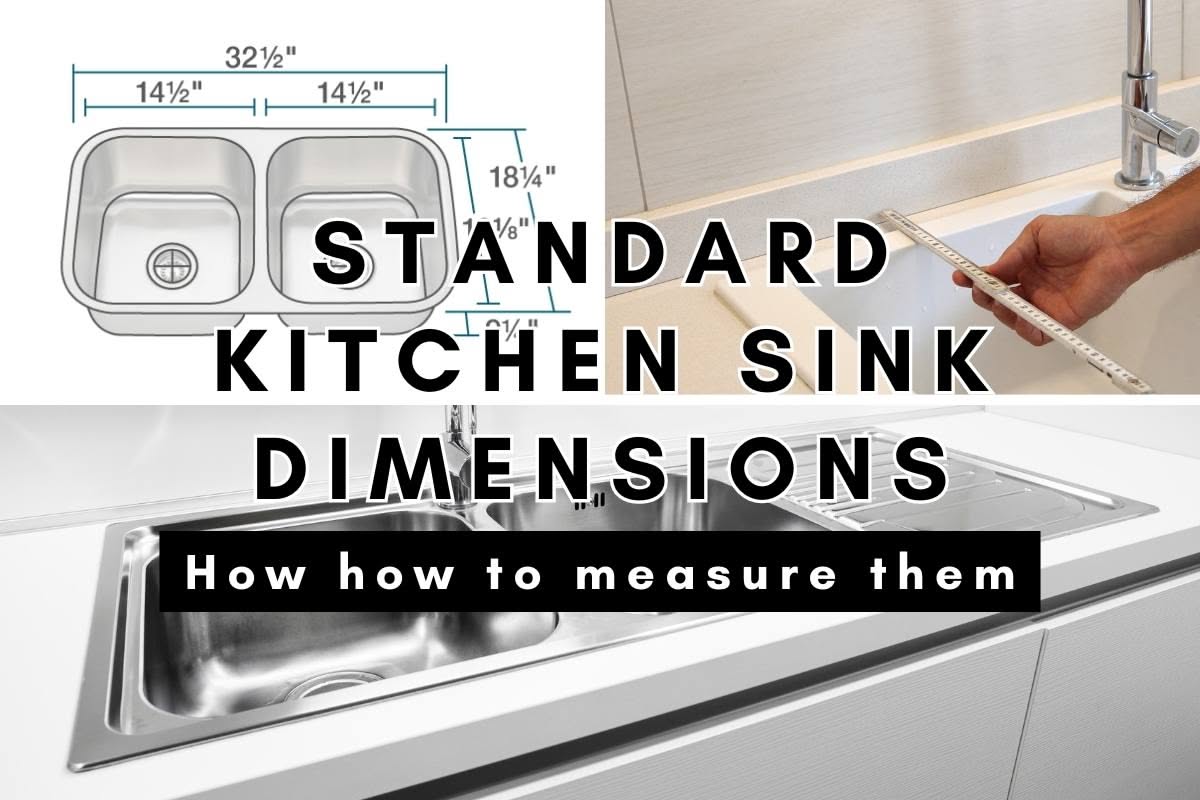
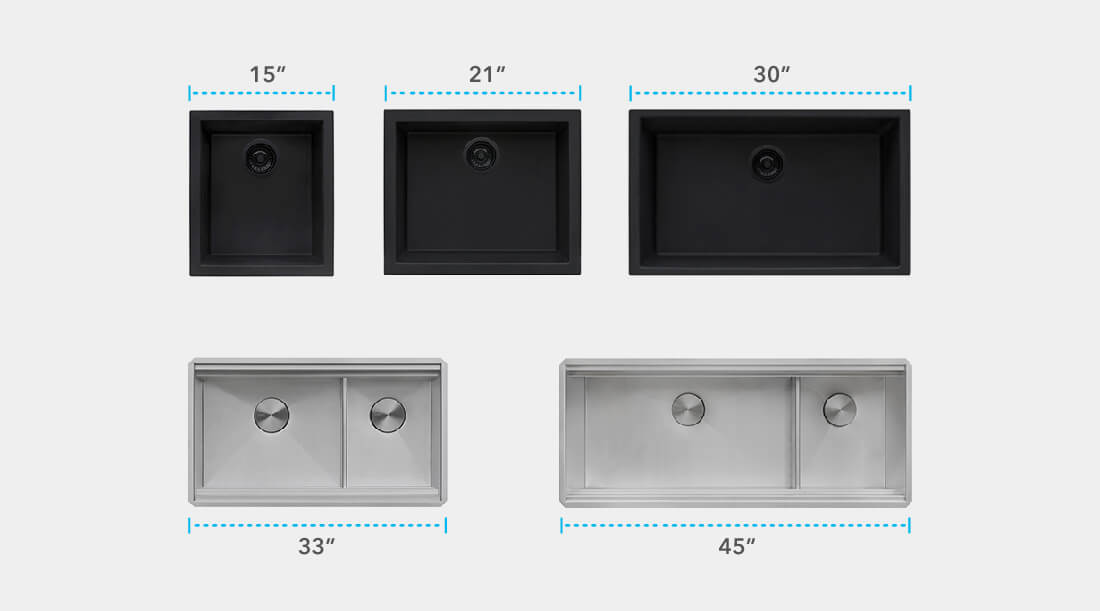
A typical kitchen sink is about 22 to 33 inches wide from side to side, with many standard single-bowl and double-bowl models falling near 25 to 33 inches. The exact width depends on the sink style, cabinet size, and number of bowls.
In American homes, kitchen sinks come in many sizes. A small apartment kitchen may have a compact sink, while a large family kitchen may have a wide double-bowl or farmhouse model. A sink around 30 inches wide is a common option, but there is no single width that fits every kitchen.
The right size depends on more than the space you can see from above. You also need to consider the cabinet below, the countertop opening, the faucet, and the room needed for installation. Knowing these measurements can help you choose a sink that fits without costly changes to your kitchen.
This guide explains common kitchen sink widths, how single-bowl and double-bowl models compare, and how to measure your current sink. You will also learn how to check cabinet space before buying a replacement.
A common kitchen sink width is roughly 25 to 33 inches, although smaller sinks can be around 15 to 22 inches wide and large models can exceed 36 inches. The best size depends on the sink design and the space available in the kitchen.
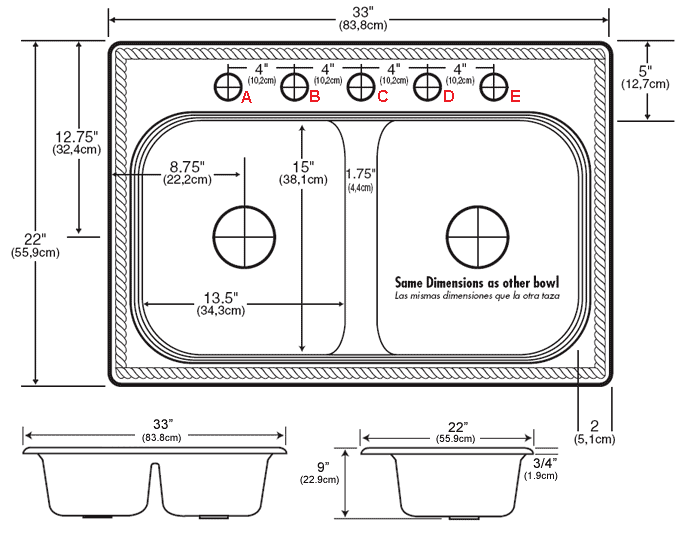
In product listings, width often means the measurement from the left outside edge to the right outside edge. Some manufacturers use the term length for this same side-to-side measurement. Read the dimension drawing rather than relying on the labels alone.
A sink’s overall width is not the same as its bowl width. The outside measurement may include the rim, mounting flange, or other parts that sit on or under the countertop. The usable bowl is often narrower.
Source: ruvati.com
Compact sinks
Sinks around 15 to 22 inches wide can suit small kitchens, bar areas, and secondary prep spaces. Bowl depth and shape affect how much they can hold.
Medium sinks
Models around 22 to 30 inches wide can work well in many small and medium kitchens, depending on the cabinet and countertop layout.
Large sinks
Sinks around 30 to 36 inches wide or more provide extra room for large pans, baking sheets, and meal prep. They may require a wider base cabinet.
Why Do Kitchen Sink Widths Vary?
The number of bowls, the shape of the basin, and the mounting style all affect the size of a kitchen sink. A single-bowl sink may use its full interior width for one open basin. A double-bowl sink divides that space between two bowls and a center divider.
A farmhouse sink may have a broad front apron and a different cabinet requirement from a top-mount sink. An undermount sink also needs a compatible countertop cutout and support system. These details can matter as much as the width printed on the product page.
Overall sink size
The full outside width, including the outer edges or rim where applicable.
Bowl width
The inside measurement of the basin. For a double-bowl sink, check each bowl separately.
Cutout width
The opening in the countertop. It may be smaller than the overall sink width and depends on the installation method.
Standard Kitchen Sink Widths by Type
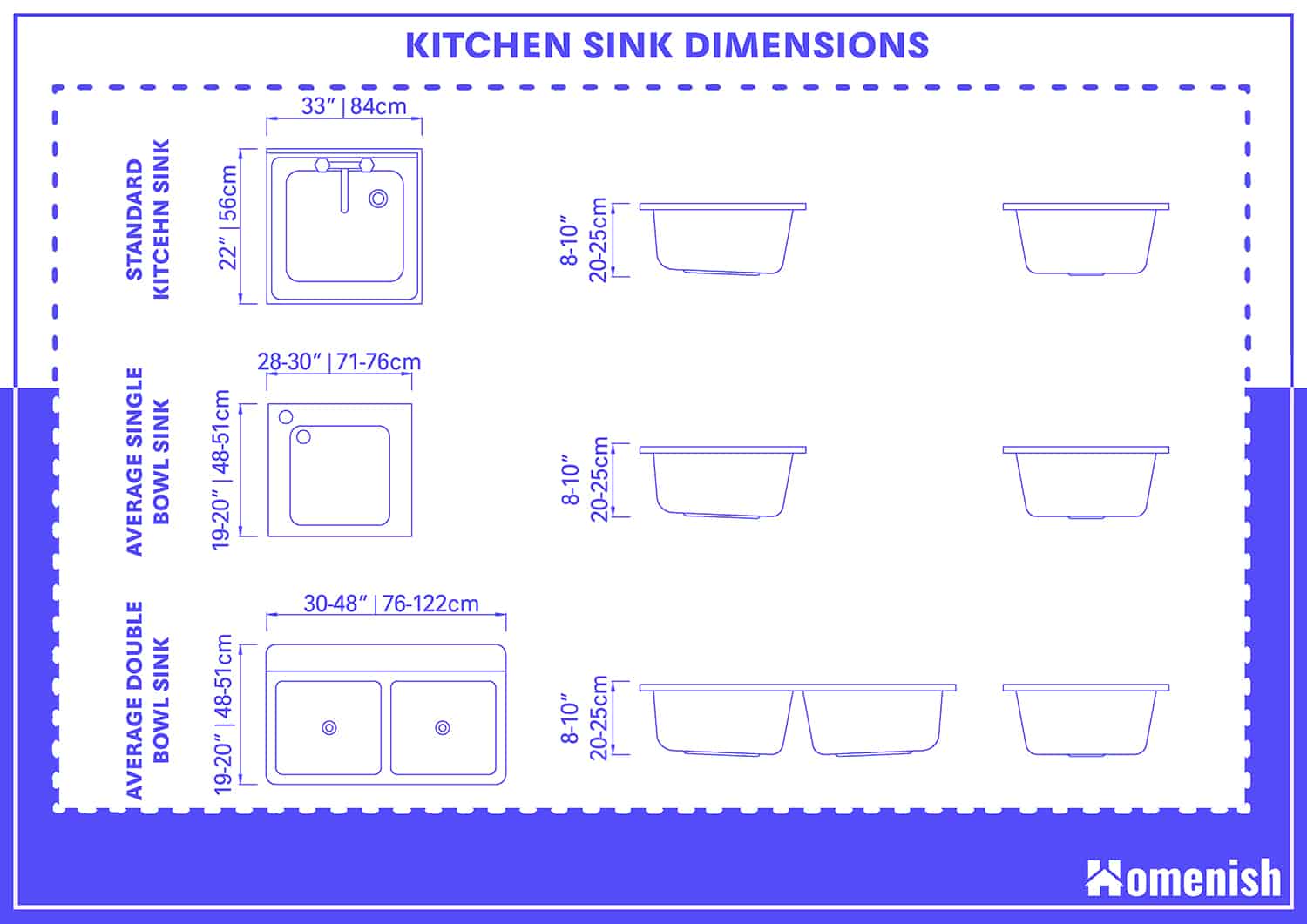
Different sink types serve different kitchen needs, so their common widths are not identical. The ranges below are practical starting points for comparing products, not fixed industry standards. Always confirm the dimensions of the exact model you plan to install.
A sink’s bowl count can give you a rough idea of how its width will be used. However, two sinks with the same outside width may have different bowl sizes, divider positions, and corner shapes.
Source: homenish.com
Single-bowl sink
Many common models are around 22 to 33 inches wide. One open basin can make it easier to wash large pots and baking trays.
Double-bowl sink
Many models are around 30 to 36 inches wide. The two bowls may be equal in size or divided into one large and one small basin.
Farmhouse sink
Common widths often fall around 30 to 36 inches, with smaller and larger designs also available. Check the apron-front cabinet requirements.
Bar or prep sink
Compact models may be around 15 to 22 inches wide. They are intended for smaller tasks rather than serving as the main family kitchen sink.
Corner sink
Corner designs vary widely because they must fit the cabinet layout. Check the full footprint and corner dimensions rather than width alone.
How Wide Is a Single-Bowl Kitchen Sink?
A single-bowl kitchen sink is often about 22 to 33 inches wide. Compact versions can be smaller, while large workstation models can be wider. The best width depends on what you wash most often and how much counter space you want to keep.
One large basin can be useful for washing stockpots, large mixing bowls, and oven trays. A wide sink may also take up more room beneath the countertop, so check the cabinet and plumbing before selecting one.
Look at wider models if you often wash bulky cookware and have enough cabinet and countertop space.
How Wide Is a Double-Bowl Kitchen Sink?
A double-bowl kitchen sink is commonly around 30 to 36 inches wide, although some models are smaller or larger. The total width includes both bowls and the divider between them.
Two bowls let you separate tasks, such as rinsing produce in one side and holding dishes in the other. The trade-off is that each bowl may be narrower than the basin in a single-bowl sink with a similar outside width.
Equal bowls
Two similarly sized bowls can help divide washing and rinsing tasks.
Unequal bowls
A larger main bowl and a smaller side bowl can offer a useful balance between cookware space and everyday tasks.
How Wide Is a Farmhouse Kitchen Sink?
Farmhouse kitchen sinks are often around 30 to 36 inches wide, but the exact range depends on the product. Their exposed front apron changes the look of the cabinet and can affect the installation work.
Do not select a farmhouse sink based on width alone. Check the apron height, bowl depth, cabinet front, countertop cutout, and support instructions. Some installations need cabinet changes or extra structural support.
Check the base cabinet
Confirm that the cabinet can accommodate the sink body and exposed front apron.
Review the installation drawing
Use the manufacturer’s template to confirm the required opening, support, and clearance.
Kitchen Sink Width and Cabinet Size
The cabinet below the sink is one of the main limits on sink width. A sink must fit the cabinet opening and leave the required space for mounting, plumbing, and any supports. A sink that looks right on the countertop may still be too large for the cabinet beneath it.
Base cabinets are often sold in nominal widths such as 24, 30, 33, and 36 inches. These are common cabinet sizes, not a guarantee that a sink of the same width will fit. The cabinet’s inside dimensions can be smaller than its listed size because of the sides, rails, and other parts.
The minimum cabinet width stated by the sink manufacturer is a key specification. For example, a sink that requires a 33-inch base cabinet should not be assumed to fit a 30-inch cabinet just because its outside width appears close.
Source: designingidea.com
Measure the cabinet’s nominal width
Check the cabinet specifications or measure across the outside sides to identify its stated size.
Check the inside opening
Measure the usable space between the cabinet sides and look for rails, drawers, or other obstructions.
Read the minimum cabinet requirement
Use the sink manufacturer’s stated minimum base cabinet width to screen out models that cannot fit.
Allow for plumbing
Check the position of the drain, disposal, water lines, and any cabinet fittings that could interfere with the sink.
Can a 30-Inch Sink Fit in a 30-Inch Cabinet?
Sometimes, but the outside sink width alone does not prove that it will fit. A 30-inch sink may need a cabinet wider than 30 inches because the bowl, mounting clips, rim, or required clearances can extend beyond the available opening.
Check the minimum cabinet width in the installation guide. If the sink is designed for a wider base cabinet, choose a compatible model or ask a qualified installer to assess whether the cabinet can be altered safely.
Good sign
The manufacturer’s guide lists your cabinet size as acceptable, and the required mounting and plumbing clearances are available.
Warning sign
The sink dimensions leave little room for mounting hardware, or the cabinet has fixed rails or drawers that block the installation.
How to Measure Kitchen Sink Width Correctly
To measure a kitchen sink, start by deciding whether you need the outside width, the bowl width, or the countertop cutout width. These are different measurements, and using the wrong one can lead to a poor fit.
For a replacement sink, measure the current sink and the cabinet below it. Then compare those measurements with the installation drawing for the new model. If the sink is undermounted or the countertop opening is irregular, do not assume that a new sink with the same listed width will fit.
Source: wikihow.com
What you need
A tape measure, paper or a phone for notes, and the manufacturer’s dimension drawing for the sink you are considering.
Before you start
Keep the sink area dry and clear. Do not remove plumbing, mounting clips, or heavy sink parts unless you know how to do so safely.
Step 1: Measure the Outside Width
Measure from the far left outside edge of the sink to the far right outside edge. Keep the tape straight across the sink rather than following a curved rim. Record the result in inches and note whether the measurement includes a lip or flange.
For a top-mount sink, the visible rim may cover part of the countertop opening. For an undermount sink, the outer basin dimensions and the exposed countertop opening can differ. Record which measurement you took so you do not confuse it with the cutout size.
Record the full width
Write down the left-to-right outside measurement, including the rim if the manufacturer’s overall dimensions include it.
Check the front-to-back size
Measure the depth of the sink footprint as well. A sink may fit in width but still be too deep for the counter or cabinet.
Step 2: Measure the Bowl
Measure the inside width of the basin from one inner wall to the other. For a double-bowl sink, measure both bowls separately because they may not be equal. Also note the front-to-back length and the bowl depth.
These measurements help you judge how much usable room the sink offers. The inside bowl width is especially useful if you need to wash wide pans or baking sheets.
Single-bowl model
Record one inside width, one inside front-to-back measurement, and the basin depth.
Double-bowl model
Record the width of each bowl, the divider, and the overall sink width.
Step 3: Measure the Cabinet
Open the cabinet doors and measure the available space below the sink. Check the inside width between the cabinet sides and note any rails, drawers, pipes, or disposal units that use space. Do not rely only on the cabinet’s outside label.
Compare the usable cabinet space with the sink manufacturer’s minimum cabinet requirement. The required clearance may depend on the mounting method and the sink’s shape.
Look for obstructions
Check whether rails, pull-out bins, drawers, or plumbing will interfere with the bowl or mounting hardware.
Check support needs
Heavy sinks, especially some farmhouse models, may need specific supports. Follow the manufacturer’s installation instructions.
Step 4: Check the Countertop Cutout
If you are replacing a sink, measure the existing countertop opening when it is accessible. Do not cut the countertop based only on the new sink’s outside width. The required opening depends on the sink design and mounting style.
A top-mount sink usually overlaps the cutout with its rim. An undermount sink is installed below the countertop, so the opening and edge finish must match the sink and counter material. Use the supplied template and specified measurements.
For top-mount sinks
Confirm that the rim will cover the opening and that the cutout meets the manufacturer’s template.
For undermount sinks
Check the opening, finished edge, mounting system, and countertop material before ordering or cutting.
Step 5: Compare All Measurements Before Buying
Compare the new sink’s overall dimensions, required cabinet width, cutout size, bowl dimensions, and mounting details. Check the faucet holes and drain location too, especially if you want to reuse the existing faucet or garbage disposal.
If the listed measurements are unclear or the old countertop opening is unusual, contact the manufacturer or an installer before making changes. A few minutes spent checking the specifications can help prevent a sink that does not fit.
Ready to proceed
The sink meets the cabinet requirement, the opening is compatible, and plumbing connections can be placed as instructed.
Pause and check
The cutout is larger or smaller than the approved template, the cabinet is too narrow, or the mounting instructions are unclear.
Kitchen Sink Width, Length, and Depth Explained
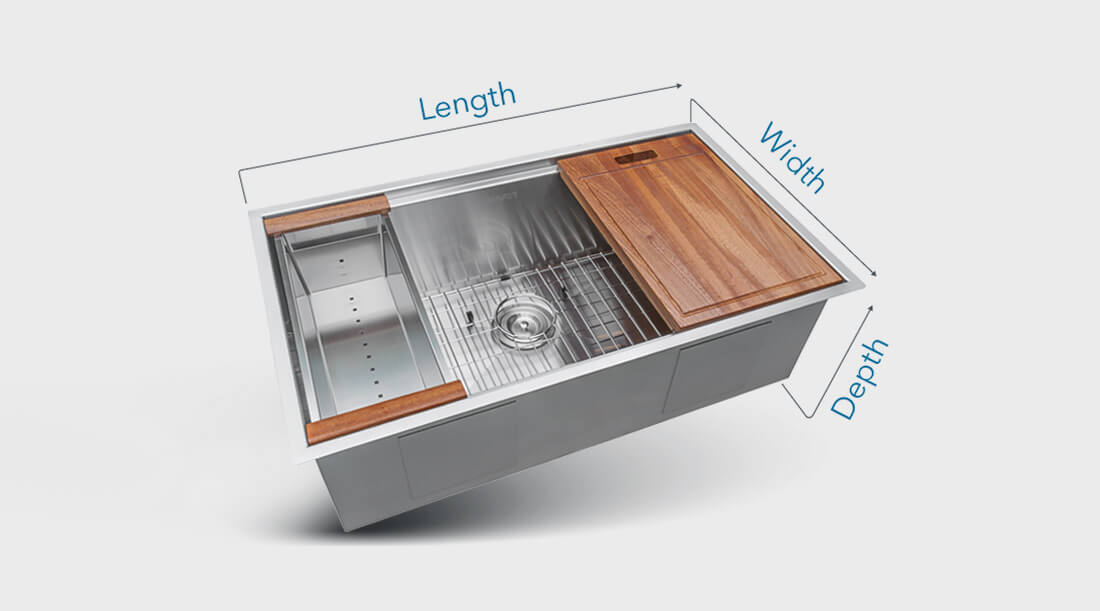
Width, length, and depth describe different parts of a kitchen sink, but product listings do not always use these terms in the same way. Some manufacturers call the left-to-right measurement length, while others call it width. The dimension drawing is the best way to identify each measurement.
For most practical sizing decisions, look at three measurements: the outside size, the inside bowl size, and the space needed for installation. A sink can have a wide outside footprint but a smaller usable bowl because of thick walls, rounded corners, or a divider.
Source: ruvati.com
Width or side-to-side length
Usually the horizontal measurement from the left edge to the right edge when viewed from above.
Front-to-back dimension
The distance from the front edge of the sink to the back edge near the wall or faucet.
Bowl depth
The vertical distance from the top of the basin to its bottom. A deeper bowl can hold more water and dishes but may take up more space beneath the counter.
Does a Wider Sink Always Have More Usable Space?
No. The outside width is only one part of the design. A sink with thick walls, a broad rim, a large center divider, or rounded inner corners may offer less usable space than another sink with the same outside measurement.
If you wash large cookware, compare the inside bowl width and the clear space at the bottom of the basin. For a double-bowl sink, check whether the larger bowl is wide enough for your biggest pan.
Compare inner dimensions
Use the bowl measurements rather than outside width alone when checking whether cookware will fit.
Check the corner shape
Rounded corners can reduce usable space in some areas, while the overall shape may affect how dishes sit in the basin.
How to Choose the Right Kitchen Sink Width
Choose a sink width that fits the cabinet and leaves enough usable counter space for your daily tasks. A larger sink can make washing cookware easier, but it may reduce the room available for food prep or affect the cabinet layout.
Think about what you wash most often, how many people use the kitchen, and whether you prefer one large basin or two separate bowls. Then compare those needs with the dimensions of the available cabinet and countertop.
Source: i.pinimg.com
For a small kitchen
Start with compact or medium models and check how much counter space remains beside the sink. A wide basin may not be worth losing needed prep room.
For a busy family kitchen
A wider single-bowl or double-bowl model may help with meal prep and dishwashing, provided the cabinet can support it.
For frequent large-pan washing
Compare the usable inside width and front-to-back dimensions with your largest pans and trays.
For a kitchen remodel
Confirm the cabinet, countertop, plumbing, faucet, and mounting requirements before finalizing the sink size.
Should You Choose a 25-Inch, 30-Inch, or 33-Inch Sink?
A 25-inch sink may suit a smaller kitchen or a cabinet with limited space, depending on its installation requirements. A 30-inch sink can offer a useful balance of basin room and countertop space. A 33-inch sink may provide more room for washing dishes, but it needs a compatible cabinet and countertop opening.
These examples describe outside widths, not guaranteed bowl sizes or cabinet requirements. Two sinks with the same listed width may have different layouts, so compare the installation drawings before choosing.
25-inch sink
Consider it when space is limited and the usable bowl meets your needs.
30-inch sink
Consider it for a general-purpose kitchen when the cabinet and countertop can accommodate the model.
33-inch sink
Consider it when you want a larger basin or more room for divided bowls and have enough cabinet space.
What Other Features Affect the Fit?
The mounting style, sink material, rim shape, drain location, and bowl depth can all affect installation. Some sinks have broad ledges for accessories, while others use a simple rim or an undermount design. Those features may change the amount of usable space or the cabinet arrangement.
A garbage disposal can also affect the space beneath the sink. If you are replacing an existing sink, check the drain position and disposal clearance before assuming that the current plumbing will work with a new model.
Mounting style
Top-mount, undermount, and farmhouse sinks have different opening and support requirements.
Faucet placement
Check the faucet holes, rear deck, wall clearance, and handle movement.
Drain and disposal
Confirm that the drain position and bowl shape allow enough room for the existing or planned disposal unit.
Common Kitchen Sink Sizing Mistakes
Most sink sizing problems start when a buyer compares only one number. Overall width matters, but it does not confirm that the sink will fit the cabinet, match the countertop opening, or provide enough usable bowl space.
Before buying, review the complete dimensions and installation requirements. If a measurement is uncertain, stop and confirm it rather than cutting the countertop or changing the cabinet based on an estimate.
Source: i.pinimg.com
Mistake 1: Confusing sink width with bowl width
The outside measurement includes parts that may not provide usable washing space. Compare the interior basin dimensions as well.
Mistake 2: Assuming a 30-inch cabinet accepts every 30-inch sink
The minimum cabinet requirement varies by model. Check the manufacturer’s specifications before ordering.
Mistake 3: Measuring only the visible opening
The countertop opening may not reveal the full sink footprint or the space needed for mounting hardware.
Mistake 4: Ignoring front-to-back dimensions
A sink may fit from side to side but still conflict with the backsplash, faucet, counter edge, or cabinet parts.
Mistake 5: Forgetting plumbing clearance
The drain and garbage disposal may use more cabinet space than expected. Check their position before choosing a different bowl shape.
Mistake 6: Treating all mounting styles alike
An undermount sink and a top-mount sink do not use the same countertop installation method. Follow the exact template and instructions.
When Should You Ask an Installer for Help?
Ask a qualified installer to assess the job if the countertop needs a new cutout, the cabinet needs structural changes, or the existing opening does not match the replacement sink. This is especially useful with stone countertops, farmhouse sinks, and heavy models that need special support.
Do not force a sink into a tight opening or remove cabinet supports without understanding their role. A professional can check the fit, mounting method, and plumbing clearance before permanent changes are made.
Stone or solid-surface countertops
A new opening or altered edge may require specialist tools and careful work to avoid damage.
Major cabinet changes
Get help if rails, sides, or supports need to be altered to fit the new sink.
Unclear installation specifications
Contact the sink manufacturer or an installer if the required cutout, support, or minimum cabinet width is not clear.
Frequently Asked Questions
Q
How wide is a standard kitchen sink in inches?
Many standard kitchen sinks are about 22 to 33 inches wide, with common single-bowl and double-bowl models often measuring around 25 to 33 inches. Smaller prep sinks and larger specialty models fall outside this range. Check the exact product dimensions before buying.
Q
Is a 30-inch kitchen sink big enough?
A 30-inch sink can be large enough for many everyday kitchen tasks, including washing dishes, produce, and medium-sized cookware. Whether it suits your needs depends on the usable bowl dimensions, sink style, and available cabinet space. Compare the inside basin measurements if you often wash large pans.
Q
What size cabinet do I need for a 33-inch kitchen sink?
The required cabinet depends on the exact sink model. A 33-inch sink may need a cabinet at least 33 inches wide or a larger one, depending on the design and mounting requirements. Use the manufacturer’s minimum cabinet width rather than assuming that the sink and cabinet must have matching numbers.
Q
Are kitchen sink widths measured inside or outside?
A listed overall width usually refers to the sink’s outside dimensions, but product terminology can vary. The inside bowl width is a separate measurement, and the countertop cutout has its own required size. Read the dimension drawing to identify which measurement the manufacturer provides.
Many double-bowl kitchen sinks are around 30 to 36 inches wide. Some compact models are smaller, and larger designs are available. The width of each bowl depends on the center divider and whether the bowls are equal or unequal in size.
Q
Can I replace a kitchen sink without changing the countertop?
Often, yes, if the replacement sink is compatible with the existing opening, countertop thickness, mounting style, and cabinet. A sink with a different rim, bowl shape, or installation method may need countertop changes. Compare the existing cutout with the new sink’s installation template before ordering.
Q
How do I measure a kitchen sink for replacement?
Measure the outside width and front-to-back dimensions, then record the inside bowl size and depth. Check the cabinet’s usable interior space and the countertop cutout. Compare all of these measurements with the replacement sink’s installation guide, including its minimum cabinet width and mounting requirements.
✦ Wrapping Up
Conclusion
A kitchen sink is often around 22 to 33 inches wide, but the right size depends on its style, bowl layout, and installation needs. A compact sink can work well in a small kitchen, while a wider model may offer more room for dishes and cookware.
Before choosing a sink, measure the outside width, inside bowl, cabinet space, and countertop opening. Check the manufacturer’s specifications for minimum cabinet width and mounting requirements. Those details matter more than the listed width alone.
If you are replacing an existing sink, compare the old measurements with the new model’s installation drawing before buying. If the countertop or cabinet needs changes, have the work assessed before cutting or removing supports.
💡 Key Takeaway
Measure your current sink and cabinet, write down the overall width and countertop opening, and compare those figures with the manufacturer’s installation guide before selecting a replacement.