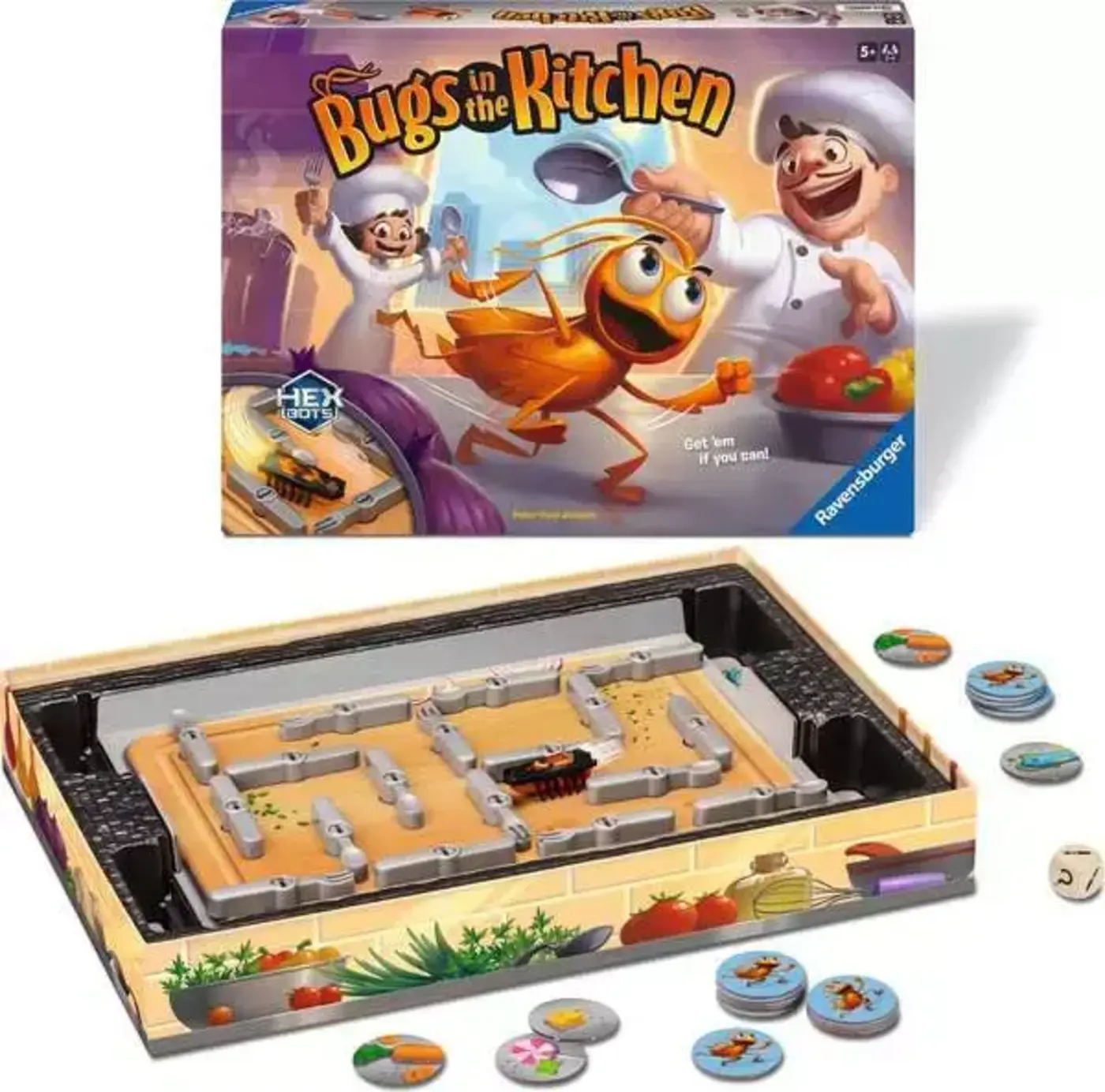
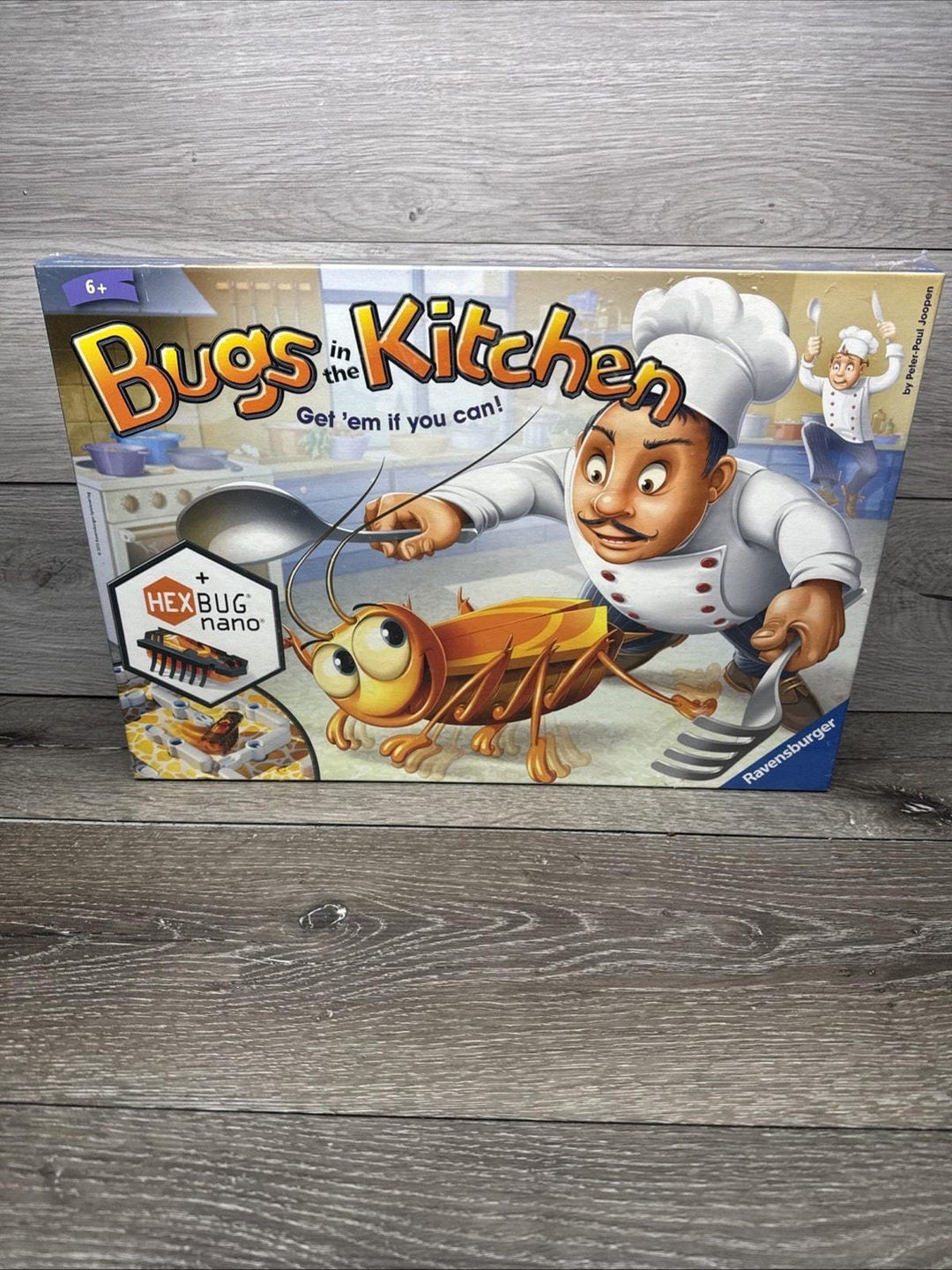
Bugs in the Kitchen is a family board game from ravensburger in which players turn kitchen utensils to guide a moving electronic bug into their own corner traps. The aim is to catch the bug and collect tokens. The player who collects the required number of tokens first wins.
In the United States, family game nights often bring parents, children, and friends around the same table. Bugs in the Kitchen fits that setting with a simple idea: move the maze, chase a little bug, and try to steer it into your trap. It combines quick decisions with a bit of luck, so each round can feel different.
The game uses a small battery-powered HEXBUG Nano that scurries across the plastic kitchen maze. Players turn forks, spoons, and knives to change its path. You do not need a long list of rules to get started, but knowing the setup, turn order, and scoring system makes the first round much easier.
This guide explains the basic rules, setup, gameplay, scoring, and common problems. It also covers age suitability, batteries, and ways to make the game easier for younger players. Product versions can differ, so check the rule sheet included with your copy if a detail does not match these general instructions.
Bugs in the Kitchen is a tabletop maze game made by Ravensburger. Its main feature is a small electronic bug that moves through a plastic kitchen filled with rotating utensils. Players change the maze in an effort to send the bug into a trap at their own corner of the board.
Unlike a traditional board game where pieces move one square at a time, this game has a moving target. The bug can change direction when it meets a utensil or an open path. Players must react to the route it takes and decide which piece to turn next.
The game’s appeal comes from its mix of simple rules and changing outcomes. A player may have a good plan, but one turn of a fork can send the bug toward another corner. That makes each round lively without requiring advanced strategy or lengthy planning.
Source: i5.walmartimages.com
Game maker
Ravensburger is the publisher associated with the Bugs in the Kitchen family board game.
Main game piece
A small moving HEXBUG Nano travels through the kitchen maze.
Main objective
Guide the moving bug into your own trap and collect the required number of tokens.
Typical age range
The game is commonly sold for children ages 6 and up. Check the age guidance on your particular edition.
What Makes the Game Different?
The maze itself changes as players turn the utensils. A fork that once blocked the bug may open a new route after a quick twist. A spoon may redirect the bug away from one corner and toward another. The board becomes part of the strategy rather than just a surface for moving pieces.
The bug’s movement also adds uncertainty. Players can influence its path, but they cannot always predict the exact result. This makes the game suitable for short rounds in which children can learn by watching what happens after each move.
Changing paths
Rotating utensils alter the routes available to the moving bug.
Quick decisions
Players must notice where the bug is heading and decide which utensil to turn.
Shared excitement
Everyone can watch the same moving bug, making the game easy to follow from around the table.
What Comes in the Box?
The standard game includes a plastic kitchen maze, rotating utensil pieces, corner traps, scoring tokens, and a small HEXBUG Nano. The exact contents can vary by edition, so compare the pieces in your box with its printed inventory before beginning.
Lay every piece on a clear table and keep the rule sheet nearby. This makes it easier to spot a missing part before the first round. It also gives children a chance to learn the names of the pieces before the moving bug starts racing around the board.
Source: cdn.onbuy.com
Kitchen board
The board holds the maze and provides spaces where the utensils can turn.
Rotating utensils
Plastic forks, knives, and spoons act as movable walls that change the bug’s route.
HEXBUG Nano
The small electronic bug moves through the maze when switched on and powered correctly.
Corner traps
The traps mark the destinations players want the bug to enter.
Scoring tokens
Tokens track successful catches and help determine the winner.
Check the Game Before Playing
Inspect the board and utensils for cracks or loose parts. Make sure each utensil fits into its space and can turn without being forced. If a piece is stuck, check the setup instructions rather than pushing it hard.
Look over the HEXBUG Nano before placing it in the maze. Check the battery compartment and switch, if fitted, according to the supplied directions. Keep loose batteries away from young children, and do not use a damaged or leaking battery.
Count the parts
Use the inventory in the instruction booklet to confirm that your set is complete.
Test the bug
Place it on a clear surface and check that it moves as described in the manual.
Clear the table
Remove cups, food, and other objects that could obstruct the board or cause the bug to fall.
How to Set Up Bugs in the Kitchen
Set up the maze before switching on the bug. A stable board and correctly placed utensils make the game easier to understand and help prevent the moving piece from leaving the playing area.
Use the diagrams in your edition’s instructions as the final guide. Some details, such as the initial utensil positions and token rules, should match the booklet supplied with your particular version.
Source: i.etsystatic.com
Step 1: Build the Kitchen Maze
Place the board on a flat table with enough space around every side. Fit the utensils into their marked spaces, then check that each one can rotate as intended. Keep the corner traps in their proper positions.
Do not arrange the maze at random unless your edition tells you to do so. The printed setup diagram shows the intended starting layout and helps everyone begin from the same position.
Use a flat surface
An uneven table can make pieces shift or the bug fall off the board.
Follow the diagram
Place the utensils and traps in the positions shown in the rule sheet.
Step 2: Give Each Player a Corner
Players use the corner traps as their goals. Agree on who controls each corner before the game begins. If the game has fewer players than available corners, follow the instructions for how to handle unused positions.
Make sure everyone can reach the utensils without leaning across another player’s space. Young children may find it easier to sit close to their assigned corner.
Choose positions
Assign players to the corners used in your edition and keep the same positions for the round.
Set out tokens
Place the scoring tokens where every player can reach them.
Step 3: Prepare the HEXBUG Nano
Check the battery requirements printed on the bug or in the instructions. Install the correct batteries if needed, observing the stated polarity. Switch the bug on only when the board is ready and everyone understands the basic goal.
Place the bug in the starting position specified by the rules. If your edition does not use a fixed starting point, follow its directions for the opening move. Avoid turning the bug on while holding it close to someone’s face or hair.
Check power
Use only the battery type and setup described by the manufacturer.
Keep hands clear
Set the bug down gently and allow it to move without squeezing or bending its body.
How to Play the Bug in the Kitchen Game
The basic idea is to turn the utensils so the moving bug enters your corner trap. Players take turns changing the maze according to the rules, while the bug travels through the open paths. The winner is the player who reaches the required number of successful catches first.
Read the turn rules before starting. Depending on the edition, players may have specific limits on which utensil they can turn or how they must respond when the bug reaches a trap. Those details matter because they keep the game fair for everyone.
Source: geekyhobbies.com
Step 1: Start the Bug
Place the HEXBUG Nano in the designated starting area and activate it. Watch the direction in which it moves. Players should keep their hands off the bug unless the rules call for moving it after a catch or resetting the round.
Watch its route
Notice which opening the bug approaches and which utensil could redirect it.
Wait for your turn
Follow the turn order in the booklet instead of turning pieces whenever you want.
Step 2: Turn a Kitchen Utensil
When it is your turn, choose a utensil that may change the bug’s path toward your trap. Rotate it in the way allowed by your edition. A small change can open one route while blocking another, so look at the surrounding spaces before making a move.
For example, if the bug is moving toward the center, a nearby fork may help direct it toward your corner. The same turn could send it toward another player instead. There is no guaranteed move because the bug’s exact movement can vary.
Look ahead
Check the next opening rather than focusing only on the bug’s current position.
Use legal moves
Turn only the utensils allowed by the current rules and do not lift the maze pieces to create a shortcut.
Act with care
Turn the pieces gently so they remain in their slots.
Step 3: Watch for a Catch
Keep watching as the bug moves through the maze. If it enters a player’s trap, use the scoring procedure described in the rule sheet. This may include awarding a token and resetting the bug for another round.
Check who earns the point before moving anything. A clear routine prevents arguments, especially when several players are excited and the bug reaches a corner quickly.
Confirm the trap
Make sure the bug has entered the trap rather than simply passing near it.
Award the token
Give the successful player the correct token under your edition’s rules.
Reset as directed
Return the bug to the required starting position before the next round.
Step 4: Keep Playing Until Someone Wins
Repeat the turn and scoring process until one player reaches the winning total stated in the instructions. Keep tokens visible so everyone can track progress. If two events seem to happen at once, pause and use the tie or scoring guidance in your edition’s rule sheet.
The game can feel close near the end because one successful catch may decide the result. Keep the same turn order and legal-move rules throughout the game rather than changing them to help a player who is behind.
Track each catch
Keep the tokens in front of the players who earned them.
Use one winning target
Agree on the correct token total before play and follow the printed rule for your edition.
Bugs in the Kitchen Rules and Scoring
The core rule is simple: players change the maze to guide the bug into their own trap. The scoring system turns each successful catch into progress toward the win. However, the exact number of tokens needed to finish should be checked in the supplied instructions rather than assumed from another edition or an online description.
Before play, settle three points: how a turn works, what counts as a successful catch, and what happens after a catch. These decisions are easier to make before anyone has started collecting tokens.
Source: images.vat19.com
Turns
Players act in the order specified by the game’s instructions and make only legal utensil moves.
Catches
A token is awarded according to the rules when the bug enters the relevant trap.
Resetting
The bug and maze are handled after a catch as directed by the rule sheet.
Winning
The first player to reach the required number of tokens wins, subject to the scoring rules of that edition.
What If the Bug Falls Off the Board?
Stop play and check the instructions for the correct way to restart. If the bug fell because the board was too close to the table edge, move the game to a safer spot before continuing. Do not award a token unless the rules say that the event counts as a catch.
A brief pause is better than guessing. Everyone can agree on the correct restart method and continue with the same rules.
Pause the round
Switch off the bug if needed and keep the maze still while you check the rules.
Check the setup
Make sure the board is flat, stable, and far enough from the table edge.
Tips to Improve Your Chances of Catching the Bug
Good play starts with watching the maze rather than turning pieces at random. Look at the bug’s current direction, the openings around it, and the next utensil that could change its path. Then make a move that supports your goal while following the turn rules.
There is still a strong element of chance because the HEXBUG Nano moves on its own. A smart turn may help, but it cannot guarantee a catch. Treat each round as a chance to learn how the maze responds.
Source: ultraboardgames.com
Watch More Than One Opening
Before moving a utensil, look at the route beyond the nearest opening. A path may lead toward your corner at first and then turn away at the next junction. Thinking one step ahead helps you avoid moves that look useful but do little to guide the bug toward your trap.
Read the maze
Look for the next two possible turns before choosing a utensil.
Avoid random turns
Make each move for a clear reason, even if the bug’s movement remains unpredictable.
Notice the Bug’s Direction
The bug’s current direction can help you decide which utensil matters most. If it is already moving away from your corner, changing a piece near that corner may not affect it soon. Focus on a utensil that lies along its likely route, while remembering that the bug may change direction on its own.
Follow its movement
Watch the bug for a moment before selecting your move.
Choose a useful point
Focus on a nearby junction that can change the available route.
Stay Calm When Another Player Is Close to Winning
A player with several tokens may seem hard to beat, but rushing can lead to poor choices. Keep using legal moves and look for opportunities to direct the bug toward your own corner. The game remains unpredictable until the winning condition is met.
Do not change the scoring target or take extra turns just to catch up. A consistent rule set makes the result fair, even when the game is close.
Keep your focus
Look at the maze and the bug instead of counting another player’s tokens during every move.
Play fairly
Use the same turn order and move limits for everyone.
Common Problems and How to Fix Them
Most problems with Bugs in the Kitchen come from setup, battery power, or a piece that cannot move as intended. Check the simplest causes first. Avoid taking apart the electronic bug or forcing a utensil into place.
Source: i.ytimg.com
The Bug Does Not Move
If the HEXBUG Nano stays still, check that its switch is on and that the batteries are installed correctly. Follow the manufacturer’s instructions for the correct battery type and polarity. If the bug still fails to move, turn it off before inspecting the battery compartment.
Look for signs of battery leakage, corrosion, or physical damage. Do not touch leaking battery material with bare hands, and keep the toy away from children until the problem has been handled safely. Replace batteries only as directed by the manufacturer.
Check the switch
Make sure the bug is turned on as described in the instructions.
Check the batteries
Confirm that the battery type, orientation, and condition meet the product requirements.
Stop if damaged
Do not continue using a bug with a damaged case or a leaking battery compartment.
The Bug Keeps Getting Stuck
A bug that repeatedly stops may be caught against a utensil, trapped in a narrow space, or unable to cross an uneven section. Check the maze layout and make sure each utensil is fitted correctly. A small obstruction can affect movement, so remove loose objects from the board.
If the problem continues, compare the setup with the printed diagram. Do not bend the utensils or force the bug through a blocked path. Use the troubleshooting guidance supplied with your game.
Check the maze
Look for misplaced pieces or blocked openings.
Inspect the surface
Make sure the board rests on a stable, level table.
A Utensil Will Not Turn
A utensil that feels stuck may not be seated properly or may be blocked by another piece. Check its position against the setup diagram. Lift or reseat a part only if the instructions allow it and the game is not in active play.
Avoid using tools or extra force. If the part is cracked or no longer fits, contact the seller or manufacturer about a suitable replacement rather than attempting a repair that could damage the board.
Check its position
Compare the utensil with the intended starting arrangement.
Avoid force
Stop if the piece resists normal movement.
Players Disagree About the Rules
Rule disputes often happen when a catch occurs quickly or players remember different instructions. Pause the game and check the printed rule sheet. Agree on the correct outcome before awarding a token or restarting the bug.
If the booklet is missing, look for instructions that match the exact product edition or item number. Rules from a similar game may differ, so do not assume that every version uses the same scoring target.
Check the exact edition
Use the instructions that match the box and product number.
Agree before restarting
Apply the same interpretation to all players.
Is Bugs in the Kitchen Good for Kids and Families?
Bugs in the Kitchen can suit families who want a game with movement, simple goals, and short decisions. Children can watch the bug, learn how the utensils affect its route, and practice waiting for their turn. Adults can join in without needing to learn a complex set of rules.
The game is commonly marketed for ages 6 and up. Age labels are a starting point, not a guarantee that every child will enjoy the game or be ready to play alone. Consider the child’s ability to follow turn rules, handle small pieces safely, and understand the scoring system.
Source: cdn.shoplightspeed.com
Benefits for Younger Players
The game gives children a clear goal and immediate feedback. They can see the effect of a utensil turn and learn that one move can change the available path. It also gives them a chance to practice taking turns and handling both wins and losses.
These are possible learning opportunities, not a guarantee of a specific educational result. The main purpose remains play, and children should not feel that they must use the game as a lesson.
Planning
Players consider which utensil may direct the bug toward a chosen corner.
Observation
Children watch how the bug reacts to openings and barriers.
Turn-taking
Players practice waiting and following a shared set of rules.
Safety for Children
The game contains small parts and a battery-powered moving toy. Keep loose batteries and small components away from children who may put them in their mouths. Adults should supervise children who are too young to handle the parts safely.
Do not place the bug near a child’s mouth, eyes, or hair. Follow the warnings on the packaging, especially those about batteries and small pieces. Store the parts in their box when the game is over.
Follow the age label
Use the manufacturer’s age guidance and safety warnings for your edition.
Watch battery handling
Adults should manage battery changes when a child cannot do so safely.
Pack away small pieces
Count and store the components after play.
How Many Players Can Play?
The number of players depends on the edition’s printed instructions. The game is designed for shared play around the maze, with players aiming to guide the bug into their assigned traps. Check the box for the supported player count before planning a game night.
If you have fewer players than the game allows, do not assume that each person can control more than one corner. Some editions may have specific rules for unused corners or reduced player counts. Follow the instructions if they address this situation.
Source: cdn.ecommercedns.uk
Can Two People Play?
Two people may be able to enjoy a casual version by choosing separate corners and taking turns, but that does not automatically make it an official two-player mode. Check your edition’s player count and any rules for reduced groups.
If the official rules do not support your group size, you can agree on a house rule for informal play. Make the change clear before starting, and keep the scoring fair for both players.
Check the box
Use the listed player count as the guide for standard play.
Agree on house rules
If you adapt the game, explain the changes before the first round.
How to Store and Maintain the Game
Store Bugs in the Kitchen in a dry place and keep the board, utensils, traps, and bug together. Put the small pieces back in the box after every session. This reduces the chance of losing a utensil or stepping on a loose component later.
Keep food and drinks away from the maze while playing. If the board needs cleaning, use the care directions supplied by the manufacturer. Do not immerse the electronic bug in water or apply cleaning fluid directly to its battery compartment.
Source: geekyhobbies.com
Care for the HEXBUG Nano
Switch off the bug when the game is finished, following the directions for your model. If the game will remain unused for a long time, check the battery instructions for storage advice. Removing batteries may be appropriate for some products, but follow the manufacturer’s guidance for your exact bug.
If the bug collects dust or stops moving well, check its exterior and follow the cleaning instructions. Do not pull apart the motor or body unless the manufacturer provides a repair procedure intended for users.
Switch it off
Turn off the bug after play to avoid unnecessary battery use.
Keep it dry
Protect the electronic parts from spills and moisture.
Store it safely
Keep the bug and batteries away from small children and pets.
Keep the Board in Good Shape
Wipe the board and plastic pieces only with a method allowed by the care instructions. Use a soft cloth if the manufacturer permits it, and allow cleaned parts to dry before storage. Strong cleaners or rough scrubbing may damage the plastic.
Check the utensils before each game. Replace missing or damaged parts with compatible components when available, and avoid forcing parts from another board game into the maze.
Clean gently
Use the care method specified for your game rather than soaking the pieces.
Check for damage
Look for cracks, sharp edges, or loose parts before children begin playing.
Frequently Asked Questions
Q
What is the main goal of Bugs in the Kitchen?
The goal is to guide the moving HEXBUG Nano into your own corner trap by turning the kitchen utensils to change its path. Successful catches earn tokens, and the first player to reach the required winning total wins according to the rules for that edition.
Q
What age is Bugs in the Kitchen suitable for?
The game is commonly marketed for children ages 6 and up. Check the age label on your box, since editions and safety guidance may differ. Younger children may need adult help with the rules and small parts.
Q
Does Bugs in the Kitchen need batteries?
The moving HEXBUG Nano requires power, and battery needs depend on the exact bug supplied with the game. Check the battery compartment and product instructions for the required type, installation direction, and replacement method.
Q
How do you win Bugs in the Kitchen?
Players turn the utensils to steer the bug toward their corner trap. A successful catch earns a token under the game’s rules. The first player to collect the specified number of tokens wins, so check the instruction sheet for the exact winning total.
Q
Can you play Bugs in the Kitchen with two players?
Check the player count printed on your edition to confirm whether two-player play is officially supported. If the rules do not cover a two-player game, you can try an agreed house-rule version, but it may not match the intended balance of standard play.
Q
Why is the bug in my game not moving?
Check that the bug is switched on and that the batteries match the instructions and are installed correctly. Make sure the maze is assembled as shown in the booklet. If the bug remains still or shows signs of damage or battery leakage, stop using it and follow the manufacturer’s troubleshooting guidance.
Q
Is Bugs in the Kitchen a game of skill or luck?
It combines both. Players use observation and planning to choose which utensils to turn, but the bug moves on its own and may not follow a fully predictable path. Good decisions can influence the route without guaranteeing a catch.
✦ Wrapping Up
Conclusion
Bugs in the Kitchen is a lively family game built around a simple challenge: turn the kitchen maze and send the moving bug into your trap. The rules are easy to learn once the board is set up, the turn order is clear, and everyone knows how catches are scored.
For the best start, check the pieces, follow the setup diagram, and read the instructions for your exact edition. Keep the board on a stable table, handle the batteries with care, and store the small parts after play. A little preparation can help the whole group focus on the fun.
💡 Key Takeaway
Before your first round, assemble the maze as shown in the rule sheet, test the HEXBUG Nano, assign the player corners, and agree on the turn and scoring rules. Then start the bug and see who can guide it into their trap first.