
Are KitchenAid mixing bowls dishwasher safe? Yes, most are, and I was glad to learn that.
KitchenAid says its stand mixer bowls can go in the dishwasher. There is one key copper bowl exception. Bowl type also matters for best care. I checked the current KitchenAid care guides to sort out steel, glass, ceramic, and copper bowls. This guide shares the simple rules I would use at home. Read on before you load your bowl.
The Short Answer on Dishwasher Safety
Yes, most KitchenAid stand mixer bowls are dishwasher safe.
KitchenAid says its stainless steel, glass, and ceramic stand mixer bowls can go in the dishwasher. The brand lists one clear exception, the hammered copper bowl from the 2022 Design Series Blossom Tilt-Head Stand Mixer.
That answer made things much easier for me.
I used to think each bowl needed its own rule. The truth is more simple. Most common KitchenAid bowls can handle a dishwash cycle.
Still, I would not toss every bowl into the machine without a quick check.
Material, finish, and bowl parts can change the best care method.
The safest rule is this:
Check the bowl type first, then load it as the care guide says.
Stainless Steel KitchenAid Bowls
Stainless steel bowls are the easy case.
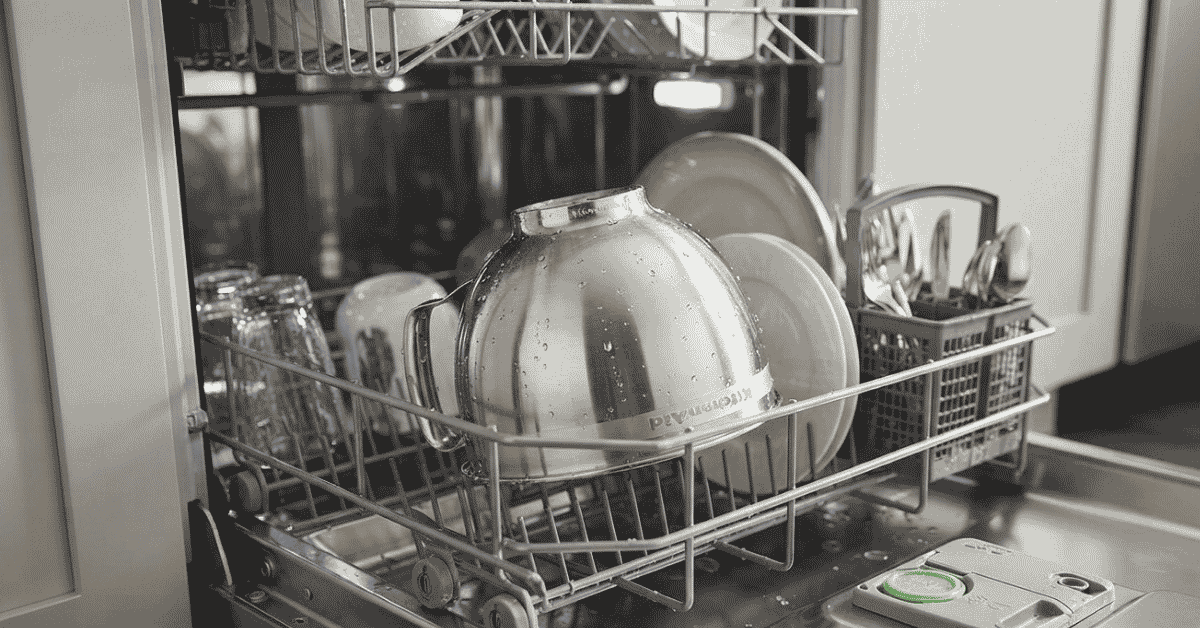
KitchenAid says its stainless steel mixer bowls are dishwasher safe. They can go on either the top or bottom rack. The brand’s stainless bowl guide also says to place the bowl upside down in the dishwasher.
That makes cleanup quite simple.
I like stainless bowls for this reason. They can take daily use without much fuss. They also do not tend to hold food smells.
My Simple Steel Bowl Routine
After baking, I scrape out any dough or batter first.
Then I place the bowl upside down in the dishwasher.
For baked-on food, KitchenAid suggests soaking the bowl in hot, soapy water for about 15 to 20 minutes before washing.
I find that step much easier than hard scrubbing.
A short soak can loosen dry dough. It also keeps me from using rough tools that may mark the surface.
Glass KitchenAid Bowls
Glass KitchenAid bowls are also dishwasher safe.
KitchenAid’s current guide says its glass bowls can go into the dishwasher. A specific glass bowl guide says the bowl and thread ring are dishwasher safe on the top rack only.
That rack rule is worth noting.
Glass bowls can be strong, but I still prefer the top rack when the model calls for it.
I would also check the parts that come with the bowl.
Some glass bowl lids have their own care rules. For example, KitchenAid says the lid on one current glass bowl model is dishwasher safe on the top rack only.
One Glass Bowl Tip I Use
I would not move a very cold glass bowl straight into a hot setting.
KitchenAid advises letting a chilled glass bowl come back to room temperature before adding hot ingredients or using it in a microwave.
That is less about the dishwasher and more about good glass care.
Still, it is an easy habit to keep.
Ceramic KitchenAid Bowls
Ceramic bowls are dishwasher safe too.
KitchenAid says all of its ceramic stand mixer bowls are dishwasher safe. The brand also says they can go on either the top or bottom rack.
That is great news if you like the look of ceramic.
I do think ceramic needs a bit more care in daily use.
A steel bowl can take a few knocks.
A ceramic bowl deserves more care around chips and cracks.
KitchenAid suggests checking ceramic bowls from time to time. If you find a crack or chip, the bowl should be replaced.
What About Painted Designs?
This is where I would slow down.
KitchenAid says ceramic bowls with patterns or painted designs are better hand washed if you want to help preserve the design.
So, a bowl can be dishwasher safe while hand washing may still be the better choice.
That is an important difference.
Safe to wash does not always mean best for the finish.
The Copper Bowl Is the Big Exception
This is the part I would remember.
KitchenAid says all its stand mixer bowls are dishwasher safe except the hammered copper bowl included with the 2022 Design Series Blossom Tilt-Head Stand Mixer.
So, if your KitchenAid bowl is that copper model, I would not put it in the dishwasher.
Copper needs more careful care.
A dishwasher can change its look and finish.
This is why I would never rely only on the words “KitchenAid bowl.”
I would look at the material first.
What About Wooden KitchenAid Bowls?
Wood is another clear exception.
KitchenAid offers a walnut bowl, and its care guide says that bowl is not dishwasher safe. It should be hand washed and dried right after washing.
That makes sense to me.
Wood and hot dishwash cycles are not a good match.
The heat and water can affect wood over time.
KitchenAid also recommends food-grade mineral oil or walnut oil for long-term care of its walnut bowl.
So, I would keep a wood bowl far away from the dishwasher.
My Quick Dishwasher Comparison
Here is the simple chart I would use when cleaning a KitchenAid bowl.
| KitchenAid bowl type | Dishwasher safe? | Rack or care note | My choice |
|---|---|---|---|
| Stainless steel | Yes | Top or bottom rack | Dishwasher |
| Glass | Yes | Check model, often top rack | Dishwasher |
| Ceramic | Yes | Top or bottom rack | Dishwasher |
| Patterned ceramic | Yes | Hand wash helps protect design | Hand wash |
| Hammered copper | No | Hand wash | Hand wash |
| Walnut wood | No | Hand wash and dry at once | Hand wash |
KitchenAid’s current care guidance supports these main material rules.
The chart also shows why the material matters more than the brand name.
How I Load a KitchenAid Bowl
Once I know the bowl is dishwasher safe, I still load it with care.
I first scrape off large bits of food.
Then I rinse the bowl if the food is very thick or dry.
For a stainless bowl, I place it upside down. KitchenAid specifically recommends this position for dishwasher cleaning.
For a glass bowl, I use the top rack if the model guide says so.
I also make sure the bowl has enough space around it.
I would not wedge a large bowl between plates or pans.
A little space helps water reach the whole surface.
Should I Hand Wash Instead?
You can.
Dishwasher safe does not mean you must use the dishwasher.
Sometimes I hand wash a bowl because it is faster.
A small amount of cake batter may take less than a minute to clean with warm water and mild soap.
KitchenAid also recommends hand washing with warm water and mild detergent as an alternative for its bowls.
For a bowl with a special finish, I may choose hand washing every time.
That gives me more control.
It also feels better when I want to protect a bowl that looks more decorative than basic.
What I Avoid When Cleaning
Even a dishwasher-safe bowl can suffer from poor cleaning habits.
I avoid a few things.
- Do not use steel wool on ceramic.
- Do not use harsh abrasive cleaners.
- Do not force off baked food with a sharp tool.
- Do not put copper in the dishwasher.
- Do not put a walnut bowl in the dishwasher.
- Do not ignore chips or cracks in ceramic.
KitchenAid advises using a soft sponge or cloth and mild soap for hand washing ceramic bowls. It also says to avoid steel wool and harsh abrasives.
I would rather soak a stuck bowl than fight it with a rough scrub pad.
Dishwasher Safe Does Not Mean Mixer Safe
There is one more point I think gets missed.
The bowl may go in the dishwasher.
The mixer itself should not.
KitchenAid says to unplug the stand mixer before cleaning. The mixer body should be wiped with a soft, damp cloth. It should never be immersed in water.
That sounds basic, but it is worth saying.
I clean the bowl in the dishwasher.
I clean the mixer body by hand.
Keeping those jobs separate makes sense.
How I Care for a Bowl After Washing
Once the cycle ends, I check the bowl.
If it is still wet, I let it dry fully.
KitchenAid recommends drying bowls thoroughly before storage.
For stainless steel, this can help reduce water spots.
For ceramic, it keeps the bowl ready for the next use.
For glass, I like to check the rim and base for drops.
It takes only a few seconds.
That small habit also gives me a chance to spot damage.
My Best Rule for Any KitchenAid Bowl
If I forget every detail, I use one rule.
Check the material and the care guide.
Stainless steel is dishwasher safe.
Glass is dishwasher safe.
Ceramic is dishwasher safe.
Copper and walnut wood need hand washing.
Decorative finishes may also benefit from hand washing.
KitchenAid says care instructions can vary by product, so the guide that came with your bowl is the final check I would trust.
That approach keeps the answer simple without taking chances.
FAQs
Are KitchenAid stainless steel mixing bowls dishwasher safe?
Yes. KitchenAid says stainless bowls can go on the top or bottom rack. Learn more about bowl care.
Can I put a KitchenAid glass bowl in the dishwasher?
Yes. Many glass bowls are dishwasher safe, with some parts limited to the top rack. Learn more about glass care.
Are KitchenAid ceramic bowls safe in the dishwasher?
Yes. KitchenAid says ceramic bowls are dishwasher safe, but hand wash may protect painted designs. Learn more about ceramic care.
Can a KitchenAid copper bowl go in the dishwasher?
No. KitchenAid lists its hammered copper bowl as an exception. Hand wash it instead. Learn more about copper bowl care.
Can I wash a KitchenAid wooden bowl in the dishwasher?
No. The walnut bowl is not dishwasher safe. Hand wash it and dry it right away. Learn more about wood bowl care.
Final Takeaway
So, are KitchenAid mixing bowls dishwasher safe? Most are, and that makes cleanup much easier. Stainless steel, glass, and ceramic bowls can go in the dishwasher. Copper and walnut wood are the key exceptions. I still check the bowl guide before each new bowl goes into my machine. As the fading light hits my kitchen wall, I hear the soft sound of my keyboard. That small check now saves me from a much bigger cleanup later.