
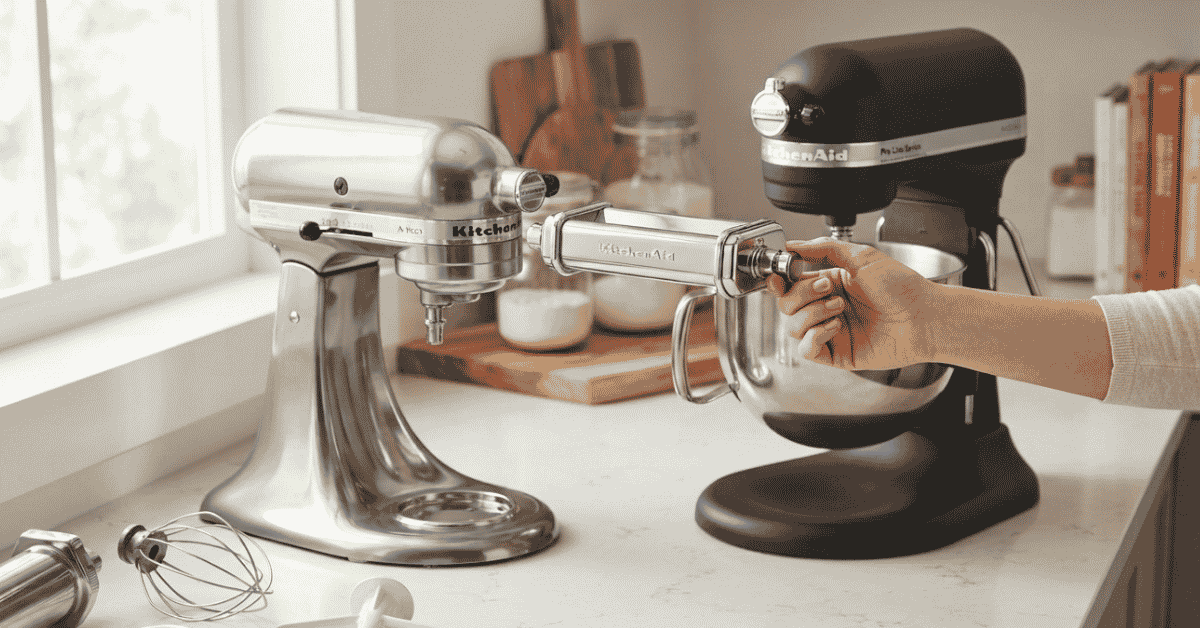
do kitchen aid attachments fit all mixers? I asked this before buying a pasta tool. I did not want a costly miss. The short answer is no. Many KitchenAid hub tools fit many KitchenAid models, but not every mixer. Brand, model, hub type, and tool all matter. I will show what I check now, so you can buy with less doubt.
The key point to know first
KitchenAid attachments use the power hub on a stand mixer. The hub sits at the front of the mixer head. A small drive shaft turns the tool.
Fit is not just about the hole. Some tools have model or bowl limits.
Brand and model both matter
A tool can look like it will fit. That does not mean it will work. KitchenAid hub tools are made for KitchenAid stand mixers. A rival brand may use a close-looking port with a different drive system.
I once saw a cheap tool that looked right. I did not trust the guess. Now I find the full mixer model first.
What the power hub does
The power hub is the small port at the front. It lets one mixer run many tools. The motor sends power through the hub.
The hub is not the whole story
The tool must lock in well. The shaft must turn with the hub. The mixer must also have enough room for the tool.
Before I buy, I check:
- Brand and full model code.
- Tilt-head or bowl-lift style.
- Tool fit list and model range.
- Hub and drive fit.
- Bowl size and tool clearance.
That takes less time than a return.
Do all KitchenAid mixers take every tool?
No. Many common hub tools fit a broad range of KitchenAid stand mixers. Still, each tool can have its own limits.
A pasta roller may fit many stand mixers. A bowl-based tool can have more limits. It may need a certain bowl size or shape.
Check the tool, not just the mixer
This is my safest rule. Check the tool’s fit list, not just the mixer name.
Pay more care when a tool sits in, over, or near the bowl. A tool can fit the hub yet still be wrong for the bowl.
What about other mixer brands?
This is where many buyers get tripped up. “Stand mixer” is a broad term. It does not mean each brand shares one hub or drive system.
A KitchenAid hub tool should not be called universal. Some third-party tools list many brands. That still does not prove that every model will fit.
Why third-party claims need care
I read the full fit list. I look for exact model names when given. I also check the return terms.
A low price is not a win if the tool will not lock in. A poor fit can also lead to poor use or damage.
Tilt-head versus bowl-lift mixers
This is one of my first checks. A tilt-head mixer has a head that tips back. A bowl-lift mixer uses a lever to raise the bowl.
Many KitchenAid hub tools work with both styles. Yet the space around the bowl can differ. That can matter for some tools.
Why bowl shape can matter
Some tools use only the front hub. Others sit in or over the bowl. If the bowl is too small, too large, or shaped in a new way, the tool may not work as planned.
I now check both the hub and bowl. That small habit saves me from guesswork.
My quick fit guide
| What to check | Why it matters | My safe move |
|---|---|---|
| Brand | Hub systems can differ | Match the listed brand |
| Model | Fit can vary | Use the full model code |
| Mixer style | Space can differ | Note tilt-head or bowl-lift |
| Hub | It powers the tool | Check hub fit |
| Bowl | Some tools use it | Match size and shape |
| Tool type | Each tool may differ | Read its fit list |
| Seller data | Claims can be vague | Check maker data first |
This simple rule catches most fit mistakes.
How I check before I buy
I start with the model code. It may be on the mixer or in its guide. If I cannot find it, I use the mixer record.
Next, I check the tool page or box. I want clear fit data. “Fits most mixers” is less useful than a full model list.
I also check the return policy
Even with good fit data, I like a safe return path. Product names can be close. Model codes can be easy to mix up.
If the seller gives no clear fit data, I pause. I would rather wait than force a tool into the hub.
Signs I never ignore
A tool should not need force. Watch for a loose lock, odd angle, blocked bowl, or missing model fit data. If any show up, I stop. I never force the tool to work.
Are KitchenAid attachments worth it?
For the right mixer, they can be handy. One mixer can handle more jobs without a new motor base.
I like it for pasta, slicing, and grinding. It can save shelf space. Still, value comes from a tool you will use.
My honest buying rule
I ask three things first:
- Does it fit my exact mixer?
- Will I use it often?
- Is it worth the cost and clean-up?
A tool can work well and still sit in a drawer.
FAQs
Do KitchenAid attachments fit all KitchenAid stand mixers?
No. Many fit a wide range, but some have model limits. Check your model and tool list first. Learn more about fit checks.
Will KitchenAid attachments fit other mixer brands?
Not by default. Hub shape and drive parts can differ by brand. Check the maker’s fit list first. Learn more about mixer hubs.
Do attachments fit tilt-head and bowl-lift mixers?
Many hub tools fit both, but bowl-based tools may differ. Check the exact model list. Learn more about mixer types.
How can I find my KitchenAid mixer model?
Look for the model code on the mixer or in its guide. Use that code when you check a tool. Learn more about model checks.
Can I force an attachment if it almost fits?
No. Never force a tool into the hub. A bad fit can harm the parts. Learn more about safe attachment use.
Final takeaway
I used to think a mixer hub made each tool a sure fit. Now I know better. The hub is just one part of the check. I look at the model, bowl, tool, and fit list each time. That brings peace of mind. As I type this, the sound of my keyboard fills the room. The light is fading by the window. I would rather spend one more minute checking than one more hour fixing a bad buy.