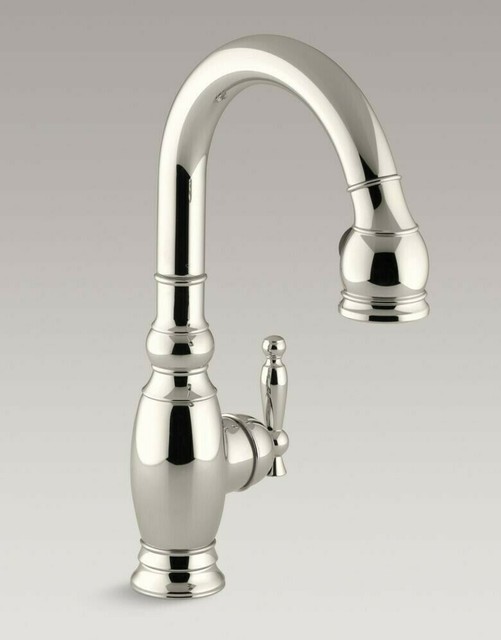
The Kohler Vinnata kitchen faucet is a traditional-style pull-down faucet with a high-arc spout, a single lever handle, and a two-function spray head. The K-690 model has a 16-5/8-inch overall height, a 9-1/2-inch spout reach, and a published maximum flow rate of 1.5 gallons per minute at 60 psi. Check the exact model, finish, installation space, and replacement-part availability before buying or repairing one.
In American kitchens, a faucet needs to do more than look good beside a sink. It must leave room for large pots, rinse food from dishes, and work with the sink and countertop already in place. The Kohler Vinnata kitchen faucet was designed around these everyday tasks, using a tall curved spout and a pull-down spray head.
The Vinnata line includes the K-690 main kitchen faucet and the K-691 secondary faucet, which has a shorter spout reach. Older product listings may show different finishes, flow figures, or model suffixes. This guide explains the documented features, key dimensions, installation checks, care steps, and common repair questions so you can make a sound choice without relying on an old listing alone.
The Kohler Vinnata kitchen faucet is a deck-mounted faucet designed for everyday kitchen use. Its traditional styling centers on a curved, high-arc spout and a single lever handle. A pull-down spray head lets the user direct water into different parts of the sink instead of relying only on the fixed outlet.
The K-690 is the main kitchen model covered by the current specification sheet. Kohler also identifies the K-691 as a secondary faucet with a shorter spout reach. These model numbers should not be treated as interchangeable when ordering a hose, spray head, or other service part.
The product’s published specifications are useful for planning a new installation or checking an existing faucet. They do not establish how well an older unit has been maintained or whether a used faucet will work without repairs. Condition, water quality, prior installation, and the availability of genuine service parts all affect the decision.
Source: storage.googleapis.com
High-arc design
The curved spout provides vertical clearance for filling many pots, pitchers, and tall containers.
Pull-down spray head
The spray head can be pulled into the sink to rinse dishes or reach areas away from the faucet outlet.
Single lever control
One handle controls water flow and temperature, reducing the need to adjust separate hot and cold knobs.
Traditional appearance
The curved shape and metal construction suit kitchens with traditional or transitional fixtures.
K-690 Versus K-691
The main difference between the K-690 and K-691 is the intended position and spout reach. Kohler’s product literature lists a 9-1/2-inch spout reach for the K-690 and a 7-1/2-inch reach for the K-691 secondary faucet. The documented overall heights are approximately 16-5/8 inches and 15-1/8 inches, respectively.
A shorter reach can suit a secondary sink or a compact work area. The main kitchen model may be more useful where the sink needs a longer reach. Compare the technical drawing with the actual sink before choosing between them.
Choose K-690
Consider this model when you need the longer reach and taller spout for the main kitchen sink.
Consider K-691
Check this model for a secondary sink or an installation where the shorter reach fits better.
Kohler Vinnata Kitchen Faucet Specifications and Dimensions
The K-690’s dimensions help determine whether it will fit the sink and leave enough room beneath nearby cabinets. Measure the space before buying, especially when replacing a faucet in an older kitchen where the sink, backsplash, and countertop holes may not follow a standard layout.
Kohler’s published K-690 specification lists a 16-5/8-inch overall height, a 10-inch spout height, and a 9-1/2-inch spout reach. The faucet has a 360-degree swivel spout and a maximum flow rate of 1.5 gallons per minute at 60 psi in the current specification. These are nominal product dimensions and stated operating specifications, not a guarantee of identical results in every plumbing system.
Source: productfrom.com
Overall height
Approximately 16-5/8 inches for the K-690.
Spout height
Approximately 10 inches, which helps estimate clearance for pots and containers.
Spout reach
Approximately 9-1/2 inches from the faucet mounting area to the outlet reference point shown in the specification drawing.
Spout rotation
The documented design allows the spout to swivel 360 degrees. Confirm that this movement will not direct water outside the sink.
Maximum flow rate
The current K-690 specification lists 1.5 gallons per minute at 60 psi.
Supply connection
The technical drawing identifies supply hoses with 3/8-inch compression fittings. Confirm that the home’s shutoff valves and fittings match.
Check Cabinet and Sink Clearance
Measure from the countertop to the lowest obstruction above the faucet. Include the bottom of a cabinet, shelf, window trim, or other feature that could interfere with the handle or spout. A tall faucet can fit through the countertop opening and still be awkward to use if the surrounding space is too tight.
Next, check where the water lands in the basin. A faucet with a long reach can work well in a wide sink, but the outlet should still direct water into the bowl rather than onto the rim or countertop. The spray head also needs room to pull down and return without catching on a divider or stored cleaning supplies.
Measure the deck
Record the thickness of the countertop or sink deck where the faucet will mount.
Measure the sink
Check basin width, depth, divider height, and the distance from the mounting hole to the bowl.
Check overhead space
Make sure the handle and spout have room to move without striking cabinets or shelves.
Why Published Flow Rates May Differ
Older Vinnata documents and retailer pages may list a maximum flow rate of 1.8 gallons per minute, while the newer K-690 specification lists 1.5 gallons per minute at 60 psi. A difference between documents does not prove that a particular faucet has been modified or is defective. Specifications can change by model revision, market, or configuration.
Use the current document for the exact model and finish you intend to buy. If you are troubleshooting an existing faucet, do not assume that a lower measured flow means the unit is faulty until you have checked the spray face, supply valves, hoses, and household water pressure.
Check the full model number
Read the label, original paperwork, or product record rather than relying on the Vinnata name alone.
Compare matching documents
Use a specification sheet that applies to the exact model and market.
Spray Settings and Everyday Use
The Vinnata’s pull-down spray head offers two documented water patterns: an aerated stream and a spray setting. The stream is suited to filling containers and ordinary washing. The spray setting can help rinse food from dishes or wash residue from the sides of the sink.
A button on the spray head controls the change between these patterns. The precise feel of the button can vary with age and condition, so a used faucet should be checked for smooth switching and a steady flow in both settings. If the spray head is stiff or the pattern looks uneven, inspect it before assuming that the internal valve has failed.
The high-arc spout gives room for larger items, while the pull-down hose brings the outlet closer to the work. That combination can make a busy sink easier to use, but it also adds moving parts that need to remain clean and free of snags.
Source: ipipeline.net
Aerated stream
Use this pattern for filling a pot, rinsing a cup, or running water into a container.
Spray pattern
Use the spray setting for rinsing food residue and reaching more of the sink basin.
Pull-down hose
Guide the spray head back into place rather than letting it snap against the faucet body.
Does the Faucet Remember the Temperature?
Yes. Kohler’s product documentation describes temperature memory, which allows the faucet to be turned off and back on at the temperature selected during the previous use. This can reduce repeated handle adjustment during ordinary kitchen tasks.
Temperature memory does not mean that the water temperature is fixed. The result can still be affected by changes in the home’s hot and cold water supply. Use care when turning on a faucet after plumbing work or a change in the water heater setting, and check the water before placing your hands under the stream.
Check the temperature
Test the water carefully when turning on the faucet, especially if children or people with limited temperature awareness use the sink.
Adjust the handle
Move the lever as needed to obtain a comfortable temperature rather than assuming the previous setting is always suitable.
Installation: What to Check Before You Start
The Kohler Vinnata K-690 is designed for single-hole or three-hole installation when fitted with the appropriate supplied mounting trim. That flexibility can help during a replacement, but it does not mean every sink cutout or countertop is suitable. Check the current installation guide and the dimensions of the actual mounting area before removing the old faucet.
The published drawing identifies a maximum deck thickness of 1-3/8 inches for the standard installation. A thicker deck may require a compatible manufacturer-approved solution. Do not force the threaded mounting parts into place or alter the faucet in a way that conflicts with the installation instructions.
The installation also needs accessible shutoff valves and compatible supply connections. If the valves are corroded, do not close fully, or begin leaking when operated, address that issue before fitting the new faucet. A plumber can help when the shutoff valves or supply pipes need repair.
Source: productfrom.com
Required checks
Confirm the model, mounting-hole arrangement, deck thickness, spout clearance, supply connections, and space below the sink.
Useful tools
Depending on the existing plumbing, you may need an adjustable wrench, basin wrench, screwdriver, bucket, cloths, and a flashlight.
Protect the work area
Clear the cabinet, place a bucket under the connections, and keep a towel nearby to catch residual water.
Basic Installation Sequence
Turn off both hot and cold water supplies before loosening any connection. Open the old faucet to relieve pressure, then disconnect the supply lines and remove the existing mounting hardware. Keep a bucket beneath the work area because water may remain in the hoses.
Follow the Vinnata installation guide to position the correct gasket, escutcheon, or mounting trim for the sink configuration. Place the faucet through the mounting opening, align the handle in the intended direction, and tighten the mounting hardware evenly. Do not overtighten parts or use an unapproved sealant where the instructions call for a gasket.
Connect the supply hoses to compatible shutoff valves without twisting or sharply bending them. Route the pull-down hose and counterweight as shown in the installation guide, keeping the hose clear of cabinet walls, drawers, and stored items. The hose must move freely through its full travel.
Turn the water supplies back on slowly and inspect each connection. Run the faucet in both spray settings and check for leaks under the sink. Pull the spray head down several times to make sure the hose moves and returns without catching.
Success sign
The faucet is firmly mounted, the handle moves as intended, both spray patterns work, the hose travels freely, and no water appears at the connections.
Stop if a connection leaks
Shut off the water and inspect the fitting and seal. Do not try to fix a leak by applying more force to an unsuitable connection.
Get help when needed
Use a licensed plumber when the shutoff valves fail, pipes are damaged, the deck needs modification, or the installation does not match the manufacturer’s instructions.
Common Kohler Vinnata Faucet Problems and Fixes
Start troubleshooting with the simplest checks. A low-flow faucet may have a clogged spray face or a partly closed supply valve, while a leaking handle may point to a different component. Replacing the whole faucet before identifying the symptom can waste money and leave the real problem unresolved.
Before removing a part, close the water supplies when the repair could open a pressurized water path. Protect the sink from dropped screws and small components, and keep track of the order in which parts are removed. Use the service instructions for the exact model rather than relying on a generic faucet diagram.
Source: ipipeline.net
Low water flow
Check that the hot and cold shutoff valves are fully open, inspect the spray face for mineral buildup, and look for a kinked or obstructed hose.
Uneven spray
Mineral deposits or debris at the spray outlets may cause an uneven pattern. Clean the face gently using a method approved for the faucet finish.
Handle feels loose
The handle or retaining hardware may need inspection. Use Kohler’s model-specific handle and bonnet instructions before attempting removal.
Water leaks under the sink
Inspect the supply connections, hose connections, and faucet mounting area to locate the source. Stop using the faucet if a leak cannot be contained.
Spray head will not retract
Check whether the pull-down hose catches on a pipe, cleaning bottle, drawer, or other item in the cabinet. Inspect the weight and hose routing if the obstruction is not external.
How to Address Low Water Flow
First, compare hot and cold flow. If only one side is weak, the issue may involve that supply valve or line rather than the spray head. If both sides are weak, inspect the shared outlet and hose path as well as the household water supply.
Turn off the faucet and follow the manufacturer’s care instructions to clean the spray face. Avoid sharp needles, hard picks, and abrasive tools that can damage the outlet surface. If the spray face is clear but flow remains poor, the hose, internal valve, or supply connection may need further diagnosis.
A faucet’s published maximum flow rate is measured under a stated pressure condition. Actual flow in a home can be lower because of water pressure, plumbing restrictions, or a partially blocked component. A bucket-and-timer check can give a rough estimate of delivered flow, but it does not identify the cause by itself.
Check one change at a time
Inspect the supply valves first, then the spray face, then the hose path. This helps avoid replacing parts that still work.
Compare hot and cold
A difference between the two can help narrow the problem to a supply-side restriction.
What to Do About a Leaking Handle or Base
Dry the faucet and the countertop, then run the water briefly while watching where the first drop appears. Water at a supply fitting suggests a different repair from water that emerges around the handle or faucet base. Water running down the spout may also be related to an internal valve or seal.
The Vinnata uses ceramic disc valve technology, but that does not mean every leak calls for a complete valve replacement. The exact cause depends on the symptom, model, and condition of the components. Use the service documentation or contact Kohler support before ordering a valve assembly.
If water continues to escape after the supply has been shut off, or if the leak reaches the cabinet floor, keep the area dry and arrange a suitable repair. A persistent leak can damage cabinetry and nearby materials.
Locate the first wet spot
Dry the area and observe carefully to distinguish a supply connection leak from a handle or body leak.
Avoid blind part replacement
Match the repair part to the full model number and the documented fault.
Why the Spray Head May Not Return
A pull-down spray head depends on a hose that can travel through the cabinet and a return arrangement that is free to move. Bottles, bins, drain pipes, or a hose loop pressed against a cabinet wall can interfere with that movement.
Clear the area beneath the sink and pull the spray head down gently to check the hose path. Do not yank the hose or add an improvised weight. If the hose is damaged, the weight is missing, or the return remains poor after the obstruction is removed, check the parts diagram for the exact model.
Clear the hose path
Move stored items away from the hose and any counterweight.
Check for damage
Look for kinks, fraying, leaks, or a damaged spray-head connection.
Kohler Vinnata Replacement Parts and Repair
The correct replacement part depends on the model and the part that has failed. Kohler’s Vinnata service documentation identifies components such as the pull-down hose, spray head, handle hardware, valve assembly, O-rings, adapters, and hose guide. Some parts also require a finish code when ordered.
The K-690 and K-691 do not use identical hose references in the cited service-parts information. For example, the documented hose references differ between the main and secondary models. This is a good reason to identify the full faucet model before ordering a replacement, even if the two faucets look similar.
A product listing that uses the word Vinnata is not enough to establish compatibility. Listings can combine old and current models, show a similar-looking finish, or omit a suffix that matters. Verify the part number with Kohler’s current parts information or support team before paying for it.
Source: productfrom.com
Spray head
Consider this part when the head is cracked, damaged, or cannot be restored by approved cleaning. Match the finish and connection.
Pull-down hose
Inspect the hose for leaks, damage, kinks, or poor movement. Check the exact model’s hose reference before ordering.
Valve assembly
This may be relevant to certain handle or water-control problems, but diagnose the cause before replacing the assembly.
Handle and bonnet hardware
Use the model-specific instructions when tightening, removing, or reinstalling these parts.
O-rings and seals
These small components can affect sealing, but the correct size, material, and placement must be confirmed.
How to Identify Your Exact Model
Start with the original purchase paperwork or installation records if they are available. Look for the model number and finish suffix, which can distinguish a polished chrome faucet from a brushed or bronze finish. If the paperwork is missing, ask Kohler support how to identify the unit from its appearance and any available product markings.
Photographs can help when contacting support. Take clear images of the faucet from the front and side, the handle, the spray head, and any visible markings. If the issue is under the sink, photograph the hose connections and routing without disconnecting anything under pressure.
Record the model
Write down the full model number, including any suffix, before searching for parts.
Record the finish
Match the finish code where the replacement part is visible.
Describe the symptom
Explain when the fault occurs, where water appears, and whether hot and cold flow behave differently.
Is It Worth Repairing an Older Vinnata Faucet?
Repair can make sense when the faucet body is sound, the problem is limited to a serviceable part, and the required component remains available at a reasonable cost. A worn spray head or damaged hose may be a more focused repair than replacing the whole faucet.
Replacement deserves consideration when the faucet body is cracked, corrosion affects important connections, several major components have failed, or compatible parts cannot be found. Compare the total repair cost with the cost of a suitable replacement, including any plumbing changes that a new faucet might require.
Do not assume that an older model has no support simply because a retailer no longer sells it. Ask Kohler about current parts availability and the warranty terms that apply to the original purchase. Availability can change, and an old listing is not proof that a part remains in stock.
Repair may suit
A faucet with a sound body, a clearly diagnosed fault, and an available compatible part.
Replacement may suit
A faucet with major damage, repeated failures, or repair costs that approach the cost of a new unit.
Cleaning and Maintaining the Vinnata Faucet
Routine care helps keep the faucet clean and makes early signs of wear easier to spot. Wipe the exterior with a soft, damp cloth and dry it to reduce water spots. Use a cleaner approved for the faucet’s finish rather than assuming that a product safe for one metal surface is suitable for every finish.
Mineral deposits can collect around the spray outlets, especially in homes with hard water. Clean the spray face according to Kohler’s instructions, and do not scrape the surface with a metal tool. Harsh cleaners, abrasive pads, and unapproved chemicals may damage the finish or the spray face.
Check the area below the sink from time to time. Look for damp cabinet flooring, water stains, loose items that obstruct the pull-down hose, or visible wear on the supply connections. Finding a small leak early can prevent a larger cabinet repair.
Source: storage.googleapis.com
Clean the finish gently
Use a soft cloth and a finish-compatible cleaner, following the manufacturer’s care instructions.
Keep the spray face clear
Remove mineral buildup with an approved cleaning method and avoid sharp or abrasive tools.
Inspect under the sink
Check for moisture, damaged hoses, and obstructions that affect spray-head movement.
Watch the handle
Address unusual stiffness or looseness before forcing the handle or removing its hardware.
Protect the Faucet Finish
The right cleaning method depends on the finish. A polished surface can show water spots, while a brushed finish may reveal scratches if it is scrubbed too hard. Bronze finishes may also need care that differs from chrome or stainless-style finishes.
Read the product care guidance for the exact finish before using vinegar, descaling products, bleach, or a strong multipurpose cleaner. Do not mix cleaning chemicals. If a product is not approved for the surface, use a soft cloth and water until you can confirm a suitable method.
Avoid abrasive pads
Scouring pads and rough powders can scratch or dull the surface.
Rinse and dry
Remove cleaner residue and dry the faucet with a soft cloth when the care instructions permit.
Finishes, Availability, and Buying Considerations
The Vinnata range has appeared in several finish options over its product history. Older listings include polished chrome, brushed finishes, and bronze finishes, but the range of finishes offered for sale today may be narrower. The presence of a finish in an old catalog does not confirm that a new faucet or matching replacement part is currently available.
Before buying a new, used, or open-box unit, compare the exact model number, finish, included mounting hardware, hose condition, and seller’s return terms. A low asking price may be less useful if the spray head, mounting parts, or supply hoses are missing and hard to replace.
If you are buying a used faucet, ask whether it was removed from a working installation and whether any leaks or control problems were known. Check for cracks, damaged threads, heavy corrosion, missing parts, and signs of makeshift repairs. A clean exterior cannot confirm the condition of internal seals or the valve.
Source: productfrom.com
New faucet
Confirm that the model is currently offered, the correct finish is in stock, and the seller provides clear warranty terms.
Used faucet
Check the actual condition, included components, return policy, and availability of compatible replacement parts.
Replacement spray head
Verify the connection and model compatibility instead of buying a head based only on appearance.
Matching secondary faucet
Compare the K-691 specifications and finish if you want a coordinated faucet for another sink.
Where to Verify Product Information
Kohler’s official product page and specification sheet are the best starting points for the K-690’s dimensions, functions, and published installation requirements. The manufacturer’s service documentation is more useful for repair work than a retailer listing that gives only a short description.
Retailer pages can help establish whether a particular seller lists a product, but they may contain old stock information or incomplete specifications. Check the date and model number of each document, especially when published flow rates or part references differ.
Product specifications
Use the official K-690 specification to confirm dimensions, mounting options, flow rate, and listed features.
Installation instructions
Follow the manufacturer’s steps for mounting, supply connections, hose routing, and leak checks.
Parts information
Confirm the replacement part against the exact model and finish before ordering.
Frequently Asked Questions
Q
Is the Kohler Vinnata kitchen faucet still available?
Availability depends on the model, finish, and seller. Some retailer listings for older Vinnata versions show discontinued or unavailable stock, while Kohler’s product information continues to provide documentation for the K-690 line. Check the official product page and current retailer listings before assuming that a specific finish can be purchased new.
Q
What is the difference between the Kohler K-690 and K-691?
The K-690 is the main kitchen faucet, with a documented 9-1/2-inch spout reach and a 16-5/8-inch overall height. The K-691 is a shorter secondary faucet, with a 7-1/2-inch spout reach and a 15-1/8-inch overall height. Check the exact model when buying parts because some components differ.
Q
Does the Kohler Vinnata have a pull-down sprayer?
Yes. The K-690 uses a pull-down spray head with two water patterns: an aerated stream and a spray setting. The spray head can be pulled into the sink to direct water where it is needed. Keep the hose path clear so the head can move and return properly.
Q
What is the flow rate of the Kohler Vinnata K-690?
The current published K-690 specification lists a maximum flow rate of 1.5 gallons per minute at 60 psi. Older documents may show a different maximum, including 1.8 gallons per minute. Check the specification that matches the exact model and revision rather than applying an older figure to every Vinnata faucet.
Q
Can I install the Kohler Vinnata on a three-hole sink?
The K-690 is documented for single-hole or three-hole installation with the appropriate included mounting trim. Confirm the hole spacing, deck thickness, mounting hardware, and sink layout before starting. Follow the current installation guide, and seek plumbing help if the existing holes or connections do not match.
Q
Why is my Kohler Vinnata faucet losing water pressure?
Possible causes include partly closed shutoff valves, mineral buildup on the spray face, a kinked hose, a restricted supply line, or an internal component problem. Compare hot and cold flow first, then inspect the simplest accessible causes. If the problem remains, use the model-specific service instructions or contact Kohler support before replacing parts.
Q
How do I find the right Kohler Vinnata replacement hose?
Identify the complete model number and finish, then check Kohler’s current parts information or contact customer support. The K-690 and K-691 have different hose references in the service documentation, so do not assume that a hose for one model fits the other. Confirm the connection and part number before ordering.
Q
How should I clean the Vinnata spray head?
Follow Kohler’s care instructions for the exact faucet finish and spray head. Use a gentle cleaning method approved by the manufacturer, and avoid sharp tools, abrasive pads, or unapproved chemicals. If cleaning does not restore the spray pattern, check the supply and hose before deciding that the spray head needs replacement.
✦ Wrapping Up
Conclusion
The Kohler Vinnata kitchen faucet combines a traditional high-arc design with a pull-down spray head, a single lever, and a swivel spout. The K-690 offers a documented 16-5/8-inch overall height and 9-1/2-inch reach, while the K-691 has a shorter reach for secondary sink use. Those dimensions and the choice of spray patterns are useful starting points when comparing the faucet with your kitchen layout.
The most important step is to confirm the exact model before buying or repairing one. Check the current specification, measure the sink and countertop, and verify the part number if a hose, spray head, or valve needs replacement. For an older unit, compare the repair cost and parts availability with the cost of a suitable new faucet.
💡 Key Takeaway
Before ordering a Kohler Vinnata faucet or replacement part, record the full model number, measure the mounting area, confirm the finish and connection type, and check the latest Kohler specification and service information.