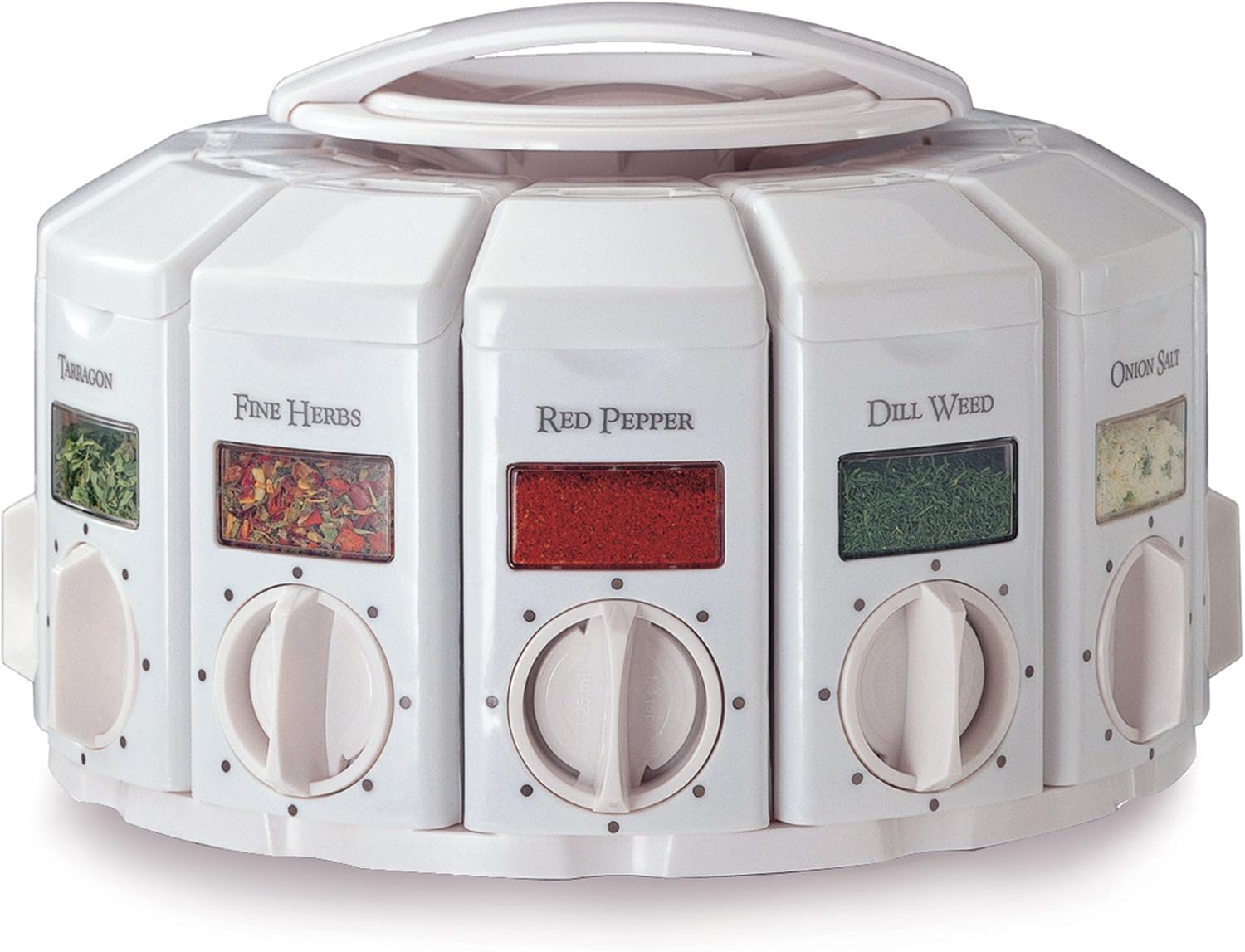
The KitchenArt Select-A-Spice Auto-Measure Carousel is a rotating spice rack with 12 removable canisters. Its dial releases spices in 1/4-teaspoon increments, while its shaker and pour openings give you other ways to season food. It suits home cooks who want easy access to common spices and less clutter in a kitchen cabinet.
In American kitchens, a busy weeknight meal can call for garlic powder, paprika, cumin, and several other seasonings. Finding each jar in a crowded cabinet takes time. Small spice bottles can also tip over, hide behind one another, or leave loose powder on the shelf.
The KitchenArt Select a Spice Auto Measure Carousel offers a different way to store these seasonings. Model 57010 is the professional Series version with a satin finish, 12 removable canisters, and an auto-measure dial. The maker lists a 4.5-ounce capacity for each canister and includes 55 spice labels. Spices are sold separately.
The key feature is its measuring system. Each click is designed to release 1/4 teaspoon of spice, so two clicks equal 1/2 teaspoon and four clicks equal 1 teaspoon. This can save time during cooking, but it does not mean every spice has the same weight or that every loose fill will be perfect.
This guide explains how the carousel works, how to fill and use it, what to check before buying, and how to care for it. The details focus on documented product features rather than claims from hands-on testing. The exact dimensions, finish, and mounting parts can vary across KitchenArt versions, so check the model number before purchase.
Source: i.pinimg.com
What Is the KitchenArt Select-A-Spice Auto-Measure Carousel?
The KitchenArt Select-A-Spice Auto-Measure Carousel is a spice storage and dispensing system. Instead of placing loose spice jars in a row, it holds several canisters on a rotating base. You turn the base to reach the spice you need, then use the canister’s dispensing feature.
The Professional Series model 57010 is listed with 12 removable canisters, a satin finish, and a measuring dial. Its design combines storage with portion control. The product catalog also describes an option to mount the unit under a cabinet or stack units for more storage.
KitchenArt has sold several versions of its Select-A-Spice range. Some have different colors, shapes, or mounting parts. A listing that says Select-A-Spice does not always refer to the same model, so the model number matters when you compare product details.
Source: m.media-amazon.com
Rotating base
The base turns so you can reach the canisters without moving a row of separate jars.
Removable canisters
Each canister can be taken out for filling, spice changes, or cleaning when needed.
Auto-measure dial
The dial dispenses spice in stated 1/4-teaspoon increments, reducing the need to reach for a measuring spoon for every small amount.
What Does the Professional Series Model 57010 Include?
The product information for model 57010 lists 12 canisters, a rotating base, 55 spice labels, and a satin finish. Each canister is rated to hold 4.5 ounces of spice. The unit is sold without spices, so you need to fill it with your own seasonings.
The maker also lists under-cabinet mounting and stacking as storage options. Do not assume every package contains the same mounting hardware or that all versions stack in the same way. Check the exact package contents and instructions before you drill holes or buy a second unit.
Model number
Look for 57010 when you want the satin Professional Series model described in this guide.
Spice capacity
The listed 4.5-ounce capacity applies to each canister. The number of ounces a spice occupies by volume can vary with its form and density.
How Does the Auto-Measure Spice Dispenser Work?
The auto-measure dial is the main feature that sets this carousel apart from a basic spice rack. Each click is designed to dispense 1/4 teaspoon of spice. You turn the dial over a bowl, pan, or measuring spoon to release the amount you need.
The idea is simple. Rather than scooping spice from a jar with a separate spoon, you use the built-in dial. This can be handy when a recipe calls for small, repeated amounts of seasoning.
The stated measure refers to volume, not weight. A teaspoon of fine garlic powder does not weigh the same as a teaspoon of coarse dried herbs. The amount released can also depend on the spice’s texture, how it settles, and whether the measuring chambers are filled as intended.
Source: i.pinimg.com
One click
The designed amount is 1/4 teaspoon.
Two clicks
The combined amount is 1/2 teaspoon.
Three clicks
The combined amount is 3/4 teaspoon.
Four clicks
The combined amount is 1 teaspoon.
How to Use the Dial for a Recipe
Start by checking the amount in your recipe. If it calls for 1/2 teaspoon, use two clicks. If it calls for 3/4 teaspoon, use three clicks. For 1 teaspoon, use four clicks, assuming the spice flows freely and the dispenser is working as intended.
Gently shake the canister as directed by the product instructions so the measuring chambers can fill. Hold the dispenser over the target dish, then turn the dial. Use a separate measuring spoon when a recipe calls for an amount that does not fit the click pattern or when you need to verify a precise quantity.
For a new spice or a recently cleaned canister, check the first few releases over a small bowl. If the amount seems uneven, stop and inspect the fill level, spice texture, and mechanism rather than adding more clicks blindly.
Read the recipe first
Work out the needed amount before turning the dial, especially when making a dish with a strong spice such as cayenne or ground cloves.
Watch the release
Make sure the spice comes out of the intended opening and does not collect around the dial.
Check unusual results
If a click releases little or no spice, inspect for a low fill level, moisture, or a blockage.
How to Fill the KitchenArt Spice Carousel
Fill the carousel with dry, free-flowing spices and herbs that suit the dispenser. Begin with clean, fully dry canisters. Moisture can cause powder to stick together, and clumps may stop the measuring parts from working as intended.
Before filling, decide which seasonings you use most often. Common choices in many American homes include black pepper, paprika, garlic powder, onion powder, cumin, oregano, cinnamon, and chili powder. Your best mix will depend on the food you cook, not on the number of labels in the box.
The model’s 4.5-ounce capacity is a stated capacity, not a promise that every standard retail jar will fit. Spice jars differ in size, and the amount that fits depends on the spice itself. Add spice carefully rather than forcing a full container into a small opening.
Source: i.pinimg.com
Prepare the canisters
Remove the canisters as directed. Make sure they are clean and completely dry before adding any spice.
Choose the right spices
Use dry seasonings that flow through the dispenser. Avoid damp blends and spices that form hard clumps.
Fill with care
Open the fill area and add spice without packing it down. Follow the instructions for the exact model.
Close each canister
Check that the lid and any seal panel sit in place before returning the canister to the base.
Test before cooking
Dispense a small amount into a bowl to check that the spice flows and the dial moves as expected.
Which Spices Work Best?
Dry, fine or moderately coarse seasonings are the most practical starting point, provided the product instructions allow them. Ground cinnamon, paprika, cumin, and garlic powder are common choices. Dried herbs may also work, but large leaves can behave differently from fine powders.
Do not assume that every spice or seasoning blend is suitable. Damp salt mixtures, sticky blends, very large flakes, and products that cake easily may not flow well. Check the instructions for any named exclusions, and do not force a spice through a blocked opening.
Good starting choices
Consider dry ground spices and finely cut dried herbs that flow freely.
Use care with coarse herbs
Large pieces may not move through the measuring parts as smoothly as fine powder.
Avoid damp contents
Moisture can lead to clumps and residue, making the dial harder to use.
How to Label the Canisters
The model 57010 includes 55 labels, giving you options for common seasonings. Place the label where you can read it while turning the carousel. Clean and dry the label surface first so the adhesive can make contact.
Use a label that matches the contents, not just the recipe you plan to make. If you refill a canister with a different spice, remove or replace the old label. This simple habit helps prevent mix-ups, especially when two powders have a similar color.
Label by spice name
Use clear names such as cumin, paprika, or oregano rather than a vague label such as seasoning.
Update after refills
Change the label when the contents change, and never rely on color alone to identify a spice.
Countertop, Cabinet, or Stacked Storage?
The carousel can be used as a countertop organizer, while product information for the Professional Series also describes under-cabinet mounting and stacking options. The best setup depends on your available space, how often you cook, and whether you want the spices within reach or out of sight.
A countertop location keeps the carousel easy to reach. It also takes up room near the stove or prep area, where space may already be tight. Choose a stable, dry spot away from direct heat, splashes, and steam.
Under-cabinet mounting can free up counter space, but it requires suitable clearance and secure attachment. Do not mount the unit over a hot cooking surface or where it could interfere with cabinet doors. Follow the instructions for the exact mounting hardware and cabinet type.
Stacking can add more storage, but check the version’s stated stacking limits and the way its base locks into place. Do not assume every Select-A-Spice model supports the same number of units or canisters.
Source: as-assets.marknetalliance.com
Countertop setup
Best when you want easy access and have a stable area with enough room to turn the carousel.
Under-cabinet setup
Useful when counter space is limited, provided the mounting surface and hardware are suitable.
Stacked setup
Can expand storage when the exact model supports stacking and the units remain secure.
Measure the Space Before Buying
Check the product dimensions for the model and finish you plan to buy. Listings for different versions may show different measurements, so do not rely on a photo or a dimension copied from another model.
For a countertop setup, leave enough room to rotate the base and remove a canister without hitting a wall or another appliance. For cabinet mounting, also check the space below the unit and the swing of nearby cabinet doors.
If you plan to stack units, confirm the instructions and storage limits first. A taller setup needs enough vertical room, and you should be able to reach the upper canisters without stretching over a hot pan.
Check width and depth
Measure the shelf or counter area and leave room to turn the base.
Check vertical clearance
Allow space to remove lids or canisters and to reach the dial with ease.
Confirm mounting parts
Review the package list before drilling or buying extra hardware.
Cleaning and Caring for the Spice Carousel
Regular care helps keep the canisters clean and the dispensing parts free of old spice. Start by removing the canister from the base according to the product instructions. Empty any remaining spice into a clean container only if it is still dry, fresh, and safe to keep.
Clean the parts using the method allowed by the manufacturer. Do not assume that the full carousel, dial, or base is dishwasher-safe. Avoid soaking parts that contain the measuring mechanism unless the instructions say this is safe.
Dry all washed parts fully before adding spices. Even a small amount of water can make powder stick to the walls or form clumps. Leave the fill area open during drying when the instructions call for it, and check that no moisture remains around the dial.
Source: i.pinimg.com
Empty before cleaning
Keep spices away from water and cleaning products. Do not mix old residue with a fresh refill.
Use a gentle method
Follow the model instructions and use a soft cloth or brush where suitable.
Dry every part
Wait until the canister and dispensing parts are fully dry before refilling.
Check for residue
Look for stuck powder near the fill area, dial, and outlet before returning the canister to use.
What to Do When the Dial Gets Stuck
A dial that will not turn may be blocked by packed spice, moisture, or a canister that is not seated correctly. Stop rather than forcing it. Extra pressure can damage the mechanism or the plastic parts.
Remove the canister as directed and check for clumps or residue. If the contents are damp or badly caked, discard them rather than trying to push them through. Clean and dry the parts according to the instructions, then reassemble and test with a small amount of dry spice.
If the dial still sticks after a careful clean, inspect the unit for cracks, warped parts, or a damaged locking tab. Contact the seller or manufacturer if replacement parts or support are available. Do not use a damaged unit that releases spice unpredictably.
Symptom: No spice comes out
Check the fill level, the outlet, and whether the measuring chamber can fill.
Symptom: The dial feels stiff
Look for caked powder, moisture, or a canister that is not fitted in the right position.
Symptom: Spice spills around the lid
Check the lid and seal panel, and make sure the canister is closed as directed.
Advantages and Limitations to Consider
The biggest benefit of the KitchenArt carousel is that it combines several spice containers in one rotating unit. It can make common seasonings easier to find and reduce the need to move loose jars around a crowded shelf. The built-in measure is another useful feature for recipes that call for small amounts.
Still, the design will not suit every kitchen. It takes up a set amount of space, and the 12-canister model cannot hold every spice in a large collection. The dial also works in stated 1/4-teaspoon increments, which may not match every recipe or every spice texture.
The unit is best viewed as a storage and dispensing aid, not a replacement for all measuring tools. You may still need measuring spoons for small fractions, larger quantities, baking tasks that call for exact amounts, or recipes that measure spices by weight.
Source: media.karousell.com
Advantage: Easy access
A rotating base brings the canisters into reach without the need to search through a deep cabinet.
Advantage: Built-in portioning
The 1/4-teaspoon increments can speed up routine seasoning when the recipe amount matches the dial.
Advantage: Removable storage
Individual canisters can be removed for filling and care, rather than handling the whole unit each time.
Limitation: Fixed number of slots
The Professional Series 57010 has 12 canisters, so a larger collection may need separate storage.
Limitation: Spice flow varies
Coarse, damp, or clumped seasonings may not dispense as smoothly as dry, free-flowing powder.
Limitation: Model differences
Finish, dimensions, stacking capacity, and included hardware should be checked for the exact version.
Is It Better Than a Basic Spice Rack?
A basic spice rack is often the simpler choice when you mainly want to see labels and grab a jar. It may also suit cooks who use many large spice containers or prefer to measure every ingredient with a separate spoon.
The KitchenArt carousel may be more useful when you want a compact group of frequently used spices and like the idea of dispensing small amounts with a dial. Its value depends on whether you will use that feature often enough to justify the space and care it needs.
Neither design is automatically better for every kitchen. Compare capacity, access, cleaning, and the way you cook rather than choosing only by appearance.
Choose a basic rack
Consider it when visibility, simple refills, or a wide range of jar sizes matters most.
Choose an auto-measure carousel
Consider it when you often use small measured amounts and want several seasonings in one rotating holder.
What to Check Before Buying a KitchenArt Carousel
Before buying, confirm the model number, the condition of the canisters, and the parts included in the box. A new product may be sold without spices, while a used unit may have missing labels, damaged lids, or a base that no longer turns smoothly.
Product pages may show different dimensions or colors because they cover different versions. Check the maker’s information and the seller’s actual item rather than relying on a title alone. If the listing does not state the model number, ask for it before placing an order.
Prices and availability can change across retailers and regions. Compare the total cost, shipping, return terms, and whether the unit is new or used. A low listed price is less useful if key canisters or mounting parts are missing.
Source: i.pinimg.com
Confirm the model
For the satin Professional Series version in this guide, look for model 57010.
Inspect the canisters
Check for cracks, broken tabs, missing lids, and signs of spice residue or moisture damage.
Check the rotating base
Make sure the carousel turns without unusual resistance and that the canisters fit securely.
Review the package contents
Confirm the included labels and mounting parts, and remember that spices are not included.
Read return terms
Check the seller’s return policy, especially for a used or open-box unit.
Should You Buy a Used Unit?
A used carousel may be worth considering if the parts are complete and the price reflects its condition. Ask for clear photos of the base, canisters, lids, and dial. A photo of the outside alone cannot show whether the measuring parts still work.
If you can inspect the item in person, turn the base and test the dial without forcing it. Look for deep cracks, sticky residue, and signs of water damage. Wash and dry the parts as directed before adding fresh spices.
Skip a unit with a cracked canister, a broken locking tab, or a dial that will not move. Replacement parts may not be easy to find, so do not assume a damaged unit will be simple or cheap to repair.
Worth a closer look
A complete unit with intact canisters, a smooth-turning base, and a working dial.
Use caution
An open-box unit with uncertain contents or no clear return option.
Avoid
A unit with cracks, broken parts, persistent moisture damage, or an unreliable measuring mechanism.
Frequently Asked Questions
Q
How much spice does one click dispense?
The KitchenArt Select-A-Spice Auto-Measure Carousel is designed to dispense 1/4 teaspoon with each click. Two clicks equal 1/2 teaspoon, three equal 3/4 teaspoon, and four equal 1 teaspoon. Actual flow can be affected by spice texture, clumping, and correct use of the dispenser.
Q
How many spices can the KitchenArt 57010 hold?
The Professional Series model 57010 has 12 removable canisters on a rotating base. The product catalog lists a capacity of 4.5 ounces per canister and includes 55 labels. The unit is sold without spices.
Q
Can the KitchenArt Select-A-Spice Carousel be mounted under a cabinet?
Product information for the Professional Series describes under-cabinet mounting as an option. Check the instructions and included hardware for your exact model before installation. Make sure the unit is secure, has enough clearance, and is not placed where heat or steam can affect the spices.
Q
Can I use any type of spice in the carousel?
Use dry spices that flow freely and follow the manufacturer’s guidance for suitable contents. Damp or clumped powders and large pieces of dried herb may not dispense well. Do not force a blocked spice through the dial, and use a separate measuring spoon when the ingredient does not flow as intended.
Q
How do I clean the KitchenArt Auto-Measure Carousel?
Remove the canisters as directed and clean the parts using the method allowed by the manufacturer. Do not assume the dial or full unit is dishwasher-safe. Dry all parts completely before refilling, since moisture can make spice powder clump or stick.
Q
Does the carousel replace measuring spoons?
Not in every case. The dial is designed for 1/4-teaspoon increments, which can help with many everyday recipes. Measuring spoons remain useful for amounts outside those increments, for checking a dose, and for recipes that require more exact control.
Q
Is model 57010 the same as every KitchenArt Select-A-Spice rack?
No. KitchenArt has offered several versions with different finishes, dimensions, and storage arrangements. Check the model number and package details before buying, especially if you need a particular color, mounting option, or stacking setup.
✦ Wrapping Up
Conclusion
The KitchenArt Select a Spice Auto Measure Carousel brings 12 spice canisters together on a rotating base and adds a dial designed to release 1/4 teaspoon per click. For home cooks who use a small group of seasonings each week, this can make spice storage tidier and portioning more convenient.
The Professional Series model 57010 has a stated capacity of 4.5 ounces per canister and comes with 55 labels. It also offers documented options for under-cabinet mounting and stacking, though the exact parts and limits should be checked for the unit you buy.
The main trade-offs are space, care, and spice flow. The dial does not replace every measuring spoon, and damp or clumped contents may cause problems. A basic rack may be more suitable if you prefer full-size jars or need room for a large spice collection.
💡 Key Takeaway
Before buying, confirm that the unit is model 57010, measure the space where you plan to keep it, and check the canisters, dial, labels, and mounting parts. Once it is set up, fill it with dry spices you use often, label each canister clearly, and test the dial before using it in a recipe.