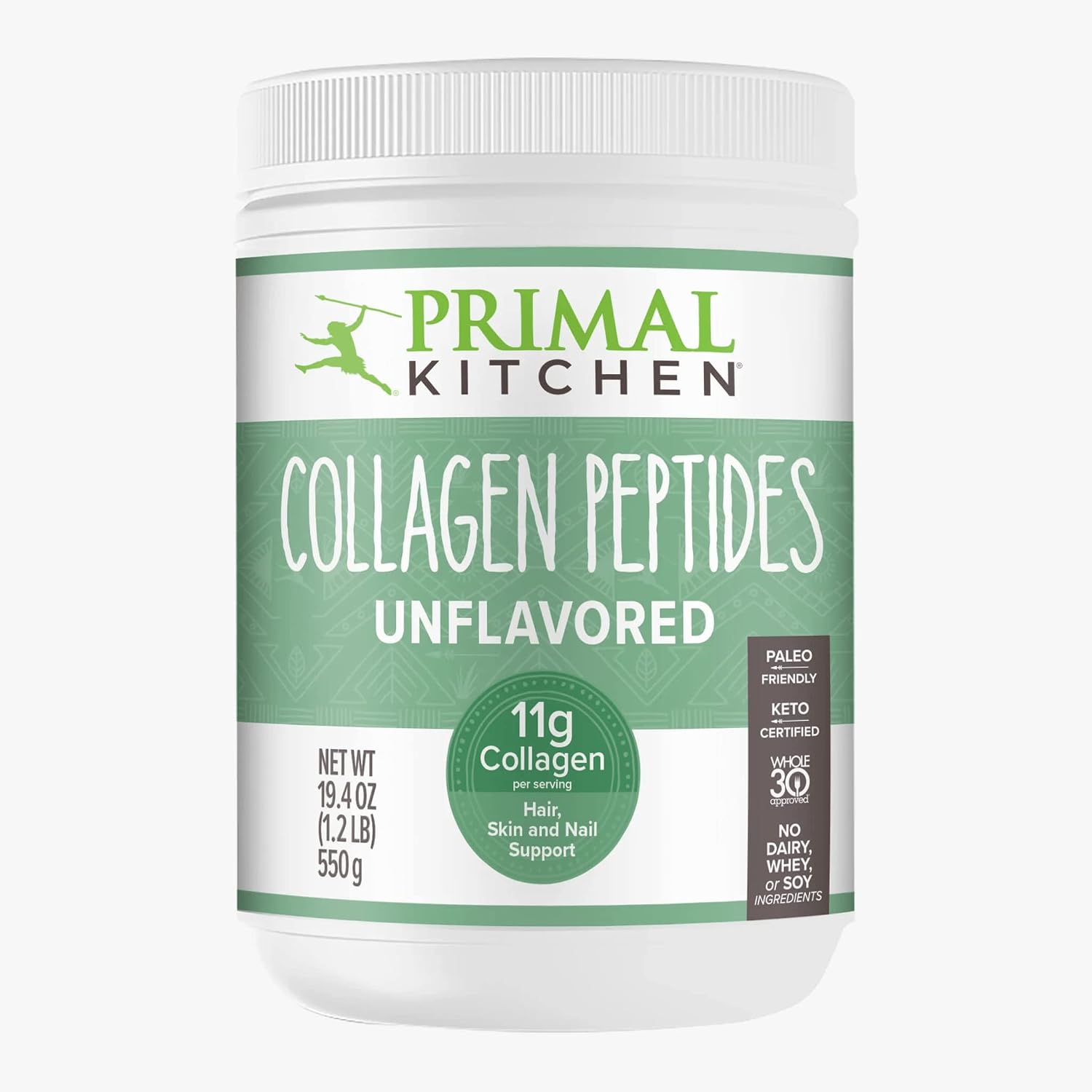
Publicly available information does not establish the exact current levels of heavy metals in Primal Kitchen collagen Peptides. The brand’s product page identifies bovine collagen peptides as the ingredient, but a current, product-specific laboratory report with numerical results is needed to confirm the levels of lead, cadmium, arsenic, and mercury.
Across the United States, collagen powders have become a common addition to coffee, smoothies, and breakfast drinks. Many people use them to add protein to their daily routine or to support skin, hair, nails, and joints. Yet a simple ingredient list cannot tell you whether a powder contains unwanted traces of heavy metals.
Primal Kitchen sells an unflavored collagen peptide powder made from bovine collagen. Its official product page lists bovine collagen peptides as the ingredient and describes a serving as providing 11 grams of collagen. These details help identify the product, but they do not show how much lead or other toxic elements a tested batch contains.
This guide separates known product information from claims that still need proof. It explains what heavy metals are, which laboratory results matter, how to ask Primal Kitchen for a report, and what to do if you cannot obtain one. The goal is to help US shoppers make a careful choice without assuming that the product is either contaminated or completely free of contaminants.
Research limitation: No current, publicly accessible, batch-specific certificate of analysis with numerical heavy-metal results was established for the exact unflavored product during this review. That is a limit on the available evidence, not proof that the brand does not test its products or that the powder contains unsafe levels.
Source: amazon.com
What Do We Know About Primal Kitchen Collagen Heavy Metals?
The most accurate answer is that the available public product information does not provide enough numerical data to confirm the current heavy-metal levels in Primal Kitchen Collagen Peptides. The official product page identifies the unflavored formula as bovine collagen peptides. It does not, in the product details reviewed for this article, provide a batch-specific table showing measured lead, cadmium, arsenic, and mercury concentrations.
That distinction matters. A missing public report does not prove that a product failed a laboratory test. It also does not prove that the product passed one. Without a suitable report, a shopper cannot independently verify the result for a particular batch.
Some online articles discuss testing practices for collagen brands, including Primal Kitchen. Such reports may offer useful leads, but their claims need to be checked against the original laboratory data, the exact formula tested, and the date of testing. A statement about one flavor or an older batch cannot automatically establish the current status of every product sold under the brand.
Source: amazon.com
What is documented
The official product listing identifies the unflavored powder as bovine collagen peptides and describes 11 grams of collagen per serving.
What remains unconfirmed
The exact current concentrations of lead, cadmium, arsenic, and mercury in a specific retail batch have not been established from a publicly available numerical report in this review.
What the evidence does not support
It would be inaccurate to declare the product contaminated, completely metal-free, or proven safe based only on the ingredient list or the absence of a public report.
Does Primal Kitchen Test Its Collagen for Heavy Metals?
The useful question is not simply whether a brand says it tests its products. Ask which product is tested, which elements the laboratory measures, how often testing occurs, and whether the results are available for review. Those details help distinguish a broad quality statement from evidence about the powder you plan to use.
A manufacturer may conduct internal quality checks, hire an outside laboratory, test incoming ingredients, or test finished products. Each approach can provide useful information, but the scope differs. Testing a raw ingredient does not necessarily establish the concentration in every finished batch, and testing one batch does not guarantee identical results in all later batches.
Ask for a certificate of analysis
Request a recent certificate of analysis, often called a COA, for the exact unflavored product and, if possible, the lot number on your container.
Ask who performed the test
Find out whether the laboratory was independent, whether it was accredited for the relevant method, and whether the report covers the finished product.
Which Heavy Metals Matter in Collagen Powder?
Four elements deserve particular attention when reviewing collagen and other dietary supplements: lead, cadmium, arsenic, and mercury. They can enter the food chain through soil, water, animal feed, raw materials, or processing. The risk depends on the element, its chemical form, the amount present, and how much a person consumes over time.
These elements are not all alike. Arsenic, for example, occurs in different chemical forms, and inorganic arsenic is generally the form of greatest concern in food safety assessments. A report that simply says total arsenic may not answer every question about the amount of inorganic arsenic present.
The term heavy metals is widely used in consumer health discussions, but a laboratory report may use the more precise term toxic elements. A good report identifies the substance measured and the analytical method. That makes the results easier to interpret and compare with a relevant safety limit.
Source: amazon.com
Lead
Lead can harm the nervous system and other organs. Exposure is especially concerning during pregnancy and childhood. Public health agencies aim to reduce exposure because no level of lead exposure is known to be completely risk-free.
Cadmium
Long-term exposure can harm the kidneys and bones. Diet is a common source of exposure, so repeated intake from several foods or supplements may add to a person’s total exposure.
Arsenic
The health effects depend in part on the chemical form. Inorganic arsenic is a concern with ongoing exposure, which is why the form tested may matter when interpreting results.
Mercury
Mercury occurs in different forms with different effects. Some forms can harm the brain and nervous system, and the source of the material affects which type of mercury is most relevant.
Can Collagen Peptides Contain Heavy Metals?
Yes, trace contaminants are possible in many food ingredients, including ingredients used to make protein powders. The possibility of contamination does not mean that every collagen product contains concerning amounts. It means that sourcing controls and suitable laboratory testing are useful parts of quality assurance.
Animal-derived collagen starts with biological material. The animal’s environment and the handling of raw materials can affect contaminant exposure, while processing and quality controls may affect the final ingredient. A label that says bovine, grass-fed, or pasture-raised does not, by itself, show the measured heavy-metal content.
Source is not a test result
Claims about animal feed or farming conditions may help describe sourcing, but they cannot replace analytical testing of the finished product.
Low levels still need context
A measured trace amount must be assessed against the serving size, frequency of use, applicable guidance, and the method’s reporting limit.
How to Read a Collagen Heavy-Metal Lab Report
A laboratory report is most useful when it gives numerical results, units, detection limits, the sample identity, and the testing method. The words passed or tested are not enough to judge the result unless the report also identifies the standard or limit used.
Start by checking the product name and lot number. A report for a flavored collagen drink mix may not represent an unflavored powder. A report for a raw collagen ingredient may also differ from one for the finished retail product. If the report does not identify the sample clearly, ask the company to explain the connection.
Next, check whether the report covers all four elements. Some reports test only a subset. Look for a result for each element, along with units such as micrograms per kilogram, milligrams per kilogram, or parts per million. For a solid powder, one part per million is generally equivalent to one milligram per kilogram.
Source: amazon.com
Sample and lot
Confirm that the product name, formula, and lot number match your container or that the manufacturer explains why the report applies to it.
Testing date
Check when the sample was collected or tested. An old report may not reflect a current formula or a later production batch.
Laboratory identity
Look for the laboratory name, method, and evidence of suitable accreditation for the analysis. Independent testing adds value when the lab and scope can be verified.
Numerical results
Check each element separately. A report that lists only a general pass result may hide the actual values needed to assess exposure.
Reporting limits
Look for the limit of detection and limit of quantification, where provided. A result reported as not detected means the amount was below the method’s stated detection capability, not necessarily zero.
Standard used
Find out which limit was applied and why it fits the product, serving size, intended users, and jurisdiction.
Why Parts Per Million Are Not the Whole Story
A concentration alone does not tell you how much of an element a person consumes. You also need the mass of powder in a serving. For example, if a hypothetical powder contained 0.10 milligrams of lead per kilogram, that would equal 0.10 micrograms per gram of powder.
If a hypothetical serving weighed 11 grams, multiplying 0.10 micrograms per gram by 11 grams would give 1.1 micrograms of lead in that serving. This is an example of the calculation only, not a measurement of Primal Kitchen collagen.
For any real report, use the actual concentration and actual serving mass. Then compare the resulting exposure with suitable guidance. Different authorities may use different reference values, and a value intended for one purpose should not be treated as a universal safety threshold.
Simple calculation
Micrograms per serving = milligrams per kilogram × grams per serving. The numerical result follows because one milligram per kilogram equals one microgram per gram.
Do not compare unlike values
A concentration limit, a daily intake reference, and a warning-label threshold are different kinds of values. Check the units and purpose before drawing a conclusion.
Does FDA Approval Guarantee That Collagen Is Free of Heavy Metals?
No. The US Food and Drug Administration does not approve dietary supplements for safety and effectiveness before they are sold in the same way it approves many medicines. Manufacturers and distributors remain responsible for ensuring that their products comply with applicable laws and are not adulterated or misbranded.
FDA rules require dietary supplement manufacturers to follow current good manufacturing practices intended to help ensure product identity, purity, quality, strength, and composition. However, these rules do not mean that FDA has tested every supplement on the market or confirmed the heavy-metal levels in each batch.
The FDA does conduct inspections, monitors the marketplace, examines certain products, investigates complaints, and can take action when it identifies violations. Its oversight is important, but the lack of a public warning or recall is not the same as a laboratory certificate showing that a particular container passed testing.
Source: amazon.com
FDA regulation
Regulatory oversight and manufacturing requirements provide a framework for supplement quality, but they do not establish the numerical contaminant levels in every retail product.
Third-party testing
An independent laboratory can measure specified contaminants in a defined sample. The value of the result depends on the sample, method, reporting limits, and interpretation.
Third-party certification
Certification generally involves a defined standard and assessment process. Check the certification directory and its scope instead of assuming that every certification covers heavy metals.
What Does NSF Certification Tell You?
NSF describes supplement certification programs that assess product composition and contaminants. Depending on the program, testing can cover lead, mercury, arsenic, cadmium, and other quality concerns. A genuine certification mark can provide more information than a vague quality claim.
Still, do not assume that Primal Kitchen Collagen Peptides holds a particular NSF certification without checking the current directory. A certification held by a manufacturer or a different product does not automatically cover this collagen powder. Check the exact product name, certification program, and status.
Check the exact product
Search the certifier’s official directory for the precise product or formula, rather than relying on a logo shown in a general brand advertisement.
Check what was assessed
Confirm whether the program covers product contents, contaminant limits, manufacturing practices, or another specific area.
How to Ask Primal Kitchen for Current Heavy-Metal Results
If you already own the powder, the most direct next step is to contact the manufacturer with the product name and lot number. The lot code is often printed near the expiration date or on the bottom of the container. Include a clear photo of the label if customer support asks for one.
Ask for a certificate of analysis or another laboratory report that covers lead, cadmium, arsenic, and mercury. Request numerical results and units, the testing date, the laboratory name, and the applicable limits. If the company cannot share the full report, ask whether it can provide a summary of results for the lot you purchased.
The official Primal Kitchen product page lists customer support information. Verify the current contact details on that page before sending a request. Keep the reply and any report with the lot number so you can refer to the same evidence later.
Source: amazon.com
Step 1: Identify the container
Record the exact product name, flavor, lot number, expiration date, and where you bought it.
Step 2: Request the report
Ask for current heavy-metal results for the finished product and the relevant production lot, if available.
Step 3: Review the scope
Check that the report covers all four elements, lists numerical results or clear reporting limits, and identifies the laboratory and method.
Step 4: Ask about unclear details
If the company shares only a pass statement, ask which limits were used, whether testing covered the finished product, and when the sample was tested.
Step 5: Decide based on evidence
If the available answer does not resolve your concern, consider a product with accessible, relevant testing rather than assuming the result is either safe or unsafe.
Sample Message to Customer Support
You can use this short message to ask for the information you need without making an unsupported claim about the product.
Suggested request
Hello, I use or am considering Primal Kitchen Unflavored Collagen Peptides. Could you share the most recent certificate of analysis or heavy-metal testing results for this product? I am looking for numerical results for lead, cadmium, arsenic, and mercury, along with the testing date, laboratory name, units, and applicable limits. If possible, please confirm whether the report applies to my lot number and finished product. Thank you.
How to Choose a Collagen Powder With Better Testing Transparency
When heavy-metal exposure is your main concern, favor a product whose manufacturer can explain its testing and provide relevant records. A simple formula may make the ingredient list easier to review, but a short list does not prove that contaminants are absent. Testing data is more useful for that question.
Compare products on the evidence available, not just on marketing terms such as clean, pure, premium, or grass-fed. These words may describe a product’s positioning or sourcing, but they do not tell you the measured amount of lead in a scoop.
You do not need to find a powder that claims to contain absolutely no metals. Laboratory methods have detection limits, and naturally occurring trace amounts may be present in food ingredients. The practical aim is to understand the measured exposure and whether it meets an appropriate, clearly stated standard.
Source: amazon.com
Prefer transparent test results
Look for a recent report that names the product, identifies the sample, lists numerical results, and covers the elements that matter.
Verify outside certifications
Use the certifier’s own directory to confirm that the product is covered and that the certification is current.
Check the serving size
A concentration may have a different practical meaning at different serving sizes. Use the actual amount you plan to consume.
Consider total exposure
A supplement is only one possible source of heavy metals. Other foods, water, occupational exposure, and environmental sources may contribute to overall exposure.
Review the whole formula
For flavored collagen products, check all ingredients and do not assume that testing for one formula applies to another flavor or version.
A Simple Product Comparison Checklist
Use the checklist below when comparing Primal Kitchen with another collagen powder. A product with more accessible evidence may be easier to assess, even when both brands make similar quality claims.
Product-specific report
The available document clearly identifies the formula being sold.
Recent and relevant sample
The report date and lot details make sense for the product you plan to buy.
Four key elements
Lead, cadmium, arsenic, and mercury are covered, with further testing where appropriate.
Clear reporting limits
The document explains what a not-detected result means and provides enough information to interpret it.
Credible laboratory
The laboratory and relevant testing capabilities can be independently checked.
Should You Stop Taking Primal Kitchen Collagen?
The available evidence reviewed here does not support a blanket instruction to stop taking Primal Kitchen Collagen Peptides because of heavy metals. It also does not provide enough product-specific numerical data to give a definitive assurance about the current level of every toxic element. The right decision depends on your concerns, the information the manufacturer can provide, and your personal health needs.
If you have not bought the product yet and you want strong proof of contaminant control before spending money, you can wait for a suitable report or choose a collagen powder with accessible results. That is a reasonable purchasing decision, not a claim that Primal Kitchen has failed a safety test.
If you already use the powder and are concerned, contact the manufacturer first. If you have a known exposure concern, a health condition that affects supplement use, or questions about several products you take each day, speak with a qualified health professional. Do not use a supplement as a substitute for a balanced diet or prescribed care.
Source: amazon.com
If you are deciding whether to buy
Ask for testing records before purchasing if published numerical results are important to your decision.
If you already own a container
Keep the label and lot number, request the relevant report, and avoid drawing conclusions from unrelated products or batches.
If you suspect harmful exposure
Seek advice from a healthcare professional or poison control service when appropriate. A clinician can decide whether exposure assessment or testing is warranted.
If you take medicines or have special health needs
Discuss supplements with your doctor or pharmacist, especially during pregnancy, while breastfeeding, or when managing a medical condition.
Can You Remove Heavy Metals by Mixing or Cooking the Powder?
No reliable home method can be assumed to remove heavy metals from collagen powder. Mixing it into coffee, water, oatmeal, or a smoothie does not establish that contaminants have been removed. Heating a drink is not a substitute for product testing.
Adding more liquid may lower the concentration in a single mouthful, but it does not reduce the total amount of a contaminant in the full serving. If the powder’s testing status is unresolved, focus on getting reliable data or choosing a product with better documentation rather than trying to treat the powder at home.
Do not rely on dilution
The total contaminant intake depends on the amount of powder consumed, not simply on how much liquid is added.
Do not attempt home purification
Straining, boiling, or blending the powder cannot be relied on to remove dissolved or bound toxic elements.
Research Notes and Important Evidence Gaps
This article addresses the main reader question: whether the available evidence confirms heavy-metal safety for Primal Kitchen Collagen Peptides. The product manufacturer’s listing was reviewed for the ingredient and serving information. US Food and Drug Administration guidance was used to explain the limits of premarket supplement approval and the manufacturer’s regulatory responsibilities.
NSF’s published information on supplement certification was also considered when explaining the difference between a manufacturer’s testing statement, laboratory analysis, and certification. Consumer guidance about testing is useful only when it is linked to the exact product and the scope of the testing program.
A third-party article or online discussion may report that a company does or does not share test results. Such a statement should be treated as a lead rather than conclusive proof unless the underlying correspondence or laboratory report can be checked. No claim of independent hands-on testing was made for this article.
Source: amazon.com
Observed product information
The official product listing identifies bovine collagen peptides and describes 11 grams of collagen per serving.
General regulatory evidence
FDA guidance explains that dietary supplements are not routinely approved before marketing and that manufacturers have responsibilities for product quality and compliance.
General certification evidence
NSF explains how defined supplement certification programs can assess composition and contaminants, including selected toxic elements.
Unresolved product-specific evidence
A current batch-specific numerical report for the exact unflavored Primal Kitchen collagen product was not established in this review.
Next-Question Gap Map
The following map distinguishes useful questions inferred from the main search intent from questions that would need further direct evidence. These are editorial assessments, not claims about verified search volume or a complete review of every page online.
What are the exact lead levels?
Reader stage: before purchase or during use. Basis: inferred next need from the heavy-metal query. Public numerical results for the exact current formula were not established. Priority: high because the result would directly affect the decision.
Does my lot have a current test report?
Reader stage: after purchase. Basis: inferred next need. The product page alone does not provide a verified lot-specific result. Priority: high because batch identity matters.
Does a certification cover this exact powder?
Reader stage: comparing brands. Basis: inferred next need. Certification rules explain what programs may assess, but the exact product’s current status requires a directory check. Priority: medium to high.
How do I compare a result with a daily limit?
Reader stage: interpreting a report. Basis: inferred next need. A concentration must be converted to exposure per serving and compared with a relevant reference value. Priority: high because unit errors can mislead.
Should I seek medical advice?
Reader stage: after a concern or suspected exposure. Basis: inferred next need. FDA consumer guidance supports consulting a healthcare professional about supplement use. Priority: high when personal health risks or possible exposure are involved.
Frequently Asked Questions
Q
Does Primal Kitchen collagen contain heavy metals?
The exact current levels of heavy metals in Primal Kitchen Collagen Peptides have not been established by a product-specific numerical report available in this review. Trace contaminants are possible in food ingredients, but that possibility does not prove that this product contains unsafe levels. A suitable laboratory report is needed to assess the tested sample.
Q
Has Primal Kitchen collagen been tested for lead?
A current numerical lead result for the exact unflavored product and a defined batch was not verified here. Contact Primal Kitchen and ask for a certificate of analysis covering lead, along with the lot number, laboratory name, units, testing date, and reporting limit.
Q
Is Primal Kitchen collagen FDA approved?
Dietary supplements are not generally approved by the FDA before they reach the US market. Manufacturers are responsible for meeting applicable safety, quality, labeling, and manufacturing requirements. FDA oversight does not mean that the agency has tested every batch of this collagen powder.
Q
What is the safest way to check collagen powder for heavy metals?
Look for a recent, product-specific laboratory report covering lead, cadmium, arsenic, and mercury. Confirm the sample identity, testing method, units, numerical results, reporting limits, and applicable standards. Independent laboratory testing and verified third-party certification can add confidence when their scope is clear.
Q
Should I stop taking collagen because of heavy-metal concerns?
A general concern about heavy metals does not prove that a particular powder is contaminated. If you want stronger evidence before continuing, ask the manufacturer for current results or choose a product with accessible testing records. For suspected exposure, pregnancy, a medical condition, or questions about supplement interactions, seek advice from a qualified healthcare professional.
✦ Wrapping Up
Conclusion
The key question about Primal Kitchen collagen heavy metals is whether reliable test results show the amounts present in the product you plan to use. The official product listing identifies bovine collagen peptides, but ingredient information alone cannot confirm the levels of lead, cadmium, arsenic, or mercury.
The evidence reviewed here does not justify calling the product contaminated, and it does not justify claiming that every current batch is free of concerning levels. A current certificate of analysis with clear numerical results would help resolve that uncertainty. If the manufacturer cannot provide suitable evidence, choosing a collagen product with transparent, relevant testing is a reasonable alternative.
A careful decision does not require alarm or blind trust. Check the product identity, review the testing scope, understand the units, and seek qualified advice when personal health factors or possible exposure make the decision more complex.
💡 Key Takeaway
Before buying or using Primal Kitchen Collagen Peptides, record the product and lot details, request a current report for lead, cadmium, arsenic, and mercury, and check that the report covers the exact formula. If suitable results are not available and testing transparency is a priority for you, consider a product with verifiable, product-specific laboratory testing.