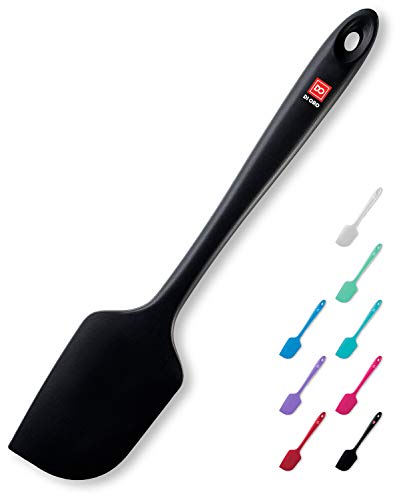
America’s Test Kitchen named the DI ORO Living seamless Silicone Spatula Large its best all-purpose silicone spatula in an earlier equipment review. A later test also recognized an OXO model as a co-winner, so check the exact review before buying.
In American home kitchens, a good spatula earns its place beside the skillet, mixing bowl, and measuring cups. It helps make fluffy scrambled eggs, smooth brownie batter, and rich sauces without leaving half the food stuck to the pan. Yet a poor spatula can bend, miss bowl corners, or trap old food where the head meets the handle.
America’s Test Kitchen has tested silicone spatulas for stirring, scraping, folding, heat resistance, and ease of cleaning. Its earlier review named the DI ORO Living Seamless Silicone Spatula Large as the best all-purpose option. A later update reported a new co-winner from OXO while retaining its appreciation for DI ORO. This means shoppers should check the date and model covered by the review rather than assume that one product holds every award forever.
This guide explains what those results mean for everyday cooking in the United States. It covers the leading models, the features that matter, the limits of silicone, and the simple checks that help you choose a useful tool. The goal is not to buy the most costly spatula. It is to find one that works well for the food you cook most often.
Source: www.pinterest.com
Which Spatula Did America’s Test Kitchen Recommend?
The DI ORO Living Seamless Silicone Spatula Large was the winner in an earlier America’s Test Kitchen review of all-purpose silicone spatulas. The test compared ten models across a range of cooking and mixing tasks. The team also considered how each tool felt in the hand and how well it stood up to heat and repeated cleaning.
The review focused on real kitchen jobs rather than looks alone. Testers stirred eggs and thick dough, scraped pans and bowls, folded whipped ingredients, and checked how the spatulas held up after use. The DI ORO model stood out for its balance of firmness, flexibility, and reach into tight corners.
That result is useful, but it needs context. America’s Test Kitchen later reported a new co-winner from OXO and continued to value the DI ORO model. Product reviews can change as new tools enter the market or a testing team revisits a category. The fairest answer is to treat DI ORO as a documented earlier winner, not the only spatula worth buying today.
Source: nicolascontee0198037.blogspot.com
Earlier winner
DI ORO Living Seamless Silicone Spatula Large was named best all-purpose silicone spatula in the earlier equipment review.
Later update
A later America’s Test Kitchen update reported OXO as a new co-winner while praising the established DI ORO pick.
Main lesson
Choose by the task, shape, build, and exact review findings rather than by an award label alone.
What Did The Testers Look For?
The test covered folding, stirring, scraping, durability, and cleanup. Testers checked whether a spatula could move through thick mixtures without bending too much. They also looked at how easily the blade reached the sides and corners of bowls and cookware.
Heat resistance was part of the process, too. The team rested each tool in a 450-degree Fahrenheit cast-iron skillet for ten minutes, then checked the effects. Repeated washing also helped reveal whether a spatula was likely to be a hassle after regular use.
Blade shape
A wide, fairly flat edge and smooth sides help scrape bowls and pans clean.
Strength and flex
The blade needs enough give to follow a bowl’s curve without folding under thick dough.
Comfort and care
A secure grip and easy cleaning matter during long prep sessions and daily use.
DI ORO Seamless Silicone Spatula Large
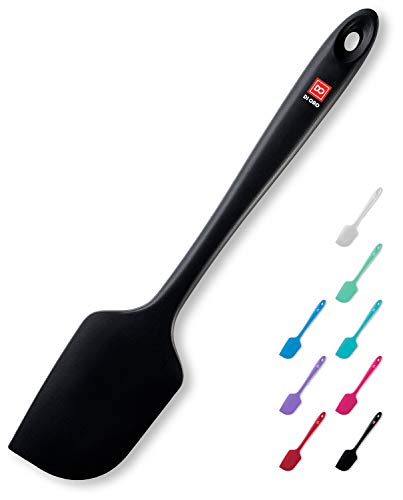
The DI ORO Living Seamless Silicone Spatula Large is a strong choice for cooks who want one main tool for stirring, folding, and scraping. Its broad blade has a flat top edge and smooth sides. That shape helps it sweep batter from a mixing bowl and scrape soft food from the sides of a pan.
The seamless design is one of its key features. The silicone head and handle form a continuous outer surface rather than a removable head attached at a joint. This can reduce the small gaps where sauce, dough, and other food bits may collect. It also makes the tool easier to inspect during washing.
DI ORO lists a stainless steel core in its Seamless Series and a heat rating of up to 600 degrees Fahrenheit for the relevant product. Those are manufacturer specifications, not proof that every part of the spatula can safely sit at that temperature for any length of time. Follow the exact model’s instructions and avoid direct contact with a flame or heating element.
For most home cooks, the main benefit is everyday control. The head is meant to stay firm enough to stir a thick mix while the outer silicone edge flexes against a bowl or pan. It is not a replacement for a thin metal turner when you need to lift a crisp fried egg or flip a burger in a pan that permits metal tools.
Source: dioro.com
Best for
Everyday mixing, bowl scraping, thick batter, sauces, and gentle stirring in suitable cookware.
Useful feature
Seamless outer construction makes it easier to wash away residue and inspect the head.
Main trade-off
Its broad silicone blade is not the best shape for every flipping or serving job.
Who Should Choose DI ORO?
Choose this model if you cook often and use one spatula for many tasks. It can move cake batter, scrape peanut butter from a jar, and stir a sauce without needing a new tool for each job. Its shape also suits cooks who want to get more food out of a bowl with fewer passes.
It may be more tool than you need if you only bake once in a while or mainly stir thin liquids. A basic silicone spatula can handle those jobs well. Compare the current price, dimensions, care directions, and warranty terms before deciding that the award-winning model is worth the extra cost.
A good fit
Frequent home cooks who want one sturdy, flexible tool for several daily tasks.
A less useful fit
Shoppers who mainly need a small jar scraper or a thin tool for flipping food.
OXO Silicone Spatulas And Other Options
OXO deserves a place in the comparison because a later America’s Test Kitchen update reported an OXO model as a new co-winner. The exact model matters, since a brand can sell spatulas in several sizes and shapes. Do not assume that every OXO spatula has the same build or earned the same result.
A comfortable handle can make a real difference when you stir a thick sauce or scrape a large bowl. Look for a grip that stays secure with damp hands and a blade that bends at the edge but does not collapse in the center. Check the product label for its heat rating and cleaning instructions rather than applying one model’s specifications to the whole brand.
Other silicone spatulas can work well, too. Models from brands such as GIR, Tovolo, Rubbermaid, and StarPack have appeared in spatula comparisons. Their presence in a test list does not mean they all earned the same award. Compare each exact product by its shape, construction, care needs, and price.
Source: sliceitright.com
OXO
Worth comparing because of the later co-winner result. Verify the exact model before purchase.
GIR and Tovolo
Other options to assess for blade shape, grip, stiffness, and care instructions.
Rubbermaid and StarPack
Models that have appeared in silicone spatula testing and may suit different budgets or tasks.
How To Compare Two Models Fairly
Start with the same task for both tools. A spatula that works well for folding egg whites may not be the best one for stirring a pot of thick chili. Compare the blade width, edge thickness, handle comfort, and stiffness under pressure.
Then check the details that affect daily use. Look for a clear temperature limit, dishwasher guidance, warranty terms, and any warnings about nonstick pans. A lower price can be a good deal if the tool suits your needs and holds up to normal care.
Use the same criteria
Compare both models for the same cooking job rather than relying on general brand claims.
Read the exact listing
Specifications and warranty terms may differ across sizes and product versions.
What Makes A Silicone Spatula Good?
A good silicone spatula balances flexibility with strength. The edge should bend enough to follow a bowl or pan, while the center should stay firm when you stir thick dough. If the whole blade folds back under pressure, you may struggle to move food where you want it.
The shape matters just as much as the material. A wide, nearly flat edge is useful for scraping and mixing. Smooth sides help reach corners, while a rounded edge can be better for curved bowls and jars. A small spatula may be easier to control in a narrow container, but a larger head moves more food at once.
The handle should feel secure without making the tool hard to turn. A bulky handle can feel strong but may tire your hand during a long baking session. A narrow handle can be easy to store yet feel less stable when you work with thick dough. Comfort is personal, so use the product’s dimensions and shape as a guide.
Source: fity.club
Flexible edge
Helps lift soft food and scrape curved surfaces with less waste.
Firm center
Gives you control when stirring thick batter, cookie dough, or a heavy sauce.
Smooth construction
Makes it easier to wash away food residue, especially around the head and handle.
Comfortable grip
Helps you keep control without squeezing the handle too hard.
Why Seamless Construction Matters
A separate head and handle can leave a joint where food gets trapped. That joint may be hard to clean if the head is fixed in place. A seamless outer surface avoids that particular gap and can make routine washing simpler.
Seamless construction does not mean a tool can never wear out or become dirty. Wash it well after each use and inspect it from time to time. Replace it if the silicone splits, the core becomes exposed, or the head shows damage that makes safe use uncertain.
Less residue to trap
A continuous surface has fewer gaps than a design with a separate head joint.
Still needs care
Wash all surfaces and replace damaged tools rather than relying on the design alone.
Silicone Spatula Uses In Everyday Cooking
A silicone spatula is useful for much more than scraping cake batter. It can fold whipped cream into a filling, stir scrambled eggs in a suitable pan, mix cookie dough, and scrape sauce from a bowl. Its soft edge also helps remove sticky food without scratching cookware that is designed for silicone tools.
The best technique depends on the food. For folding, slide the blade down the side of the bowl, move under the mixture, and lift it over the top. Turn the bowl and repeat until the ingredients are mixed. Use slow, broad strokes so you keep as much air in the mixture as the recipe calls for.
For pan cooking, keep the blade flat against the surface when scraping food from the bottom. Do not force it against burnt-on residue or use a spatula with a damaged edge. A silicone tool can protect many nonstick surfaces, but it cannot fix a worn coating or replace the right utensil for a specific pan.
Source: storage.googleapis.com
Baking
Scrape batter from mixing bowls and fold soft ingredients into cake or muffin mixtures.
Stovetop cooking
Stir eggs, sauces, and soft foods when the pan and the spatula’s heat rating permit it.
Jar scraping
Use a small or narrow head to remove nut butter, jam, or sauce from tight spaces.
Food transfer
Move soft mixtures from a bowl into a baking dish with less waste.
When A Different Spatula Works Better
A silicone scraper and a turner are not the same tool. A scraper is built to stir, fold, and follow a bowl’s curves. A turner has a flatter blade designed to slide under food and lift it. For pancakes, burgers, or crisp fried eggs, a turner is often easier to use.
Metal turners can scratch nonstick coatings, so use them only with cookware that permits them. For delicate coated pans, choose a suitable silicone or nylon turner and follow its temperature limit. A small collection of tools is often more useful than asking one spatula to do every job.
Use a scraper
Choose it for mixing, scraping bowls, folding, and stirring soft foods.
Use a turner
Choose a suitable flat blade for lifting, flipping, and serving food.
Heat Resistance, Cookware Safety, And Cleaning
Heat resistance is a key buying factor, but the number on the package needs context. Some silicone spatulas carry high temperature ratings, while others have lower limits. A rating of 600 degrees Fahrenheit does not mean every model can stay against a hot pan forever or touch an open flame without damage.
Use the temperature limit listed for your exact spatula. Avoid leaving the blade resting against the side of a hot skillet for long periods unless the maker allows that use. Keep the tool away from direct flame, heating elements, and sharp edges that could cut the silicone. If the head becomes sticky, cracked, badly stained, or misshapen, check the maker’s advice and replace it when needed.
For cleaning, wash the head and handle with warm water and dish soap soon after use. Sticky batter and oily sauces are easier to remove before they dry. If the product is labeled dishwasher-safe, follow its directions for rack placement and care. Do not assume that every spatula is dishwasher-safe simply because it is made from silicone.
Source: kitchenquik.com
Check the rating
Use the maximum temperature listed for the exact model, not a rating copied from another product.
Protect cookware
Use soft silicone on suitable nonstick pans and avoid scraping with damaged edges.
Wash soon
Remove food and grease before they dry, and follow the maker’s cleaning instructions.
Inspect often
Replace tools with splits, exposed cores, loose parts, or other damage that affects safe use.
How To Remove Lingering Smells And Stains
Silicone can hold onto the smell of garlic, curry, tomato sauce, or other strong foods. Start with hot water and dish soap, then wash and rinse the tool well. If the smell remains, soak it only in a cleaning solution that the manufacturer permits.
Some cleaning advice suggests a dilute hydrogen peroxide solution for stubborn odors, but do not mix cleaning chemicals or use a stronger solution without checking the product instructions. Never mix bleach with ammonia, acids, or other cleaners. Rinse the spatula well after any approved treatment and let it dry fully before storing it.
First step
Wash with dish soap and warm water, paying close attention to the blade and handle.
If the smell stays
Check the manufacturer’s care guidance before trying an odor-removal soak.
The right spatula depends on what you cook and how often you cook it. A home baker may need a broad, flexible blade for batter and frosting. Someone who cooks eggs every morning may prefer a smaller tool with a slim edge. A cook who makes thick dough or large batches of sauce may want a stronger center and a longer handle.
Start by choosing the main task. Then compare blade size, edge shape, grip, temperature limit, cleaning needs, and price. If you use nonstick cookware, confirm that the tool is suitable for that surface. If you bake often, a smaller scraper may be useful beside a larger all-purpose model.
Do not pay extra for a long list of claims that do not matter to your cooking. A well-shaped basic spatula can be enough for light use. A higher-quality seamless model may be worth considering if you cook daily and value easy cleanup, good control, and a design that suits several jobs.
Source: fity.club
For baking
Choose a flexible edge that can reach the sides and bottom of a mixing bowl.
For daily stovetop use
Look for a secure grip, a firm center, and a heat rating suited to your cooking.
For small jars
Choose a narrow head that can reach the base and curved sides.
For nonstick pans
Pick a soft, cookware-safe tool and avoid metal edges that may scratch the coating.
A Simple Pre-Purchase Checklist
Before you order, check the full product name and size. Make sure the listing matches the model discussed in the review, especially if the product line includes several spatulas. Read the current care directions and warranty terms, as these can differ across models or change over time.
Look at the blade as well as the handle. A large head can scrape a mixing bowl quickly, while a small head can reach a narrow jar. If you only want one spatula, a medium or large all-purpose model with a flexible edge and a firm center is a sensible starting point.
Model
Confirm the full name and size before comparing review results.
Materials
Check the outer material and any internal support described by the maker.
Care
Read the temperature limit, dishwasher instructions, and storage advice.
Value
Compare the current price with the tool’s expected use and your need for extra features.
Frequently Asked Questions
Q
What is America’s Test Kitchen’s best spatula?
The DI ORO Living Seamless Silicone Spatula Large was the winner in an earlier America’s Test Kitchen all-purpose silicone spatula review. A later update reported an OXO model as a new co-winner. Check the exact review and model before buying, since recommendations can change.
Q
Is the DI ORO spatula worth buying?
It may be worth the cost if you cook often and want a versatile tool for mixing, scraping, and stirring. Its seamless outer construction can make cleaning easier, and the reinforced design aims to balance flexibility with strength. Compare the current price, care instructions, and warranty with other models before deciding.
Q
Can I use a silicone spatula in a hot pan?
Yes, if the spatula is rated for the heat and the manufacturer allows that use. Check the exact model’s temperature limit, avoid open flames and heating elements, and do not leave the blade against a hot pan for longer than the instructions permit.
Q
Are silicone spatulas safe for nonstick pans?
Many silicone spatulas are suitable for nonstick cookware because their soft edges are less likely to scratch the coating than metal tools. Still, inspect the blade for cuts or hard exposed parts and follow the cookware maker’s advice. A damaged spatula can harm a pan even if its outer material is silicone.
Q
How do I clean a silicone spatula that smells like garlic?
Wash it with warm water and dish soap soon after use, then rinse and dry it well. If the smell remains, check the maker’s care instructions before using a soak or other cleaning treatment. Do not mix cleaning chemicals, and replace the tool if it is cracked, sticky, or otherwise damaged.
Q
What is the difference between a silicone scraper and a turner?
A silicone scraper has a flexible blade for mixing, folding, and scraping bowls or pans. A turner has a flatter shape designed to slide under food and lift or flip it. Many kitchens benefit from having both, with the turner material chosen to suit the cookware.
✦ Wrapping Up
Conclusion
America’s Test Kitchen’s earlier all-purpose silicone spatula winner was the DI ORO Living Seamless Silicone Spatula Large. Its broad blade, flexible edge, and seamless outer surface make it a useful option for cooks who stir, scrape, and fold food often. A later test update also recognized an OXO model as a co-winner, which is a good reason to check the precise model and date behind any award.
The best spatula for your kitchen is the one that fits your usual cooking tasks. Look for a blade that reaches bowl corners, a center that stays firm under pressure, and a grip that feels comfortable. Check the heat rating and cleaning directions before use. A good spatula should make everyday cooking easier, not leave you wrestling with a bent blade or food stuck in the corners.
💡 Key Takeaway
If you want a versatile first choice, compare the DI ORO Living Seamless Silicone Spatula Large with the exact OXO model named in the later America’s Test Kitchen review. Check current specifications, price, care instructions, and cookware compatibility before placing an order.