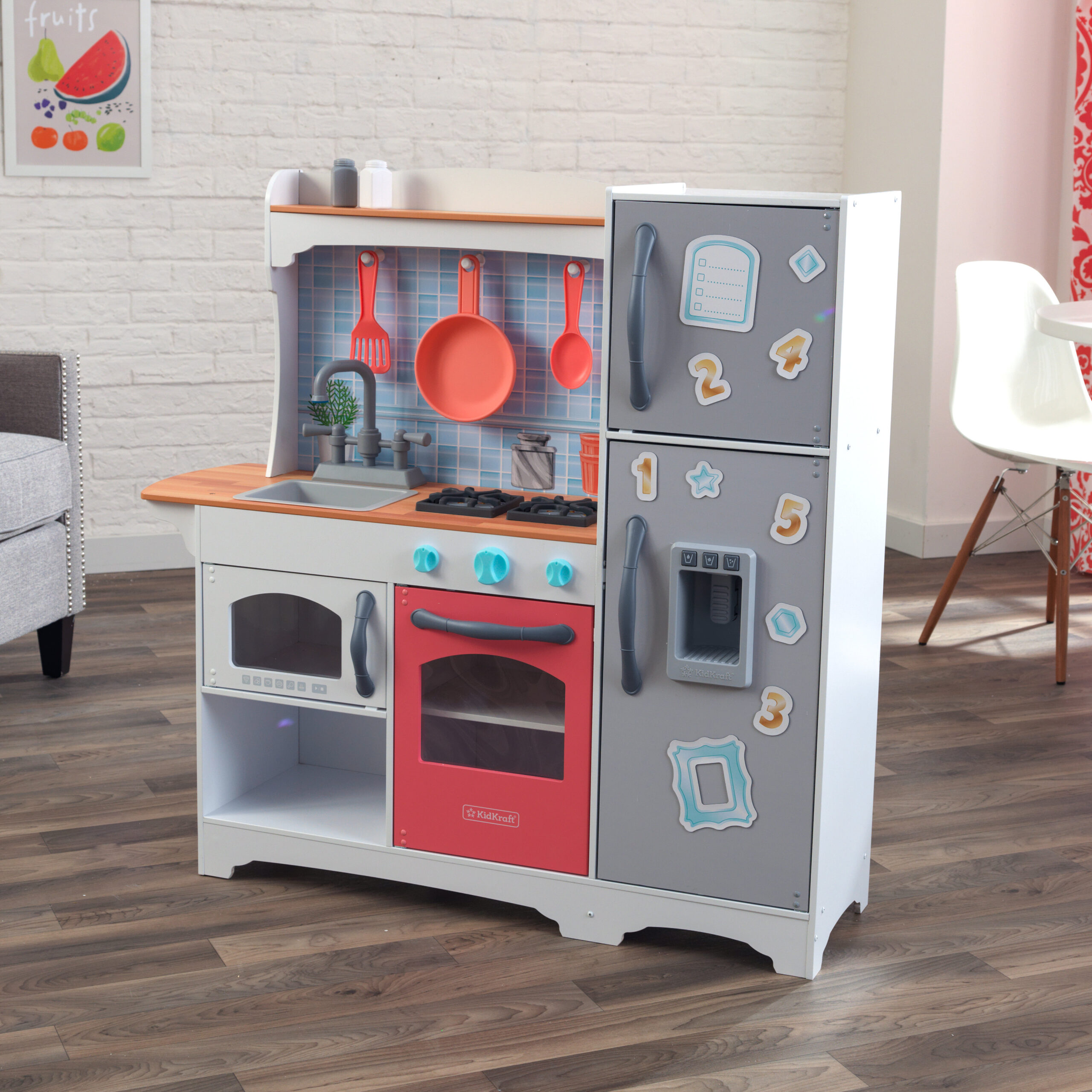
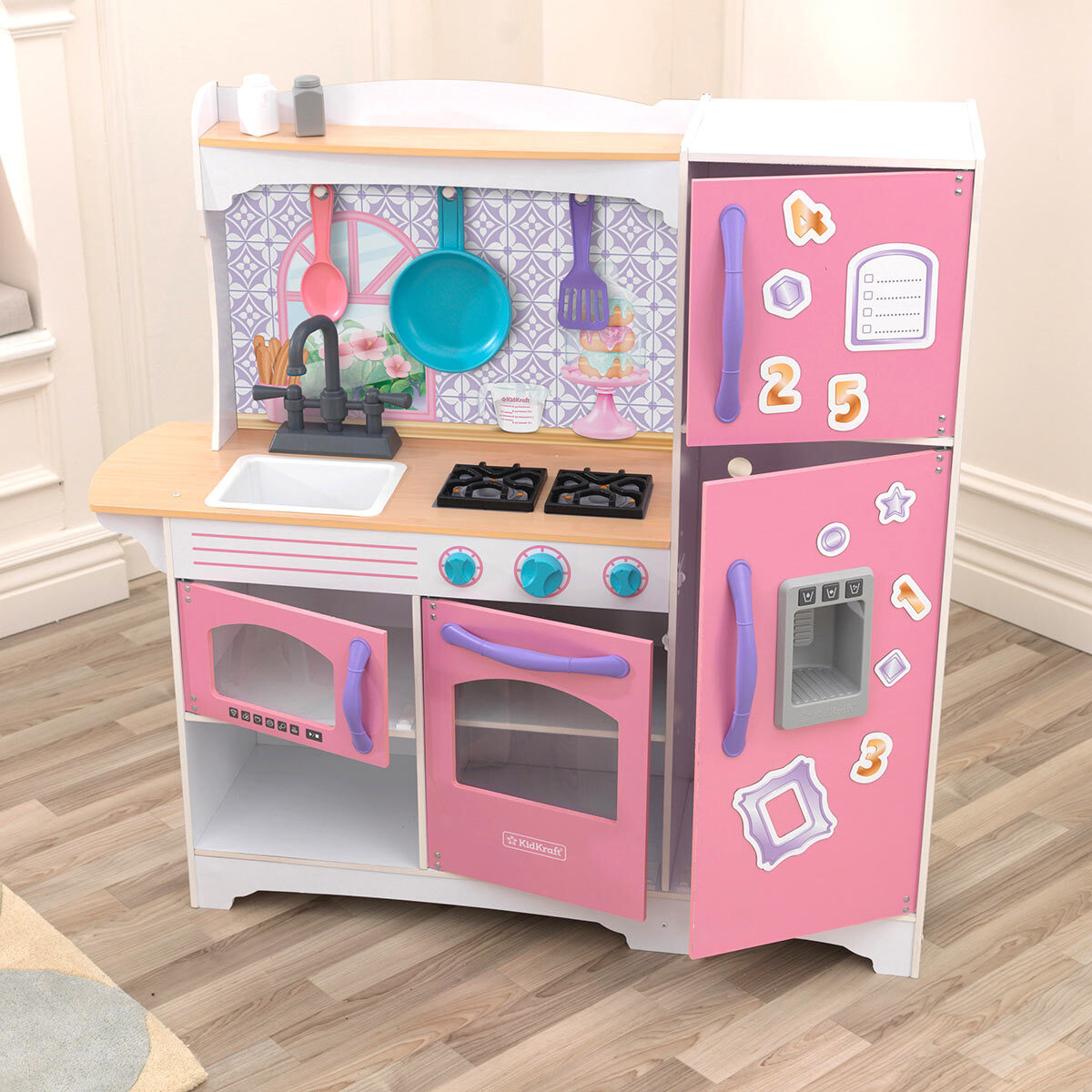
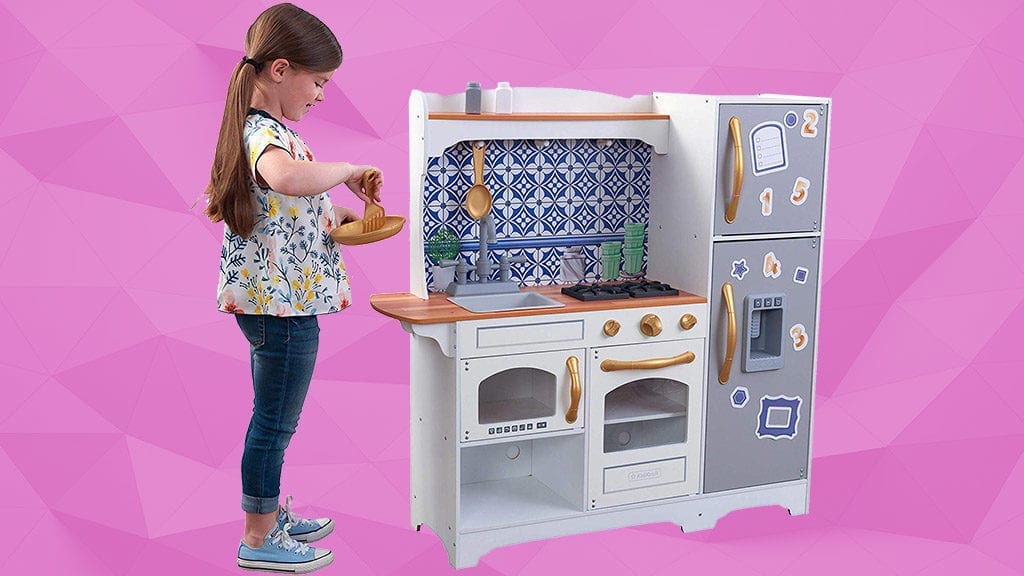
The KidKraft Mosaic Magnetic Play Kitchen is a wooden pretend kitchen with a magnetic fridge, toy ice maker, oven, stove, microwave, sink, and storage. It suits children ages 3 and up who enjoy make-believe cooking, serving food, and copying daily kitchen tasks. Check the exact model, size, included parts, and condition before buying.
In American homes, a play kitchen can give a child a small place to cook, serve lunch, and run a pretend restaurant. It can fit in a bedroom, family room, or playroom, as long as there is enough space to move around it. The KidKraft Mosaic Magnetic Play Kitchen stands out for its tiled-look back panel, wooden build, and hands-on features.
The name can refer to more than one version of this kitchen. Older Mosaic Magnetic models, including model 53448, have different listed dimensions and accessory details from the coral model 10070. This guide explains the main features, what to check before a purchase, how to set it up, and how to care for it. It is based on product information and published descriptions, not a hands-on test.
Source: m.media-amazon.com
What Is the KidKraft Mosaic Magnetic Play Kitchen?
The KidKraft Mosaic Magnetic Play Kitchen is a child-sized kitchen set made for pretend play. It gives children several familiar kitchen areas in one unit, including a refrigerator, freezer, oven, stove, microwave, and sink. Storage areas also give small cooks room to keep play items close at hand.
The magnetic fridge is one of its main features. Children can place the supplied magnets on the door, make a pretend shopping list, or use the fridge as part of a make-believe grocery game. Other details, such as turning knobs and a toy ice dispenser, make simple play feel more like daily life.
This is not a working kitchen appliance. The stove, oven, and other parts are for pretend use, and the toy ice cubes are not real ice. The exact functions and included pieces can vary by model or package, so the product label and manual matter more than the name alone.
Source: littledreamers.ie
Main play areas
A fridge and freezer, stove, oven, microwave, sink, and storage areas support a range of make-believe kitchen tasks.
Hands-on details
The magnetic fridge, turning knobs, and ice dispenser give children small actions to repeat during play.
Wood-based construction
The older Mosaic Magnetic model is listed with wood-based materials, including MDF. Check the materials for the version you plan to buy.
Who Is This Play Kitchen For?
The Mosaic Magnetic Play Kitchen is generally listed for children ages 3 and up. It may suit preschoolers who like to copy meal prep, play shop, or serve food to family members and toys. An older child may also enjoy it when play includes menus, shopping lists, and shared stories.
Age is only one part of the decision. Consider the child’s height, interests, and ability to follow play rules. A child who likes blocks or toy cars more than kitchen games may use this set less often than a child who enjoys copying adults in the kitchen.
For one child
The separate kitchen areas offer several simple tasks without needing another child to join in.
For siblings or friends
One child can cook while another serves food or pretends to shop, though the available standing space may limit group play.
Key Features That Make This Kitchen Fun
The appeal of this play kitchen comes from its mix of familiar tasks and small moving parts. A child can open the fridge, place magnets on the door, turn a stove knob, move a toy pan, and pretend to serve dinner. These actions give a play session a clear start and a simple story to follow.
The white and gray appliance details, wood-look worktop, and mosaic-style back panel create a home kitchen look. The design may suit a family room or playroom where a large toy stays in view. Still, color, finish, and included accessories should be checked against the exact listing because model versions differ.
Source: toycorner.ae
Magnetic refrigerator
The fridge offers a place for the supplied magnets. Children can pretend to plan meals, write a shopping list with adult help, or store pretend food.
Toy ice maker
The dispenser releases small plastic ice cubes in versions equipped with this feature. Keep the cubes away from children who may put small objects in their mouths.
Oven and microwave
Doors let children pretend to bake, heat a meal, or check on a dish. These parts do not cook or heat real food.
Stove knobs
The knobs on documented versions turn and make clicking sounds. This adds a simple action to pretend cooking.
Sink and storage
The sink supports pretend washing, while shelves and other storage spaces help keep toy kitchen items in one place.
What Accessories Come With It?
Published descriptions of the older Mosaic Magnetic kitchen list items such as a pan, ladle, spatula, salt and pepper shakers, and magnets. Some listings describe six accessory pieces, while other packages use different accessory counts. Do not assume that every listing includes the same items.
If you are buying a new set, compare the box contents with the seller’s current description. For a used set, ask for a photo of every accessory laid out beside the kitchen. This makes it easier to spot missing pieces before you pay.
Check the small parts
Count the magnets, utensils, toy ice cubes, and other listed pieces against the manual or original package list.
Plan for extra play food
Play food may need to be purchased separately. Choose items suited to the child’s age and the space available.
Size, Materials, and Space Requirements
Measure the place where you want to put the kitchen before ordering it. The older KidKraft Mosaic Magnetic Play Kitchen model 53448 is listed at about 40.55 inches long, 12.99 inches deep, and 39.76 inches high. Those figures give you a useful starting point, but you should confirm the dimensions in the manual for your exact model.
The kitchen takes up more room than its depth alone may suggest. A child needs space in front of the unit to open doors, move toy food, and stand while playing. Allow room around the sides as well if more than one child will use it.
The older model is described as a wood-based play kitchen, with MDF among its listed materials. MDF is an engineered wood product. The finished surface still needs gentle care, especially around joints, edges, and places where water could enter.
Source: toys-shop.gr
Measure the floor area
Check length and depth, then add space in front for a child to stand and use the doors.
Check ceiling and wall clearance
Make sure the top and back of the assembled unit fit without blocking doors, vents, or walkways.
Think about the floor
Choose a level, stable spot. Avoid placing the kitchen where it can wobble or block an exit.
Confirm the material details
Check the exact model listing and manual rather than assuming every Mosaic Magnetic version has the same parts or finish.
Will It Fit in a Small Playroom?
It can fit in some small rooms because the older model is relatively shallow compared with many large play kitchens. The main challenge is the room needed in front of it. A tight corner may leave too little space for a child to open the oven and fridge doors with ease.
Use painter’s tape to mark the listed floor dimensions before assembly. Stand in front of the outline and check the path from the doorway. If the marked space blocks a walkway or leaves little room to play, look for a smaller kitchen.
Best placement
A clear wall with level flooring can make the kitchen easier to use and keep the room tidy.
Avoid cramped corners
Leave enough room to open doors and reach the sink without bumping into furniture.
How to Assemble the KidKraft Mosaic Magnetic Play Kitchen
Adult assembly is required, and careful setup helps the kitchen stay stable during play. The time needed depends on the model, the parts supplied, and the builder’s pace. A published review of the older design reported about an hour, while the manufacturer’s instructions for the coral model give a wider estimate of roughly half an hour to two hours.
Do not begin by tightening parts at random. First, match the model number to the correct instructions and check that the hardware is present. Building the kitchen in the wrong order can make panels hard to fit and may require you to undo earlier steps.
Source: costco.co.uk
Step 1: Check the box
Lay out the panels, screws, fittings, and accessories. Look for cracks, bent pieces, or missing hardware before building.
Step 2: Read the manual
Confirm the model number and study the diagrams. Do not rely on instructions for a similar-looking KidKraft kitchen.
Step 3: Prepare a clear work area
Use a level floor or broad work surface. Keep small screws and fittings away from children and pets.
Step 4: Build in the stated order
Fit the main panels and supports as directed. Use the specified hardware and avoid forcing a screw into a misaligned hole.
Step 5: Fit the doors and moving parts
Install doors, knobs, the sink, and the ice dispenser according to the manual. Check that moving parts work without binding.
Step 6: Inspect the finished unit
Check each connection, the base, the doors, and the back panel. Do not let a child use the kitchen until assembly is complete and the unit is stable.
What If a Part Is Missing?
Stop the build if a structural panel, support, or key fitting is missing. Contact the seller or the manufacturer’s parts support with the model number, part name, and a photo of the manual diagram. A complete order is easier to resolve when you can identify the exact missing item.
Do not replace a missing screw with a random screw that seems to fit. Its length or head may differ and could damage the panel or leave the joint weak. Keep the kitchen out of use until the missing part is replaced and the assembly is sound.
Keep the model label
Save the model and item number so you can request the right part or manual.
Do not improvise structural repairs
Use approved replacement parts and the stated assembly method rather than glue or mismatched hardware.
How Children Can Use It for Pretend Play
A play kitchen gives children a setting for stories they know from home. One day it can be a breakfast counter; the next, it can be a café, bakery, or grocery shop. Adults can join in by asking what is on the menu or what ingredients the pretend chef needs.
The best play ideas use the features already on the kitchen. Magnets can stand for a shopping list, the sink can be used for pretend washing, and the oven can hold a toy meal. No special lesson plan is needed. A few props and time to play are often enough to get a story started.
Source: thetoyinsider.com
Run a pretend diner
Let the child take orders, prepare toy food, and serve each guest. Use paper menus if the child enjoys drawing or writing.
Plan a grocery trip
Use the fridge magnets to make a pretend list, then gather play food before preparing a meal.
Sort kitchen items
Ask the child to place utensils, food, and dishes in set areas. This adds a simple sorting task to the game.
Play together
Take turns as the cook and guest. Simple shared stories can give siblings or friends a reason to work together.
Does a Play Kitchen Help Children Learn?
Pretend kitchen play can give children chances to practice language, planning, turn-taking, and fine motor actions. A child may name foods, follow a pretend recipe, count plates, or decide what to serve first. These are possible play-based learning opportunities, not a promise that one toy will lead to a set result.
You can support the play without taking control of it. Ask open questions, name a new food, or show how to put the toys away. Let the child make choices and change the story. The goal is to make room for play, not to turn each session into a test.
Language practice
Talk about foods, colors, tools, and steps while the child prepares a pretend meal.
Early math
Count toy plates, sort pretend food, or share items between guests.
Daily routines
Use pretend washing, cooking, and tidying to act out familiar home tasks.
Cleaning, Care, and Common Problems
A quick care check can help keep the kitchen neat and ready for play. The manufacturer’s care guidance for the coral version calls for surface cleaning with a damp cloth. Use a soft cloth with a small amount of water, then wipe away moisture rather than leaving the surface wet.
Avoid soaking the sink area or allowing water to sit on seams and edges. Wood-based panels can be damaged if moisture enters and causes swelling. Do not use harsh cleaners unless the manual says they are suitable for the finish.
Check the unit from time to time, especially after a move or a long play session. A loose door, missing fitting, cracked panel, or unstable base needs attention before the next use. Small accessories also need regular checks for damage.
Source: assets.wfcdn.com
Wipe the surfaces
Use a soft, slightly damp cloth. Dry the surface after cleaning and avoid soaking the panels.
Check the doors
Make sure the fridge, oven, and microwave doors move as intended and do not catch or pull loose.
Inspect the base
Look for wobble, loose fittings, or cracked panels. Tighten only as the manual allows.
Count small accessories
Keep magnets, toy ice cubes, and utensils in a set storage spot so you can spot missing or damaged pieces.
Troubleshooting the Ice Maker and Knobs
If the ice dispenser does not release its toy cubes, check the instructions and make sure the mechanism is assembled in the right order. Remove any jammed cube only when the part can be reached safely and without forcing the mechanism. Do not use a sharp tool to pry it open.
If a knob will not turn, check whether it is fitted as shown in the manual. A knob that feels stuck may be misaligned or damaged. Do not force it, since that can break the part or loosen the panel. Contact the seller or parts support if a correct assembly check does not solve the problem.
Door will not close
Check for a misplaced item, an uneven fit, or a loose hinge. Follow the manual before adjusting the door.
Kitchen feels unstable
Stop play, place the unit on a level floor, and inspect its supports and fittings before using it again.
Magnet is damaged
Remove damaged magnets from play. Replace them only with suitable parts and keep loose magnets away from young children.
Safety Checks Before Letting a Child Play
Follow the age label and safety instructions for the exact kitchen you own. Many Mosaic Magnetic models are marked for ages 3 and up. Small pieces, including toy ice cubes and magnets, can pose a choking risk for younger children. Adult supervision is needed when small accessories are in use.
Build the kitchen fully before play begins. Check that the base is stable, all required fasteners are secure, and no sharp edges or damaged panels are exposed. Teach children to use the kitchen as a toy rather than a climbing frame. Do not let them sit, stand, or hang from the countertop or doors.
Keep real food, hot liquids, kitchen tools, and cleaning products away from pretend play. The toy does not replace a real kitchen safety lesson, and its plastic accessories are not meant for cooking or eating. Remove broken parts at once instead of taping them back together for continued use.
Source: m.media-amazon.com
Check small parts
Inspect magnets, ice cubes, knobs, and accessories for breaks or loose pieces. Store small parts away from children who may mouth them.
Do not allow climbing
The kitchen is designed for pretend play, not to support a child’s weight. Keep play on the floor and at the work surface.
Inspect after moving
If the kitchen is moved to another room, check its joints and base before letting children use it.
Use the correct manual
Follow the instructions and age guidance for the exact model rather than a similar-looking kitchen.
Check the Model Before Buying Used
Used play kitchens can be good value, but a low price is not enough to make a set worth buying. Ask for clear photos of the model label, the front, the back, the doors, and the main joints. Compare the parts with the manual and ask whether the magnets, ice cubes, and utensils are included.
Check the manufacturer’s recall information as part of the purchase. A 2025 recall notice concerns the separate KidKraft Farm to Table model 53411, not the Mosaic Magnetic model 53448. The products should not be confused simply because they share the KidKraft name. If you cannot identify a used kitchen with confidence, contact the manufacturer before allowing a child to use it.
Confirm the model number
Find the label on the unit or check the original box and manual. Do not rely on the seller’s title alone.
Ask about damage
Look for swelling from water, cracked panels, loose doors, missing hardware, and rough edges.
Check parts support
Confirm that the needed manual or replacement part can be obtained before buying a set that is incomplete.
Is the KidKraft Mosaic Magnetic Play Kitchen Worth Buying?
This kitchen may be a good fit for a child who likes pretend cooking and for a family that has enough room for a full-size toy unit. Its mix of a magnetic fridge, ice maker, oven, stove, sink, and storage offers several ways to play without adding many separate toys. The mosaic-style design may also appeal to parents who want a toy that looks like a home kitchen.
The main trade-offs are its floor space, assembly work, and the need to track small accessories. It is also worth checking whether the exact model is still sold new, since older listings may refer to discontinued colors or packages. Prices and availability can change, so compare the full cost rather than relying on an old advertised price.
There is no single best play kitchen for every family. A smaller plastic set may suit a tight room or a lower budget, while a larger kitchen may suit children who play together often. The Mosaic Magnetic model makes the most sense when its features match the child’s interests and its size works in the room.
Source: toycorner.ae
A good fit if
The child enjoys pretend meals, the room has enough clear floor space, and the buyer wants several kitchen features in one unit.
Think twice if
The play area is very small, assembly is not practical, or the child has little interest in kitchen role-play.
Before you pay
Check the model, dimensions, age label, accessory list, current price, return terms, and availability of replacement parts.
What Should You Compare With Other Play Kitchens?
Compare kitchens by their real features rather than by color or photos alone. Look at the height, depth, materials, number of play areas, included accessories, and the work needed to assemble them. If your child loves making pretend drinks, an ice maker may matter more than extra shelves.
Also consider how the toy will be stored and cleaned. A set with many loose pieces can be fun, but those pieces need a place to go after play. A simpler kitchen may be the better buy if it fits the room, meets the child’s needs, and is easier to keep tidy.
Space
Compare assembled dimensions and the room needed to open doors and stand in front.
Play features
Choose features the child will use, such as a fridge, sink, oven, storage, or pretend sound effects.
Long-term care
Check surface-cleaning instructions, the availability of parts, and the ease of storing loose accessories.
Frequently Asked Questions
Q
What age is the KidKraft Mosaic Magnetic Play Kitchen for?
Many versions are listed for children ages 3 and up. Check the age label and manual for your exact model. Small magnets, toy ice cubes, and other loose accessories can pose a choking risk for younger children, so keep them out of reach.
Q
What are the dimensions of the Mosaic Magnetic Play Kitchen?
The older model 53448 is listed at about 40.55 inches long, 12.99 inches deep, and 39.76 inches high. Dimensions can vary by version, so confirm the model number and manual before measuring your play area.
Q
Does the KidKraft Mosaic Magnetic Play Kitchen come with play food?
Do not assume that play food is included. Published descriptions of the kitchen list accessories such as a pan, ladle, spatula, salt and pepper shakers, and magnets, but the package contents can vary. Check the seller’s current list of included items before ordering.
Q
How long does assembly take?
Allow enough time to sort the parts and follow the instructions without rushing. A published review of an older version reported about an hour, while the manufacturer’s estimate for the coral model is roughly half an hour to two hours. The exact time depends on the model and the builder.
Q
How do you clean the Mosaic Magnetic Play Kitchen?
Wipe the surface with a soft, slightly damp cloth and dry it after cleaning. Avoid soaking the wood-based panels or leaving water around joints and edges. Follow the care instructions for your model and remove damaged accessories from play.
Q
Can I buy a used KidKraft Mosaic Magnetic Play Kitchen?
Yes, if the unit is complete, stable, and in good condition. Ask for photos of the model label, all main panels, doors, hardware, and accessories. Check the correct manual and the manufacturer’s current recall information before use. Do not buy a damaged set if key structural parts or safe replacement parts are unavailable.
Q
Is the Mosaic Magnetic Play Kitchen the same as the Farm to Table model?
No. They are different KidKraft play kitchen models. The 2025 recall notice for Farm to Table model 53411 should not be treated as a recall of Mosaic Magnetic model 53448. Confirm the model number on any used kitchen and review the official recall information if the label is missing or unclear.
✦ Wrapping Up
Conclusion
The KidKraft Mosaic Magnetic Play Kitchen brings several familiar kitchen tasks into one pretend play space. Its magnetic fridge, toy ice maker, oven, stove, microwave, sink, and storage can give children many ways to make up stories and act out daily routines. It may suit families who have room for a wooden play kitchen and a child who enjoys role-play.
The key is to buy the right version and set it up with care. Confirm the dimensions, age label, model number, included accessories, and condition. Once assembled, keep the kitchen dry, inspect its joints, and store small parts safely. These simple checks can help you make a more informed purchase.
💡 Key Takeaway
Before buying, write down the model number and dimensions, measure the planned play area, compare the included accessories, and check the manual and recall information. For a used set, inspect the panels, doors, base, magnets, and hardware before letting a child play.