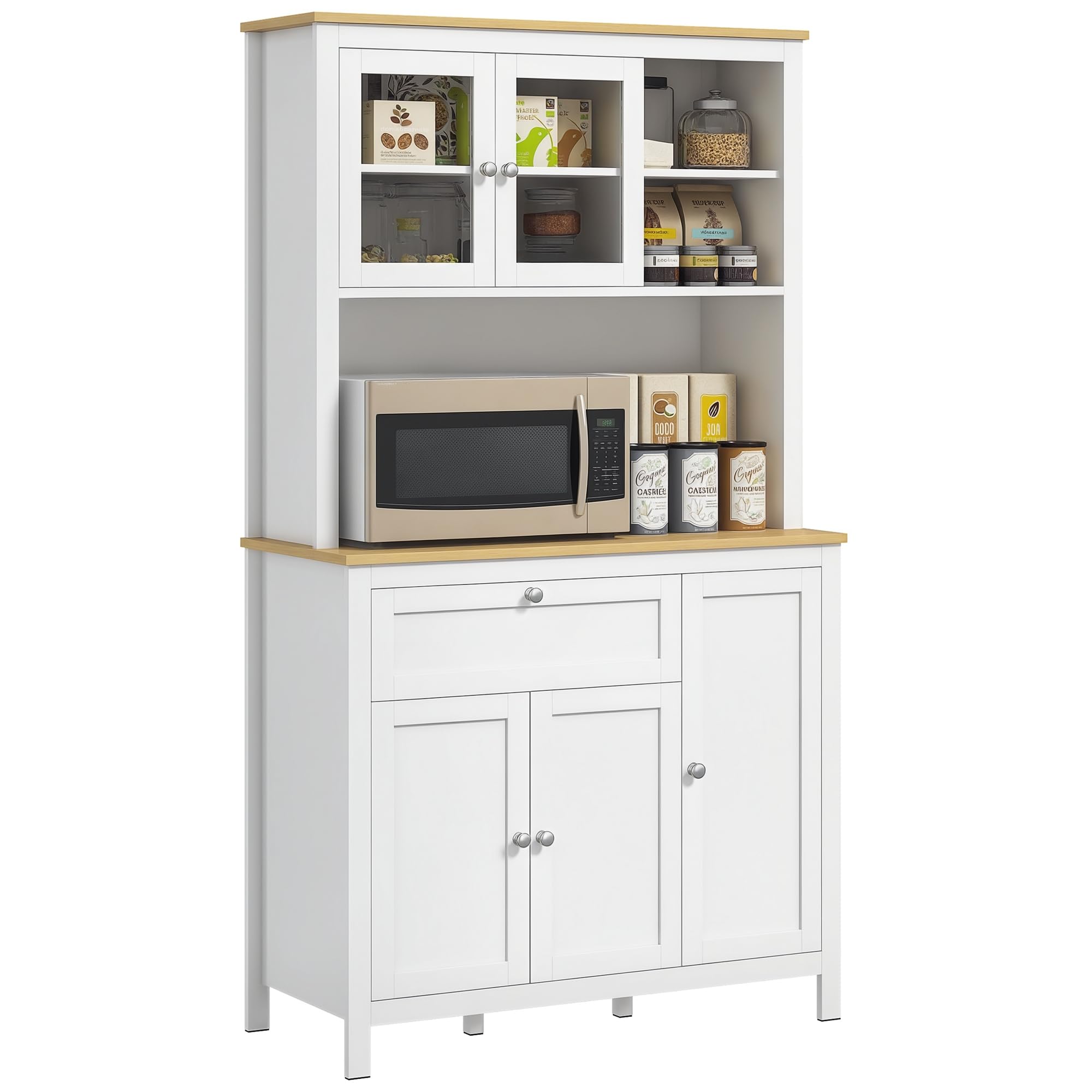
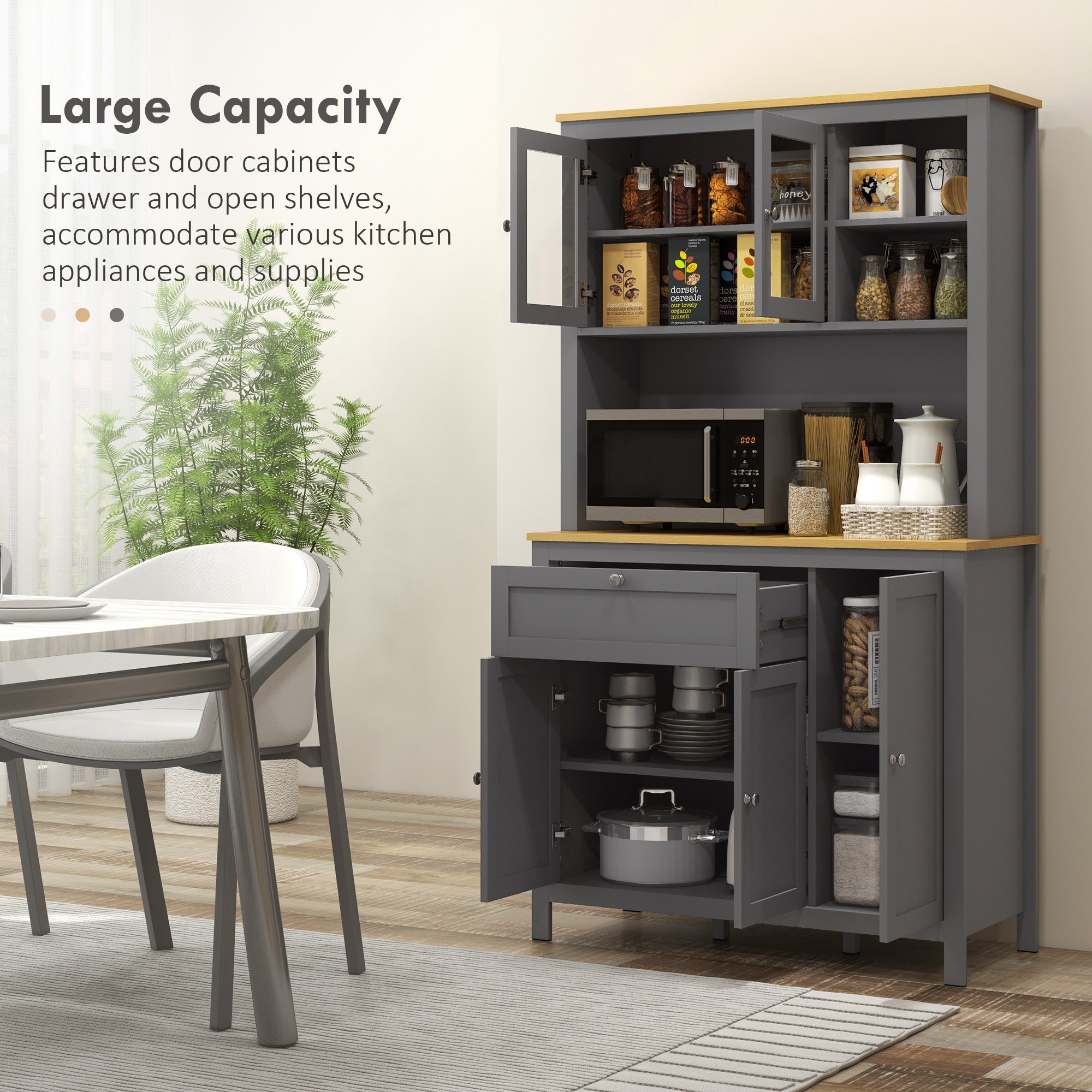
The HOMCOM 71 kitchen pantry is a tall storage cabinet designed to add cupboard space and a work surface to a kitchen. Depending on the exact model, it can include glass-front upper cabinets, adjustable shelves, drawers, lower cupboards, and an open counter for a microwave or other small appliances.
In American homes, kitchen storage can get tight fast. A small apartment kitchen may lack a full pantry, while a family kitchen can run short on room for snacks, dishes, mugs, and countertop appliances. A freestanding pantry cabinet can help fill that gap without the cost or work of adding built-in cupboards.
The HOMCOM 71 kitchen pantry comes in more than one design, so the model number matters. One documented version, model 83A-010V80WT, measures about 39.4 inches wide, 15.7 inches deep, and 70.9 inches tall. It has adjustable shelves, enclosed storage, an open counter, a drawer, and cable management. Other HOMCOM cabinets with a similar height may have two drawers or different weight limits, so their specifications should not be treated as interchangeable.
This guide explains what to check before buying, how to plan the space, how to organize the cabinet, and how to assemble and maintain it. The information is based on published product specifications and available product documentation, not hands-on testing. Check the listing and instruction manual for your exact model before making a purchase or loading the cabinet.
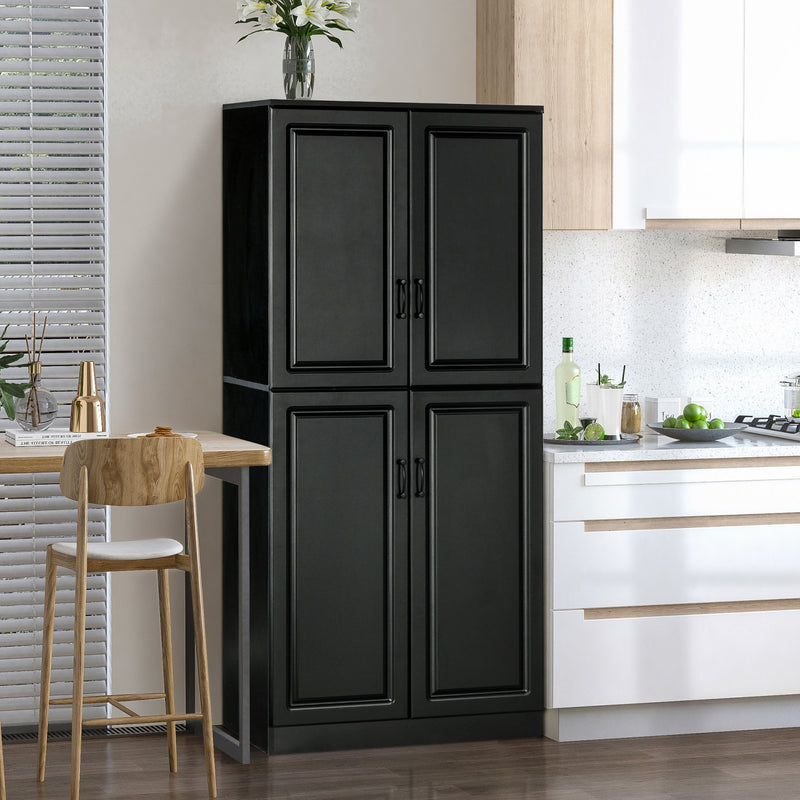
The HOMCOM 71 kitchen pantry is a freestanding kitchen storage unit that combines cupboard space with a furniture-style design. Some versions resemble a traditional pantry, while others have a hutch layout with upper cabinets and a central counter. This mixed layout can serve several jobs in one footprint.
The key detail is that the phrase HOMCOM 71 kitchen pantry does not identify one single product configuration. Listings may describe different colors, door styles, drawers, shelf layouts, and model numbers. Before comparing prices or reading a manual, match the listing to the model number printed on the product label or packaging.
A documented white version, model 83A-010V80WT, has a reported overall size of 39.4 inches wide, 15.7 inches deep, and 70.9 inches high. Its product listing describes an open counter, an open shelf, enclosed cupboards, a drawer, adjustable shelves, cable management, and an anti-tip device. Those details apply to that version rather than every HOMCOM pantry near 71 inches tall.
Source: thebrick.com
Freestanding storage
The cabinet can add storage without replacing existing kitchen cabinets. It still needs a suitable, level location and the required wall attachment.
Mixed storage layout
Closed cupboards, open areas, and drawers can separate food, dishes, small kitchen tools, and other household items.
Furniture-style appearance
Glass-front doors and paneled lower doors are used on some versions. Check product photos and specifications for the finish and layout you will receive.
Why the model number matters
Two cabinets can both be advertised as 71-inch HOMCOM kitchen pantries yet have different construction and capacity limits. For example, the 83A-010V80WT version is listed with a total capacity of 176 pounds, while the separate 83A-068V80 series has different published specifications. Do not use one model’s load figures or assembly steps for another.
Save the product listing and instruction manual before assembly. These documents can help identify replacement parts, clarify shelf positions, and establish the right weight limits if you need support later.
Dimensions and Space Planning
Measure the intended location before ordering the pantry. A cabinet that fits along a wall may still block a doorway, overlap a baseboard, cover an outlet, or leave too little room for an appliance. The cabinet’s full height and depth matter just as much as its width.
For the documented 83A-010V80WT version, the listed overall dimensions are 39.4 inches wide, 15.7 inches deep, and 70.9 inches high. The measurements provide a useful starting point, but verify the dimensions for the color and model you intend to buy. Product families can include similar-looking units with different proportions.
Measure the floor area from the wall outward. Then check the full height from the floor to the ceiling or any shelf above the intended location. Leave enough room to open the doors and drawers fully, and consider nearby appliances and the path through the kitchen.
Source: thebrick.com
Width
Measure the wall space between neighboring cabinets, appliances, and door frames. Include any trim that could narrow the usable area.
Depth
Check how far the cabinet will extend into the room. Make sure it will not narrow a walkway or interfere with an oven, refrigerator, or dishwasher.
Height
Measure from the floor to the lowest obstruction above the cabinet. Account for uneven floors and the space needed to assemble or position the unit.
Access
Measure doorways, stair turns, hallways, and other tight points along the delivery route. The shipping package may be larger than expected.
A simple measuring example
Suppose your available wall section is 43 inches wide and the cabinet is 39.4 inches wide. The difference is 3.6 inches, or 1.8 inches on each side if centered. That looks workable on paper, but you still need to check trim, nearby handles, door swing, and any space required for safe installation.
Do not assume that a small gap is enough for every kitchen. The right clearance depends on the room layout and what sits beside the pantry. Mark the cabinet outline on the floor with painter’s tape before delivery to see how it affects movement.
Storage Features and Everyday Use
The main benefit of a pantry cabinet is that it gives common kitchen items a clear home. Instead of spreading mugs, food packs, dishes, and appliances across several surfaces, you can group them by use. The best arrangement depends on the exact interior layout and what you need to store.
Some HOMCOM 71-inch pantry models combine upper glass-front cupboards, lower enclosed storage, adjustable shelves, a drawer, and an open counter. These features can suit a kitchen that needs extra storage and a small appliance station. However, each feature should be checked against the actual product listing rather than assumed from the cabinet’s name.
Source: thebrick.com
Adjustable shelves
Shelf positions can be changed to make room for different item heights. Follow the manual when moving shelf supports, and never exceed the stated capacity.
Glass-front cupboards
Glass doors let you see some stored items without opening the cabinet. They work well for neat rows of mugs, glasses, or dishes, but fingerprints and visible clutter may need more frequent attention.
Lower cupboards
Enclosed lower areas can hold larger bowls, serving dishes, food containers, or other suitable supplies. Store heavy items low and respect each shelf’s individual limit.
Drawer storage
A drawer can keep smaller items such as measuring spoons, bag clips, or kitchen towels together. Check its dimensions and capacity before using it for heavier tools.
Open counter
The counter can provide a spot for a coffee maker, toaster, or compatible microwave. Check appliance dimensions, ventilation needs, and the specific counter weight limit first.
Cable management
A cable opening on some versions can help route an appliance cord. It does not replace a suitable outlet, safe cord placement, or the electrical requirements of the appliance.
How to arrange food and kitchen supplies
Place frequently used items where they are easy to reach. Keep everyday mugs and plates on a convenient shelf, and place rarely used serving pieces in less accessible areas. Use small bins to group packets, baking supplies, or snack bars so they do not slide around.
Keep dry food in sealed containers when suitable, especially if the original packaging is easy to tear or does not close well. Read food labels and store items according to their instructions. A pantry cabinet is ordinary furniture, not a temperature-controlled food storage unit.
Do not store cleaning chemicals beside unpackaged food. If the cabinet will hold both kitchen supplies and household products, use separate enclosed areas and keep hazardous products away from children and pets.
Can You Use the Pantry as a Microwave Stand?
Some HOMCOM pantry models include an open counter intended for small kitchen appliances. Whether it is suitable for your microwave depends on the appliance’s size, weight, ventilation requirements, and the cabinet’s own specifications. The presence of a countertop does not mean every microwave will fit or operate safely there.
Start by checking the counter’s usable width and depth. Measure the microwave’s base, not just its outer height, and compare those measurements with the counter dimensions. Leave the clearance required by the microwave manufacturer, including any space needed around vents and above the appliance.
The listed counter capacity on the 83A-010V80WT version is 66 pounds. That value is a maximum listed load, not a recommendation to place any appliance weighing less than 66 pounds on the surface without further checks. Confirm that the appliance fits, that its feet sit securely, and that the manual allows the planned placement.
Source: manuals.plus
Check the appliance manual
Follow its ventilation, clearance, electrical, and placement instructions. If the required clearance cannot be met, choose another location.
Keep cords clear
Route cords so they do not pinch behind the cabinet, touch hot surfaces, hang across a walkway, or become trapped by moving parts.
Use a suitable outlet
Plug the appliance into an outlet that meets its instructions and local electrical requirements. Avoid relying on an extension cord or power strip unless the appliance manufacturer permits it.
Keep the surface stable
Do not use the counter if it rocks, has loose fasteners, or shows signs of damage. Resolve those problems before loading it.
Other uses for the open counter
If a microwave will not fit, the counter may work as a coffee station, tea area, or place for a small toaster, provided the appliance instructions and counter limits allow it. A tray can group mugs and coffee supplies, while a small container can hold tea bags or sweeteners.
Keep hot appliances away from cabinet panels and nearby items when their manuals require clearance. Never cover ventilation openings or leave an appliance running in a way its instructions prohibit. If the counter is too small or too close to an upper cabinet, use a different surface.
Materials, Finish, and Care
Published specifications for HOMCOM pantry models may list MDF, particleboard, or other forms of engineered wood. These materials are used in many furniture products, but the exact mix and finish vary by model. Read the material details on the listing rather than assuming that every cabinet has the same construction.
Engineered wood furniture needs sensible care around water and heat. A damp cloth is usually a better starting point than soaking a panel, spraying cleaner into joints, or leaving spills in place. Always follow the manufacturer’s care instructions if they differ from general advice.
Source: tsc.ca
Wipe spills promptly
Use a soft cloth to remove water, oil, or food residue. Dry the surface afterward so moisture does not sit along seams or panel edges.
Use mild cleaning methods
Start with a soft cloth and a little mild soap if needed. Test an unfamiliar cleaner on a hidden area and avoid abrasive pads that could scratch the finish.
Protect glass doors
Use a suitable glass cleaner on the glass itself, applying it to a cloth when practical. Keep excess liquid away from wood panels, hinges, and joints.
Check hardware
Look for loose screws, misaligned hinges, damaged shelf supports, and drawer problems during routine cleaning. Stop using a damaged section until it is repaired.
What to avoid
Do not use a steam cleaner or flood the panels with water unless the manufacturer explicitly permits that method. Moisture can damage some engineered wood finishes or cause edges to swell. Avoid harsh solvents and strong abrasives that may dull the surface.
Keep the cabinet away from direct heat and persistent moisture where possible. A pantry beside a sink or stove may need more frequent checks for splashes and heat exposure. Follow any clearance rules given for the cabinet and nearby appliances.
Assembly Guide: What to Prepare Before You Start
The HOMCOM 71 kitchen pantry requires assembly, so plan for more than a quick setup. The number of panels, hinges, shelf supports, and fasteners depends on the exact model. Use the manual supplied with your unit instead of following instructions for a similar-looking cabinet.
Choose a clear, level work area with enough room to lay out the panels. Protect the floor with a blanket or cardboard, and keep small hardware in labeled groups. Two adults can make it easier to handle large panels and position the assembled cabinet without twisting or dropping it.
Source: manuals.plus
Inventory the parts
Compare the package contents with the parts list before building. Contact the seller or manufacturer if key pieces are missing or damaged.
Use the right tools
Prepare the tools named in the manual. A screwdriver may be needed, but the exact tool list depends on the product version.
Protect finished panels
Keep panels on a soft, flat surface and avoid dragging them across concrete or tile. Separate the pieces to reduce scratches and mix-ups.
Follow the part labels
Match each panel and fastener to the diagram. Similar panels may have different holes or edges, so do not rely on appearance alone.
A practical assembly sequence
Begin by reading the entire instruction manual and identifying the base, side panels, shelves, doors, drawer parts, and hardware. Build the sections in the order shown in the diagrams. Tighten fasteners as directed, but do not force a screw into a hole that does not line up.
Install drawer slides and hinges according to their labeled positions. Check that the parts face the correct way before securing them. Once the lower and upper sections are ready, join them as instructed and check the cabinet for square alignment.
Fit the shelves, doors, and drawers after the main structure is secure. Make small hinge adjustments if the manual allows them. The doors should move without scraping, and the drawer should travel smoothly without needing force.
Install the anti-tip hardware before using the cabinet. Follow the supplied directions for the wall connection and suitable fixing method. If the wall material or attachment point is uncertain, ask a qualified installer for help rather than guessing.
Signs that the assembly needs a second look
A cabinet that rocks, leans, or has doors that will not align may have loose fasteners, an uneven floor, or parts fitted in the wrong position. Empty the unit before checking it. Do not try to correct a major lean by loading one side more heavily.
If a panel cracks, a shelf support will not seat, or a fastener spins without tightening, stop and identify the cause. Replacing a damaged part is safer than hiding the problem with extra screws or improvised brackets.
Weight Limits and Anti-Tip Safety
Follow the weight limits printed in the manual for your exact pantry model. A total capacity does not mean every shelf, drawer, or counter can carry the same load. The weight rating for each part can be much lower than the overall rating.
For model 83A-010V80WT, the published overall capacity is 176 pounds, with a listed counter capacity of 66 pounds, shelf capacity of 11 pounds, and drawer capacity of 6.6 pounds. These figures apply to that specified version only. A different HOMCOM cabinet may have higher or lower limits, so check its documentation before storing heavy items.
Weight also needs to be spread sensibly. Keep heavier objects on lower shelves when the design and stated limits allow it. Avoid placing a concentrated load at the front edge of a shelf or drawer, and do not climb on the cabinet to reach a high cupboard.
Source: thebrick.com
Use the anti-tip device
Install the supplied anti-tip hardware as directed. A tall cabinet can tip if a person pulls on a door or drawer, or if weight shifts toward the front.
Secure it to a suitable wall point
Use the attachment method specified for the cabinet and wall type. Do not assume that an arbitrary screw or a weak wall anchor will provide adequate support.
Keep children from climbing
Do not let children climb the shelves or hang from doors and drawers. Store tempting heavy items low and keep the cabinet secured.
Recheck the fasteners
Inspect the anti-tip connection and cabinet hardware periodically, especially after moving the unit or noticing movement.
Where should heavy items go?
Large serving bowls, pots, and other heavy items are often easier to handle in a lower cupboard than in an upper glass-front cabinet. Before storing them, confirm the lower shelf’s stated limit and make sure the item fits without pressing against the door.
Do not treat a shelf that looks thick as proof that it can carry a heavy load. The support system, fasteners, panel material, and installation all affect how the cabinet performs. Use the documented limit rather than a visual guess.
How to Decide Whether This Pantry Fits Your Kitchen
The HOMCOM 71 kitchen pantry may suit a household that needs extra enclosed storage and a compact appliance counter in one unit. It is less suitable when the room cannot accommodate its depth, when built-in cabinetry is required, or when the intended items exceed the documented load limits.
Compare the cabinet with your actual storage needs instead of judging it by appearance alone. Write down the items you want to store, measure the largest pieces, and decide whether you need more shelf space, drawers, or a clear counter. This simple check can prevent a cabinet from arriving only to find that your cookware or appliance will not fit.
Source: thebrick.com
Consider it if
You need additional kitchen storage, have enough floor space, want a combination of open and closed areas, and can safely secure the cabinet to a suitable wall.
Compare other options if
You need a very narrow unit, a deep space for large appliances, solid wood construction, built-in cabinetry, or a different arrangement of drawers and shelves.
Check the full cost
Compare the current item price, delivery charges, assembly needs, and return terms. Prices and availability vary by retailer, color, model, and location.
Confirm the warranty
Read the warranty attached to the exact listing and seller. Do not assume the same warranty applies across all HOMCOM pantry models or retailers.
Questions to ask before ordering
Does the cabinet fit the space with the doors and drawers open? Will the largest plates, bowls, containers, or appliances fit through the openings? Can the intended appliance meet its ventilation and power requirements? Can you install the anti-tip hardware correctly?
Check the delivery and return policy as well. Large flat-pack furniture can be awkward to repack after assembly, and missing or damaged panels may require seller support. Keep the packaging and paperwork until you have checked the parts and confirmed that the unit is complete.
Common Problems and Practical Fixes
Most pantry cabinet problems should be checked while the unit is empty. This reduces the chance of a loaded shelf shifting during inspection. If the cabinet is leaning, unstable, or has a damaged panel, stop using it until the cause is resolved.
Source: manuals.plus
Doors do not line up
Check whether the cabinet is level, the hinges are fitted in the correct positions, and the fasteners are secure. Use the manual’s hinge adjustment method if one is provided.
Drawer sticks or feels rough
Remove the contents and check for debris, misaligned slides, or loose screws. Reinstall the slide only as directed, and do not force the drawer past a jam.
Cabinet rocks on the floor
Check the floor and base supports, then confirm that all structural fasteners are tight. Do not rely on the wall strap to correct a poorly assembled or damaged frame.
Shelf seems to sag
Remove the load and inspect the shelf and its supports. Confirm the correct shelf position and stated weight limit. Replace damaged parts rather than adding weight or improvised supports.
A part is missing
Compare the package with the parts list and contact the seller or manufacturer with the model number and part identifier. Avoid substituting random screws or connectors.
When to stop and seek help
Stop using the cabinet if a panel splits, a major fastener will not hold, the anti-tip attachment fails, or the unit continues to lean after basic checks. Contact the seller or manufacturer about replacement parts. For an uncertain wall attachment, consult a qualified installer who understands the wall construction.
Do not drill extra holes or change the cabinet structure without suitable instructions. An improvised repair can weaken the panel or create a new tipping risk.
Frequently Asked Questions
Q
How tall is the HOMCOM 71 kitchen pantry?
A documented HOMCOM model, 83A-010V80WT, measures 70.9 inches tall, which is commonly rounded to 71 inches. Its listed width is 39.4 inches and its depth is 15.7 inches. Confirm the dimensions on your exact model listing before ordering.
Q
Does the HOMCOM 71 kitchen pantry come assembled?
Assembly is required for the documented models discussed in this guide. The package includes components and an instruction manual, but the exact hardware and assembly steps depend on the model. Check the listing for package details and allow enough space to build the cabinet safely.
Q
Can a microwave sit on the pantry counter?
Some models have an open counter designed to hold small appliances, but suitability depends on the counter dimensions, the appliance’s weight, its ventilation needs, and the stated load limit. Check both manuals before placing a microwave there. Never block its vents or ignore the required clearance.
Q
What is the weight capacity of the cabinet?
Capacity varies by model and by cabinet section. The 83A-010V80WT version is listed with an overall limit of 176 pounds, a counter limit of 66 pounds, a shelf limit of 11 pounds, and a drawer limit of 6.6 pounds. Use the figures printed in the manual for your own unit.
Q
Does the HOMCOM pantry need to be attached to the wall?
Use the supplied anti-tip hardware and follow the installation instructions. A tall cabinet can tip when a door or drawer is pulled, or when someone climbs on it. Choose a suitable wall attachment based on the wall construction, and ask a qualified installer if you are unsure how to secure it.
Q
How do you clean a HOMCOM kitchen pantry?
Start with a soft cloth and mild soap when needed, then dry the surface. Avoid soaking engineered wood panels, using harsh abrasives, or allowing water to collect at seams. Follow the care directions for your exact finish, and use a suitable cleaner for glass doors.
Q
Is every HOMCOM 71-inch pantry the same?
No. Similar product names can describe cabinets with different model numbers, colors, drawers, shelf layouts, materials, and weight limits. Match the model number on the listing to the manual before relying on its dimensions, assembly steps, or capacity figures.
✦ Wrapping Up
Conclusion
The HOMCOM 71 kitchen pantry can add useful storage to a kitchen that needs more cupboard space and a place for small appliances. Its tall, furniture-style layout can combine adjustable shelves, enclosed cabinets, and an open counter, depending on the model. The key is to check the exact product rather than assume every cabinet sold under a similar name has the same features.
Before buying, measure the space, compare the interior with the items you plan to store, and read the assembly and safety instructions. After setup, secure the cabinet with the required anti-tip hardware, spread weight within the stated limits, and clean the surfaces with care. These checks help you decide whether the pantry suits your kitchen and use it more safely.
💡 Key Takeaway
Before placing an order, confirm the model number, assembled dimensions, shelf and counter weight limits, appliance clearance, return terms, and anti-tip installation requirements. Keep the matching instruction manual for assembly and future maintenance.