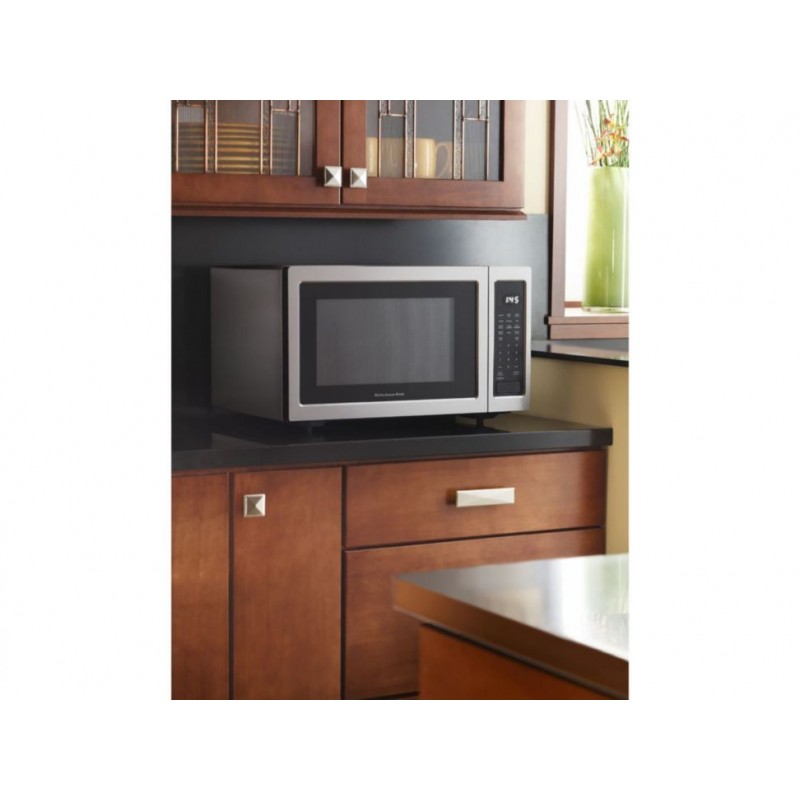
The KitchenAid KCMS1655BSS is a 1.6-cubic-foot countertop microwave with 1,200 watts of cooking power, sensor cooking, preset menus, and a stainless steel finish. It can also be used with a compatible built-in trim kit when the installation requirements are met.
In American kitchens, a microwave often handles the small jobs that keep a busy day moving. It reheats last night’s dinner, warms a mug of coffee, softens butter, and defrosts food before supper. The KitchenAid KCMS1655BSS is designed for these everyday tasks. Its 1.6-cubic-foot capacity and 1,200-watt output give it useful space and power for common home cooking needs.
This guide explains the model’s main features, controls, size, installation options, cleaning needs, and common faults. The details are based on available model documentation and product information, not hands-on testing. That distinction matters when judging cooking performance, long-term reliability, or the condition of a used unit. If you are buying one, check the exact model suffix, included parts, and current availability before you pay.
The KitchenAid KCMS1655BSS is a countertop microwave oven made for routine food preparation in a home kitchen. Its stainless steel appearance suits many modern kitchens, while its capacity leaves room for many everyday plates, bowls, and microwave-safe containers. The model belongs to the KCMS1655 family, so manuals may use the shorter KCMS1655 name rather than repeat the full finish code.
That model distinction matters when you need a part or an installation guide. A related model may share many controls but differ in its finish, included hardware, or product revision. Read the complete model number on the appliance rating label before ordering a replacement component. If the label includes an extra suffix, such as a revision number, keep it with your records.
For US buyers, the key questions are simple: does the oven fit the available space, does its power meet your cooking needs, and can you obtain the parts or service you need? The model’s specifications help answer the first two questions. A current parts lookup or service inquiry is needed for the third.
Source: mastertechbahamas.com
Product type
Countertop microwave oven, with a compatible trim-kit option for certain built-in installations.
Capacity
1.6 cubic feet of interior space.
Cooking output
Rated at 1,200 watts of microwave cooking power.
Finish
Stainless steel appearance, as indicated by the BSS model designation in product listings.
Who May Find This Microwave Useful?
This model may suit households that often reheat meals, warm drinks, defrost frozen food, or use preset cooking options. The capacity is useful for many standard dinner plates and medium-sized dishes, though unusually wide cookware still needs a fit check.
It may be less suitable for someone who needs a convection oven, air-frying mode, or a dedicated grill. The KCMS1655BSS is a microwave, and its documented cooking features should not be mistaken for those of a convection model. Check the feature list before replacing another type of appliance.
A practical fit
A household that wants a full-size countertop microwave for reheating and everyday cooking.
Check before buying
Anyone who needs a specific specialty cooking mode, a very compact footprint, or a confirmed replacement part.
KitchenAid KCMS1655BSS Specifications and Dimensions
The most useful specifications are capacity, cooking output, and the space needed for the appliance. Available documentation lists the KCMS1655BSS at 1.6 cubic feet and 1,200 watts. Published dimensions are approximately 21.75 inches wide, 13 inches high, and 17.25 inches deep, with a net weight of about 42 pounds.
Use these measurements as a starting point rather than a complete installation plan. The cabinet, counter, plug, door swing, and required air space all affect the final fit. A built-in installation also requires the correct trim kit and a cabinet opening that matches the installation guide.
Cooking power describes the microwave’s rated output, not the amount of electricity it draws from the wall. The electrical input can be higher than the cooking output. For that reason, do not estimate the circuit requirement from the 1,200-watt cooking figure alone. Follow the rating label and installation manual for the correct electrical requirements.
Source: i.pinimg.com
Capacity
1.6 cubic feet. Check the size of your usual cookware as well as the listed capacity.
Microwave output
1,200 watts. Actual heating time still depends on the food, its starting temperature, the amount, and the container.
Width
Approximately 21.75 inches. Allow for the correct clearances and access to the door.
Height
Approximately 13 inches. Measure the full space, including any shelf or cabinet above it.
Depth
Approximately 17.25 inches. Check the plug position and space behind the oven.
Weight
Approximately 42 pounds net. Use a stable, level surface that can support the appliance.
How Much Counter Space Do You Need?
Start by measuring the counter’s width, depth, and available height. Compare those figures with the model dimensions and the clearance rules in the installation guide. Remember that a microwave may sit farther from the wall than its listed depth suggests because of the plug and ventilation needs.
Do not place the oven in a tight cabinet simply because its body fits. Poor airflow can cause overheating or affect operation. The exact clearance depends on the installation method, so use the instructions for the specific model and trim kit rather than a general rule from another microwave.
Measure twice
Check the opening, the counter surface, and the route through which the oven must pass.
Check ventilation
Leave all required air gaps clear and do not block vents with containers or kitchen items.
Features and Cooking Controls
The KCMS1655BSS offers several ways to control heating time and power. Its documented functions include manual cooking, staged cooking, sensor cooking, preset menus, weight defrost, timed defrost, a favorite-program feature, a kitchen timer, a clock, and a control lock. These features help reduce the number of steps needed for common tasks.
Sensor cooking uses moisture released by food during heating to help adjust the cooking cycle. It is not a guarantee that every portion will reach a safe temperature. Food shape, quantity, starting temperature, covering method, and placement can all affect the result. Stir or rotate food when appropriate, allow standing time, and check the center of the food before serving.
The favorite function can store and recall up to three commonly used manual cooking programs, according to the model’s use and care documentation. This may help if you often use the same time and power settings. Always confirm that the stored setting suits the amount of food in the dish. A program for a small serving may not work well for a larger one.
Source: comercializadorazeus.com.mx
Manual cooking
Enter a cooking time and choose a power level when you want more control over the cycle.
Power adjustment
Use a lower setting for tasks that benefit from gentler heating, such as softening or warming some foods.
Sensor cooking
Choose a suitable sensor cycle and follow the food quantity and covering directions.
Quick-touch menus
Use the available preset menus for listed foods and serving sizes. Check the control panel label for the supported options.
Defrost
Use weight defrost when the program supports the food and weight, or use timed defrost and check the food often.
Control lock
Lock the controls to reduce accidental operation, especially when children can reach the panel.
How to Use Sensor Cooking
Place the food in a suitable microwave-safe dish and choose the matching sensor menu. Cover the food as directed, but allow steam to escape when the manual calls for a vented cover. Steam is part of the sensing process, so opening the door during detection may interrupt or cancel the program.
When the cycle ends, let the food stand if the instructions call for it. Check the center and stir when safe and suitable. For meat, poultry, leftovers, and other foods that need temperature control, use a food thermometer and follow current food-safety guidance instead of relying only on appearance or the end of a sensor cycle.
Use the right cover
Follow the manual’s instructions for a lid, microwave-safe cover, or vented plastic wrap.
Avoid interrupting the cycle
Keep the door closed during sensor detection unless the instructions require otherwise.
Check the result
Stir, stand, or measure the food temperature when needed before serving.
What Does Add 30 Seconds Do?
The Add 30 Seconds control offers a quick way to extend heating without entering a full new time. It is handy for warming a drink or adding a short burst of heat to a dish. The added time is not a substitute for checking the food, especially when the contents are dense or heat unevenly.
For foods that scorch or dry out easily, use shorter intervals and lower power as appropriate. Stir between intervals when safe. Let hot dishes stand briefly before handling, since the container may become hot from the food even when the container itself is microwave-safe.
Good use
Adding a short heating interval to food that needs a little more time.
Use care
Check liquids and dense foods to reduce the risk of hot spots and burns.
How to Install the KCMS1655BSS Safely
The KCMS1655BSS is designed as a countertop microwave, and a compatible trim kit may allow a built-in installation. The trim kit is a separate installation consideration, not proof that any cabinet opening will work. The model’s installation instructions specify the opening dimensions, support requirements, and fitting steps for the approved configuration.
Before unpacking, check the oven for shipping damage. Look for a door that sits out of line, dents, damaged seals, or other signs that the unit may have been hit. Do not use an oven with a damaged door or damaged sealing surfaces. Contact the seller or qualified service personnel to determine the next step.
For a countertop setup, use a stable, level surface and keep the ventilation areas open. Follow the manual’s electrical instructions and use a properly grounded outlet. Do not use an extension cord unless the manufacturer explicitly permits the proposed setup. If the outlet, circuit, or cabinet work needs changes, have the work assessed by a qualified professional.
Source: mastertechbahamas.com
Confirm the exact model
Match the full rating-label model number to the installation guide and any trim-kit documentation.
Inspect before use
Check the door, hinges, seals, cavity, plug, and outer case for visible damage.
Check the opening
Use the specified cutout dimensions for a built-in installation rather than the countertop dimensions alone.
Protect airflow
Do not cover or obstruct ventilation openings.
Use the correct power supply
Follow the appliance label and installation guide for grounding and electrical requirements.
Can You Install It as a Built-In Microwave?
A compatible trim kit is documented for certain installations of this microwave family. The model’s installation material identifies trim-kit models MK2167 and MK2160. Compatibility should still be confirmed against the exact oven model, kit instructions, cabinet opening, and any local installation requirements before purchasing parts.
A trim kit gives the front a more finished appearance, but it does not turn the appliance into a different cooking type. It also does not remove the need for the required airflow, support, and electrical setup. Do not modify the cabinet or the microwave to force a fit that the installation guide does not approve.
If you are replacing an older built-in microwave, compare the required opening dimensions and kit model before removing the existing unit. Similar-looking appliances may need different trim kits. A small mismatch can lead to gaps, poor support, or an installation that does not follow the manufacturer’s directions.
Check kit compatibility
Verify the full model number and the trim-kit part number in the relevant instructions.
Do not guess cutout size
Measure the cabinet and compare it with the official installation diagram.
Get help when needed
Use a qualified installer for cabinet modifications or electrical work beyond your skill and authorization.
Cleaning and Routine Maintenance
Regular cleaning helps keep the microwave free of food residue and odors. Turn the controls off and let the oven cool before cleaning. Use a soft cloth or sponge with mild soap and water for most surfaces, then rinse away cleaner residue and dry the area. Avoid abrasive cleaners or pads that can damage the interior or finish.
For stuck food inside the cavity, the use and care guide describes heating one cup of water for two to five minutes to loosen residue. For odor removal, it describes heating one cup of water with one tablespoon of lemon juice or vinegar for two to five minutes. Use a microwave-safe container, watch the heating process, and allow the container to cool before removing it. Hot water and steam can cause burns.
Clean the turntable and its support when spills build up. The guide permits cleaning the glass turntable with a mild cleanser and scouring pad, or in a dishwasher. Reinstall it correctly before use. The microwave should not be operated without its turntable and support functioning as intended, because the food may not heat as designed.
Source: i.pinimg.com
Interior cavity
Use mild, nonabrasive soap and water. Wipe away residue and dry with a soft cloth.
Stainless steel exterior
Use a cleaner suitable for stainless steel and wipe in the direction of the grain.
Glass door
Apply glass cleaner to a cloth or paper towel rather than spraying it directly onto the appliance.
Control panel
Wipe gently with a damp cloth, then dry. Avoid soaking the controls.
Turntable support
Remove and clean the turntable and support parts as described in the manual, then refit them correctly.
How to Remove Food Odors
First, remove food scraps and wipe away grease. If the odor remains, heat one cup of water with one tablespoon of lemon juice or vinegar for the two-to-five-minute period described in the use and care guide. Let the steam loosen residue, then wait until the container is safe to handle and wipe the interior.
Never heat a sealed container, and do not leave the microwave unattended if the water may boil over. If a burning smell continues after cleaning, unplug the unit if it is safe to do so and stop using it until the cause is checked. A persistent electrical smell or smoke needs more than routine cleaning.
Start with residue
Remove splashes and grease before using a steam-cleaning method.
Handle hot water carefully
Allow time for cooling and use an oven mitt when removing the container.
Troubleshooting Common KCMS1655BSS Problems
When a microwave stops working as expected, begin with simple checks that do not require opening the case. Confirm that the outlet has power, the door closes fully, and the control lock is not active. Check the display for a warning or error message and compare it with the use and care guide. Never remove the outer cover to inspect internal parts yourself.
A microwave contains high-voltage components that can remain dangerous even after it has been unplugged. Repairs involving the magnetron, capacitor, internal wiring, door interlocks, or sealing system belong to qualified service personnel. If the door, hinges, latches, or seals are damaged, stop using the appliance until it has been assessed.
The checks below are intended to help identify simple causes, not to promise that a fault can be fixed at home. If the problem continues after the permitted checks, record the model number and symptoms before contacting service. This makes it easier to explain what happened and to identify the right parts or repair instructions.
Source: static-data2.manualslib.com
The display is blank
Check the outlet and household circuit from a safe position. If power is present but the display remains blank, request service.
The oven does not start
Close the door firmly and check whether the control lock is active. Do not force a door or bypass a safety switch.
The oven runs but does not heat
Confirm the selected controls and settings. If the oven still does not heat, stop and arrange qualified service.
The turntable does not rotate
With the oven off and cool, check that the glass plate is seated correctly and that the removable support is clean and properly placed.
The door warning appears
Open and close the door normally, then try starting the oven again. If the warning remains, do not attempt to defeat the door interlock.
Sparks appear
Stop the cycle. Check for metal objects or damaged cookware only after the oven is off. If sparking continues or the interior is damaged, stop using the unit.
Why Is the Microwave Not Heating?
Start by checking whether the cycle was started and whether the chosen program or power level is suitable. Confirm that the door closes normally and that no control-lock setting prevents operation. If the display works and the turntable moves but the food remains cold, the fault may involve an internal component.
Do not test internal electrical parts, remove the cabinet, or attempt to replace a magnetron at home. If the basic checks do not solve the problem, contact an authorized or otherwise qualified appliance repair provider. Ask for a diagnosis and estimate before deciding whether repair makes sense for the appliance’s age and condition.
Safe check
Review the controls, power supply, and door closure without dismantling the appliance.
Stop if the problem persists
Arrange service for suspected internal faults or damage to the door and seals.
Why Is the Turntable Not Spinning?
Switch the microwave off and wait until it is cool. Remove the glass turntable, then inspect the removable hub and roller support for food scraps. Clean the parts and replace them in the correct positions. Make sure the plate sits securely on the support before running a short test with a microwave-safe cup of water.
If the turntable still does not rotate, or if it makes unusual noises, stop using the oven and request service. Do not operate it with the turntable or support missing. The rotating plate helps expose the food to more even heating, although it cannot eliminate every hot or cold spot.
Clean and reseat
Check the removable plate, hub, and roller support while the oven is off.
Do not force movement
If the support is damaged or the mechanism remains stuck, arrange repair instead of forcing it.
Replacement Parts, Manuals, and Service
The safest way to find a replacement part is to start with the complete model number on the appliance label. Write down any suffix and, if available, the serial number. Search the manufacturer’s parts and support resources or ask a service provider to confirm compatibility before ordering a turntable, support ring, trim kit, or other component.
The KCMS1655BSS use and care guide covers setup, controls, cooking methods, cleaning, troubleshooting, and warranty information. A separate installation guide covers trim-kit fitting. KitchenAid’s official manuals and literature page lets owners search by model number. If the exact model is no longer listed, the support team may help locate archived documents or identify an appropriate service route.
Availability can vary by region and over time. A manual being available online does not prove that every replacement part is still sold, and a part listed for the KCMS1655 family may not fit every suffix. Ask the supplier to verify the full model before paying. Keep the receipt and any part number with the appliance records.
Source: mastertechbahamas.com
Use the official manuals page
Search KitchenAid’s Manuals and Literature section using the exact model number.
Verify the trim kit
Confirm the kit model and installation instructions before ordering or cutting a cabinet opening.
Ask about service
Provide the model number, symptoms, and any warning shown on the display.
Check the cost of repair
Compare the written repair estimate with the price of a suitable replacement and the age of the existing oven.
Is the KCMS1655BSS Still Available?
Current availability should be checked rather than assumed. Older model manuals and product images may remain online even when new units are difficult to find. A seller may offer a used or refurbished oven, but the condition, warranty, return terms, and included trim-kit parts can differ from one listing to another.
If buying a used unit, ask for a clear photo of the model label and the inside of the oven. Check the door, hinges, seals, cavity, controls, and turntable. Ask whether the seller has tested heating and whether any repair history is known. Do not buy a unit with a damaged door or signs of unsafe modification.
New unit
Confirm that the item is actually in stock and that the warranty applies in your location.
Used unit
Inspect its condition, request a return option, and verify that the included parts match the model.
Repair decision
Get a diagnosis and cost estimate before spending money on an older appliance.
Is the KitchenAid KCMS1655BSS Worth Considering?
The KCMS1655BSS may be worth considering if you want a 1.6-cubic-foot microwave with 1,200 watts of cooking output, sensor functions, and a stainless steel look. Its mix of manual controls and preset programs supports common kitchen tasks without requiring a specialty cooking system. The trim-kit option may also matter if you are matching an existing cabinet design.
The main trade-offs are fit, current availability, and the cost of keeping an older appliance in service. Its published dimensions are not small, so it may take up more counter space than a compact microwave. Buyers who need convection baking, air frying, or a specific smart feature should confirm those requirements separately because they are not established by the documented feature set for this model.
There is no sound basis to call this model the best choice for every household without current pricing, condition, competing models, and reliable performance testing. Instead, judge it against the tasks you do most often, the room available, the warranty or service options, and the total cost. If you already own one, a compatible part or a simple cleaning step may be more sensible than replacing the whole unit.
Source: i.pinimg.com
Consider it if
You want a full-size countertop microwave and its controls meet your everyday cooking needs.
Measure first if
Your counter or cabinet has limited space, or you plan to use a built-in trim kit.
Compare other models if
You need convection cooking, a smaller footprint, a specific warranty, or confirmed long-term parts support.
What Should You Compare Before Buying?
Compare the exact capacity and external dimensions, not just the brand name. Check the cooking output, sensor options, controls, door opening, and whether the unit fits the dishes you use. If you need a trim kit, include its cost and installation needs in the total price.
For a used or older appliance, condition and serviceability can matter more than the original feature list. Ask whether the oven heats correctly, whether the turntable runs, and whether the door closes cleanly. Confirm return terms before purchase, especially if you cannot test the unit in person.
Fit
Compare the appliance dimensions with the space and ventilation requirements.
Features
Choose functions you will use instead of paying extra for modes you do not need.
Ownership cost
Consider the price, delivery, installation, service, and any required trim kit or replacement part.
Frequently Asked Questions
Q
How many cubic feet is the KitchenAid KCMS1655BSS?
The KitchenAid KCMS1655BSS has a listed capacity of 1.6 cubic feet. This is the interior capacity, not the appliance’s outside size. Check the width, height, depth, and required clearances before placing it on a counter or inside a cabinet.
Q
How many watts is the KCMS1655BSS microwave?
The model is rated at 1,200 watts of microwave cooking output. That figure does not necessarily equal its electrical input from the wall. Follow the rating label and installation instructions for the correct power supply and circuit requirements.
Q
Can the KitchenAid KCMS1655BSS be built into a cabinet?
A compatible trim kit is documented for certain built-in installations in this microwave family. The installation guide identifies MK2167 and MK2160 trim-kit models. Confirm compatibility with your exact model number, cabinet opening, and kit instructions before starting the installation.
Q
Why does my KitchenAid KCMS1655BSS run but not heat?
Check the selected cooking settings, control lock, door closure, and power supply without removing the microwave’s cover. If the oven still does not heat, it may have an internal fault that needs qualified service. Do not try to repair high-voltage components yourself.
Q
How do I unlock the KCMS1655BSS control panel?
The use and care guide describes pressing and holding STOP CANCEL for about three seconds while the oven is off, until the control-lock indication changes and a tone sounds. Repeat the procedure to change the lock state. If your panel behaves differently, confirm that your manual matches the exact model.
Q
How do I clean the inside of this KitchenAid microwave?
Turn the controls off and let the oven cool. Clean the cavity with a soft cloth or sponge and mild soap and water. For stuck residue, the manual describes heating one cup of water for two to five minutes to loosen food. Handle the hot container carefully, and avoid abrasive cleaners that may damage the interior.
Q
Where can I find the KCMS1655BSS manual?
Use KitchenAid’s official Manuals and Literature page and search by the full model number. The available use and care guide explains the controls, cooking features, cleaning, and troubleshooting. A separate installation guide covers the trim-kit setup. If the exact model does not appear, contact KitchenAid support for help locating the right document.
✦ Wrapping Up
Conclusion
The KitchenAid KCMS1655BSS is a 1.6-cubic-foot countertop microwave with 1,200 watts of cooking output and a useful set of everyday functions. Sensor cooking, preset menus, manual power control, and defrost options cover many common kitchen tasks. Its published dimensions and optional compatible trim-kit route also make fit and installation key parts of the buying decision.
Before buying or repairing one, confirm the full model number, check the manual, and inspect the unit’s condition. Use only a compatible trim kit, keep ventilation clear, and leave internal electrical repairs to qualified service personnel. If the oven already works, regular cleaning and correct turntable placement can help you care for it.
💡 Key Takeaway
Measure your space, confirm the exact KCMS1655BSS model and compatible parts, then consult the matching KitchenAid use and care or installation guide before use, repair, or installation.